
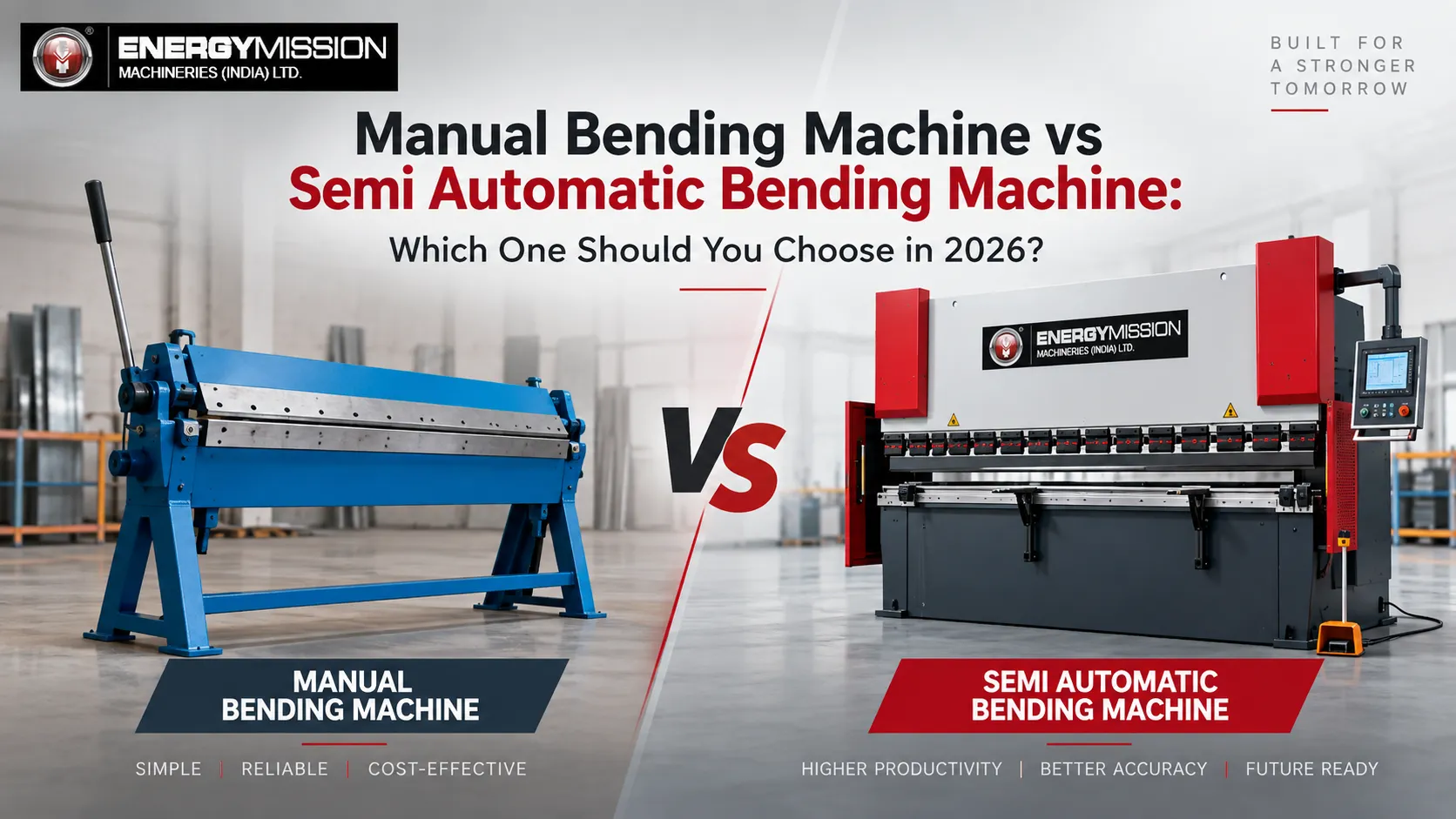
If you’re running a sheet metal fabrication shop – or planning to set one up – one of the first real decisions you’ll face is choosing between a manual bending machine and a semi automatic bending machine. It sounds straightforward, but get it wrong and you’re either overspending on automation you don’t need, or bottlenecking your entire production line with a machine that can’t keep up.
Over the years, I’ve seen both scenarios play out on shop floors across India – small job shops running semi-automatic machines at 30% capacity, and mid-scale fabricators trying to push complex angle profiles through a manual machine and wondering why reject rates are climbing. The right choice depends on your material, volumes, part complexity, and budget.
This guide breaks it all down – no fluff, no sales pitch – so you can make a confident, informed decision.
What Is a Manual Bending Machine?
A manual bending machine (also called a manual press brake or manual folder) is a sheet metal forming machine operated entirely by the physical effort of the operator. The operator positions the sheet metal between a punch (upper tool) and a die (lower tool), then applies downward force – either through a mechanical lever, flywheel, or foot pedal – to create a bend.
Manual bending machines are simple by design. There are no CNC controllers, no hydraulic power units, and no programmable axes. The operator controls everything: material placement, bend depth, back gauge position (if any), and ram stroke.
Typical capacity range: Up to 2–3 mm mild steel, 1–1.5 mm stainless steel
Bending length range: 1000 mm to 2500 mm (common in Indian workshops)
Approximate price range in India: ₹1.5 lakh to ₹6 lakh depending on capacity and build quality
What Industries Use Manual Bending Machines?
Manual bending machines are widely used across:
- Small fabrication workshops and job shops
- Agricultural equipment manufacturers (small component forming)
- Electrical enclosure and panel shops (for simple box bends)
- Furniture and rack manufacturers
- HVAC duct fabrication (light gauge work)
- Rural and semi-urban fabrication units where power infrastructure is limited
What Is a Semi Automatic Bending Machine?
A semi automatic bending machine is a hydraulically or electro-hydraulically powered press brake where the machine performs the ram movement and bending force automatically, but the operator is still involved in material feeding, positioning, and program selection.
In a semi automatic setup, you typically get:
- A hydraulic power unit driving the ram with consistent, programmable force
- A NC (Numerical Control) or basic CNC controller for setting bend angle, ram depth, and back gauge position
- A motorised back gauge that moves automatically to set positions between bends
- Consistent tonnage that doesn’t vary with operator fatigue or effort
The operator feeds the sheet, confirms the bend, and the machine handles the force and stroke. This removes the biggest variable in manual bending: human inconsistency.
Typical capacity range: 1 mm to 12 mm mild steel (depending on model and tonnage)
Tonnage range: 40 Ton to 300 Ton (commonly 80T–160T in Indian SME sector)
Bending length: 1600 mm to 4000 mm
Approximate price range in India: ₹8 lakh to ₹45 lakh depending on tonnage, controller, and brand
Manual vs Semi Automatic Bending Machine: Head-to-Head Comparison
Table 1: Manual Bending Machine vs Semi Automatic Bending Machine – Feature Comparison (as of 2026)
|
Feature |
Manual Bending Machine |
Semi Automatic Bending Machine |
|
Power Source |
Operator effort / mechanical |
Hydraulic / electro-hydraulic |
|
Bending Force |
Limited (operator-dependent) |
40T to 300T (consistent) |
|
Material Thickness |
Up to 2–3 mm MS |
Up to 12 mm+ MS |
|
Angle Repeatability |
±1° to ±3° (operator skill-dependent) |
±0.1° to ±0.5° (machine-controlled) |
|
Back Gauge |
Manual or none |
Motorised, programmable |
|
Controller |
None |
NC / basic CNC |
|
Setup Time |
Low |
Low to medium |
|
Operator Skill Required |
High |
Medium |
|
Production Speed |
Low |
Medium to high |
|
Tooling Flexibility |
Limited |
Good (standard V-dies, punches) |
|
Maintenance |
Minimal |
Moderate |
|
Power Consumption |
Nil / very low |
3–7.5 kW (typical) |
|
Price Range (India) |
₹1.5L – ₹6L |
₹8L – ₹45L |
|
Best For |
Low-volume, simple bends |
Medium-volume, consistent accuracy |
Key Differences You Need to Understand Before Buying
1. Bending Force and Material Capacity
This is the most important technical difference. A manual bending machine relies on the operator’s physical force, which naturally limits it to thin, low-tensile materials – typically up to 2 mm mild steel or 1 mm stainless steel. Try to push heavier gauge material through a manual machine and you risk tool damage, poor bend quality, or operator injury.
A semi automatic hydraulic bending machine generates force through a hydraulic cylinder, delivering consistent tonnage from the first bend to the thousandth. If your work involves 4 mm, 6 mm, or 8 mm MS plate – or stainless steel and aluminium in medium gauges – you need hydraulic power, period.
2. Angle Accuracy and Repeatability
On a manual machine, every bend depends on how well the operator reads the scale, positions the sheet, and controls the stroke. Even a skilled operator will see ±1° to ±2° variation across a batch. For simple brackets or non-critical components, this may be acceptable.
Semi automatic machines use a depth-stop or NC controller to control the ram’s exact bottom position, delivering repeatable angles within ±0.1° to ±0.5°. If your parts go into electrical panels, precision enclosures, automotive components, or any assembly where mating parts must fit perfectly – repeatability is not optional.
3. Production Output and Operator Fatigue
A manual machine puts physical strain on the operator. Over an 8-hour shift, fatigue leads to inconsistency, slower throughput, and potential injury risk on heavier gauge work. Production volumes on a manual machine are inherently limited.
A semi automatic machine removes the physical effort. The operator’s role becomes material handling, positioning, and monitoring – far less fatiguing. This means consistent output quality across full shifts and significantly higher throughput for repeat jobs.
4. Setup and Changeover Time
Interestingly, for very small batches and highly varied jobs, a manual machine can sometimes be faster to set up – there’s no programming involved. You adjust the stops, position your material, and bend.
Semi automatic machines with NC controllers require you to enter bend angles and back gauge positions, which adds a few minutes per job. For repeat jobs, however, that program is saved and recalled instantly – giving semi auto machines a massive advantage in medium-volume production with recurring part programs.
People Also Ask: Bending Machine Selection
Is a manual bending machine suitable for a small fabrication workshop?
Yes, a manual bending machine is suitable for small fabrication workshops handling thin gauge (up to 2 mm) mild steel with low daily volumes and simple bend profiles. It is cost-effective, easy to operate, and requires no power connection. However, as job complexity or volume increases, the limitations become a production bottleneck.
For shops working with electrical enclosures, light furniture frames, simple brackets, or agricultural components in thin sheet, a manual machine can serve well for years. The key constraint is material thickness and required accuracy – if either of those grows, you’ll outgrow the machine quickly.
What is the accuracy of a semi automatic bending machine?
A semi automatic bending machine typically achieves bend angle accuracy of ±0.1° to ±0.5° depending on the controller, tooling condition, and material consistency. This level of accuracy is sufficient for electrical panels, telecom enclosures, general fabrication, and automotive sheet metal components.
The accuracy is driven by the NC controller’s control over ram depth and the motorised back gauge’s positioning precision. High-quality hydraulic systems with proportional valves can push accuracy even closer to ±0.1°.
How much does a semi automatic bending machine cost in India?
In India, a semi automatic hydraulic bending machine costs approximately ₹8 lakh to ₹45 lakh depending on tonnage capacity, bending length, controller type (NC vs CNC), and brand. A common 80-ton, 2500 mm machine with an E21 or DA-41 NC controller typically falls in the ₹12 lakh to ₹22 lakh range from reputable Indian manufacturers.
Imported European brands cost significantly more. Indian-manufactured machines – particularly from established manufacturers with 20+ years of experience – offer excellent value for money with comparable build quality and better local support.
Can a semi automatic bending machine replace a CNC press brake?
A semi automatic bending machine is not a direct replacement for a full CNC press brake for high-volume, multi-bend complex parts. Semi automatic machines handle medium complexity well – they can store programs, automate back gauge movement, and deliver consistent bends. A full CNC press brake adds multi-axis back gauge control, crowning compensation, offline programming, and faster cycle times for high-production environments. For most SMEs doing general fabrication, a semi automatic machine is the practical, cost-effective middle ground.
What maintenance does a hydraulic bending machine require?
A semi automatic hydraulic bending machine requires regular hydraulic oil checks and changes (typically every 2000–3000 hours), filter replacement, cylinder seal inspection, and lubrication of the back gauge ball screws and linear guides. The tooling (punch and die) should be inspected for wear and kept clean. Electrical connections and the NC controller should be checked periodically. With proper maintenance, a quality hydraulic bending machine can deliver 15–20 years of reliable service.
How to Choose the Right Bending Machine for Your Workshop
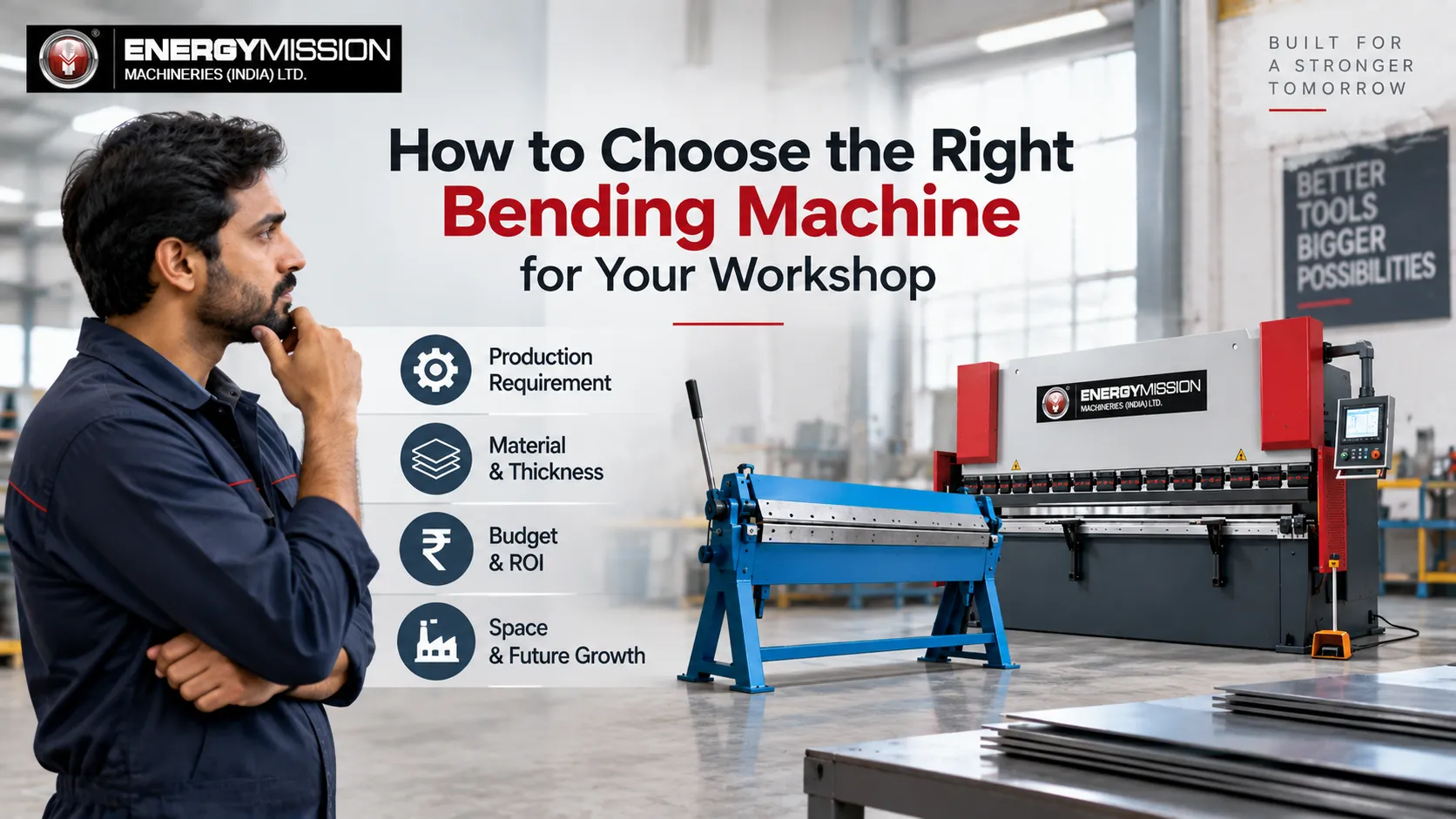
This is where most buyers go wrong – they either over-buy or under-buy. Here’s how to think through the decision systematically:
- What is the maximum material thickness you bend?
- Up to 2 mm MS → Manual may work
- 3 mm and above → You need hydraulic / semi automatic
- What are your daily production volumes?
- Less than 20–30 bends/day, varied jobs → Manual is fine
- 50+ bends/day, or repeat production runs → Semi automatic saves time and improves quality
- How important is angle accuracy?
- Simple frames, brackets, non-critical parts → Manual acceptable
- Panels, enclosures, auto parts, assembly components → Semi automatic required
- Do you have repeat jobs or recurring orders?
- One-off jobs only → Manual
- Repeat orders with same part programs → Semi automatic (program recall = instant setup)
- What is your budget and ROI expectation?
- A semi automatic machine costs 5–10x more than a manual machine. But if it allows you to take on higher-value orders, reduce rejections, and run one operator across higher output, the ROI calculation often favours the semi automatic within 18–30 months.
- Is trained after-sales support available locally?
- For Indian buyers: prioritise manufacturers who have service engineers and spare parts availability within your state or region. Downtime on a production machine is expensive. This is where Indian manufacturers with pan-India service networks have a real advantage over imported machines.
- Do you plan to scale production in the next 3–5 years?
- If yes, buy for tomorrow’s needs, not just today’s. A semi automatic machine that seems slightly over-spec today becomes the right choice when orders grow.
Expert Tips from the Shop Floor
Here are a few observations from real manufacturing environments that don’t make it into brochures:
- Don’t underestimate operator skill on a manual machine. A good operator on a well-maintained manual press brake can produce surprisingly consistent work – but that dependency on a single skilled person is also a business risk.
- Tooling quality matters as much as the machine. A semi automatic machine with worn or mismatched tooling will not deliver the accuracy the spec sheet promises. Budget for quality tooling from the start.
- Hydraulic oil quality is underestimated. Indian workshops often neglect oil quality – using the wrong grade or changing it too infrequently. This is the single biggest cause of hydraulic system problems on semi automatic machines.
- NC controllers from brands like Estun, Delem, and ESA are field-proven in Indian conditions and have local support networks. Avoid obscure controllers where spares or service are unavailable within India.
- A motorised back gauge saves more time than most buyers realise. For repeat jobs, the back gauge moving automatically to the next position between bends is not a luxury – it’s a consistent time saver that adds up across thousands of bends.
Industry FAQ
Q1. Can I upgrade a manual bending machine to semi automatic later?
Generally, no. Manual and hydraulic semi automatic machines have fundamentally different structures – the ram drive, frame design, and bed construction differ significantly. It is almost always more practical and cost-effective to purchase a semi automatic machine from the start if you foresee that need, rather than retrofitting a manual machine.
Q2. What gauge steel can a 40-ton semi automatic press brake bend?
A 40-ton press brake can bend approximately 3–4 mm mild steel over a 1000–1250 mm bending length, using a standard V-die opening of 5–6x material thickness. For thicker material or longer lengths, higher tonnage is required. Always use a tonnage calculator or consult the manufacturer before finalising machine capacity.
Q3. How long does it take to train an operator on a semi automatic bending machine?
A mechanically aware operator with basic fabrication exposure can be trained to run a semi automatic machine with an NC controller in 3–7 days for standard operations. Advanced programming, tooling changes, and troubleshooting take longer – typically 2–4 weeks of hands-on experience. The machine itself is far less skill-dependent than a manual machine for consistent output.
Q4. Is a manual bending machine safe to use?
A properly maintained manual bending machine is safe when operated correctly with standard safety practices – keeping hands clear of the tooling zone, using proper work-holding, and never exceeding rated capacity. However, manual machines lack the safety features (light curtains, two-hand controls, safety PLC) typically available on hydraulic machines. For workshops with higher throughput or multiple operators, hydraulic machines with integrated safety systems are the safer choice.
Q5. What is the difference between an NC and CNC controller on a semi automatic press brake?
An NC (Numerical Control) controller on a semi automatic press brake allows the operator to input bend angle, ram depth, and back gauge position for individual bends or simple sequences. It stores basic programs and controls one or two axes. A CNC (Computer Numerical Control) controller offers multi-axis control, graphical bend sequence simulation, crowning compensation, and offline programming capability. NC controllers are standard on semi automatic machines; full CNC is typically found on higher-end, production-oriented press brakes.
Q6. Which is better for an electrical panel manufacturer – manual or semi automatic?
For electrical panel fabrication, a semi automatic bending machine is clearly the better choice. Panel boxes require consistent 90° bends, precise flange dimensions, and repeatable profiles across production runs. A semi automatic machine with an NC controller and motorised back gauge ensures that every panel shell comes out to the same dimension – which is critical when panels need to accept standard DIN rails, cable trays, and door frames. Manual machines struggle to maintain this consistency across batches.
Q7. Do Indian-made semi automatic bending machines match imported machine quality?
Reputable Indian manufacturers with 20+ years of experience have closed the quality gap significantly in hydraulic bending machines. Frame rigidity, hydraulic system quality, and controller integration in Indian machines are now well-matched to mid-range European and Taiwanese machines – at 40–60% lower cost, with the added advantage of local spare parts, faster service response, and machines designed for Indian power supply conditions and workshop environments. “Make in India” manufacturing has genuinely matured in this product category.
Q8. What bending length should I choose – 2500 mm or 3000 mm?
Choose bending length based on the largest sheet you regularly work with, not the largest sheet you might ever work with. A 2500 mm machine handles standard 2438 mm (8 ft) sheets comfortably and is the most common choice for general fabrication. If you regularly bend larger blanks or structural sections, a 3000 mm or 4000 mm machine makes sense. Larger bending length increases machine cost, footprint, and tooling investment – don’t over-specify unnecessarily.
Key Takeaways
- A manual bending machine is best for low volumes, thin gauge (up to 2 mm) material, simple bend profiles, and budget-constrained startups
- A semi automatic bending machine is ideal for medium production volumes, material up to 12 mm, consistent accuracy requirements, and repeat jobs
- The single biggest differentiator is bending force – hydraulic machines deliver consistent, programmable tonnage; manual machines rely on operator effort
- Angle repeatability on a semi automatic machine (±0.1°–0.5°) far exceeds what any manual machine can consistently deliver
- For Indian buyers, after-sales service, local spare parts, and NC controller support are as important as machine specs
- A semi automatic machine’s program recall feature dramatically reduces setup time on repeat jobs – a major productivity advantage
- Don’t buy for today’s volume only – factor in growth over the next 3–5 years when selecting machine capacity and automation level
- Indian-manufactured hydraulic press brakes offer excellent value for money with strong local support – a genuine advantage under “Make in India”
Conclusion
The choice between a manual bending machine and a semi automatic bending machine is not really about which is “better” – it’s about which is right for your specific production environment, material range, accuracy needs, and growth trajectory.
Manual machines earn their place in small shops, startup fabricators, and rural workshops where volumes are low, materials are thin, and budget is the primary constraint. They are simple, reliable, and require no electrical power or hydraulic infrastructure.
Semi automatic bending machines are the working backbone of India’s mid-scale fabrication industry – electrical panel shops, auto ancillary suppliers, agricultural equipment manufacturers, construction component fabricators, and general engineering workshops. They deliver the accuracy, throughput, and consistency that modern fabrication contracts demand.
If you’re still unsure which direction to go, map your current jobs against the decision criteria above. The answer will usually become clear within the first few questions.
Ready to Choose the Right Bending Machine? Talk to Energy Mission
Energy Mission Machineries (India) Ltd. has been manufacturing press brakes, shearing machines, plate rolling machines, and sheet metal fabrication equipment for 25+ years. Our machines are trusted by fabricators across India and exported to 30+ countries including the UAE, Saudi Arabia, Oman, Qatar, Kuwait, Bahrain, and across Africa.
We manufacture both hydraulic semi automatic press brakes and can guide you on the right machine configuration for your specific application – material type, thickness, bending length, tonnage, and controller requirements.
What we offer:
- Machine customisation to your production requirements
- Free technical consultation before purchase
- Strong after-sales service and spare parts network across India
- Machines built and tested at our Indian manufacturing facility
Whether you’re buying your first bending machine or upgrading an existing line, our technical team can help you make the right decision without overselling you on capacity you don’t need.
Contact Energy Mission today for a machine recommendation, technical specification, or quotation.