
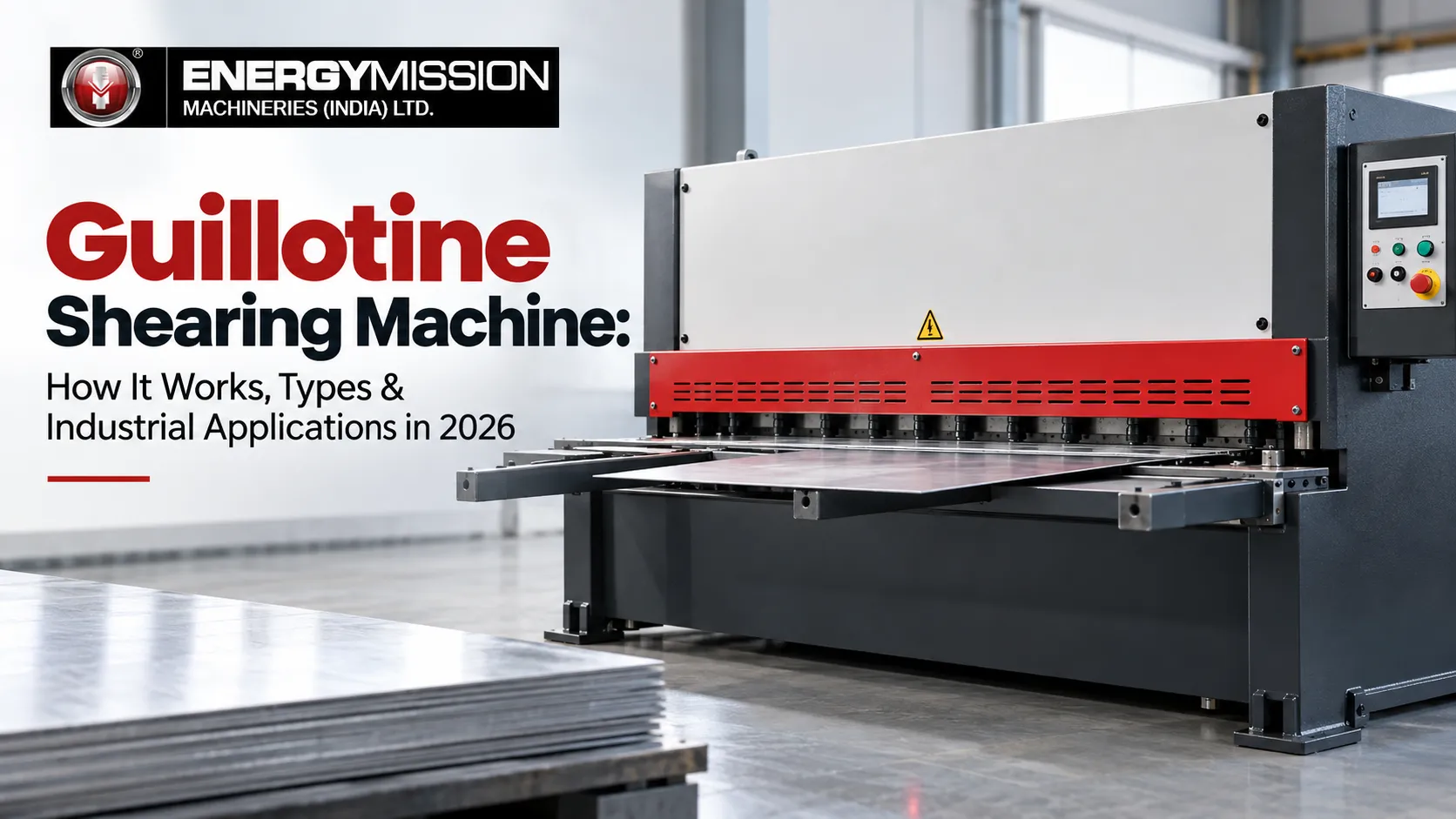
If you work in sheet metal fabrication, you already know that cutting accuracy is everything. A guillotine shear is one of the most widely used and reliable machines for cutting flat metal sheets into precise dimensions without creating burrs, heat distortion, or material waste. Whether you are buying your first machine or upgrading an existing setup, understanding how a guillotine shearing machine works and which type suits your production will save you significant time and money.
This article covers everything the working principle, blade mechanics, machine types, industrial applications, buying factors, and a practical comparison table to help you make the right decision.
What Is a Guillotine Shearing Machine?
A guillotine shearing machine is a metal cutting machine that uses a straight, hardened blade moving vertically (or at a slight rake angle) to cut flat metal sheets cleanly along a straight line. The blade action resembles the historical guillotine – hence the name.
Unlike laser cutting or plasma cutting, a guillotine shear is a cold-cutting process. There is no heat involved, which means the material retains its original mechanical properties right up to the cut edge. This makes it ideal for precision sheet metal work where edge quality and dimensional accuracy matter.
Guillotine shears are used to cut materials like mild steel, stainless steel, aluminium, copper, and galvanized sheets – typically in thicknesses ranging from 0.5 mm to 25 mm or more, depending on the machine capacity.
How Does a Guillotine Shearing Machine Work?
The working principle of a guillotine shearing machine is based on applied shear stress between two hardened blades – one fixed (lower) and one moving (upper).
Here is the step-by-step process:
- Sheet Feeding: The operator places the metal sheet on the machine table and aligns it against the back gauge – a movable stop that controls the cut length precisely.
- Clamping: Hydraulic or pneumatic hold-down clamps press the sheet firmly against the table. This prevents movement during cutting and ensures a clean, straight shear line.
- Blade Descent: The upper blade descends onto the sheet at a preset rake angle. The rake angle (typically 0.5° to 3°) reduces the shear force required and results in a cleaner cut.
- Shearing Action: As the upper blade contacts the sheet, the metal is stressed beyond its shear strength and separates cleanly. The cut-off piece drops away.
- Blade Return: The upper blade returns to its home position. The back gauge repositions automatically for the next cut.
What is rake angle in a guillotine shear?
Rake angle is the angular difference between the upper and lower blades. A higher rake angle reduces cutting force but can cause slight material deformation on thicker plates. For precision work on thin sheets, a lower rake angle is preferred.
Types of Guillotine Shearing Machines
Not all guillotine shears are built the same. The right type depends on your production volume, material thickness, and accuracy requirements.
1. Mechanical Guillotine Shear
Mechanical shears use a flywheel-driven crankshaft mechanism to power the blade. They are fast, simple, and cost-effective for high-volume repetitive cutting. However, they offer less flexibility in stroke adjustment and require more maintenance on the clutch and brake system.
Best for: High-speed repetitive cuts, lighter gauge materials (up to 4–6 mm), job shops with budget constraints.
2. Hydraulic Guillotine Shear
Hydraulic guillotine shears use a hydraulic cylinder system to drive the upper blade. They offer smooth, controllable cutting force, adjustable stroke length, and consistent performance across different material thicknesses. Most modern fabrication shops prefer hydraulic shears for their reliability and quieter operation.
Best for: Medium to heavy plate cutting (up to 20–25 mm), production environments requiring consistent cut quality, workshops running multiple shifts.
3. NC Guillotine Shear (Numerical Control)
An NC guillotine shear includes a basic numeric controller that allows the operator to set back gauge position and number of cuts. The machine executes these settings automatically. NC shears significantly reduce setup time and human error compared to manual shears.
Best for: Small to medium batch production, workshops transitioning from manual to automated cutting.
4. CNC Guillotine Shear (Computer Numerical Control)
A CNC guillotine shear is the most advanced version. It features a full CNC controller that programs complex cutting sequences, manages the back gauge with servo motor precision, controls blade gap automatically based on material thickness, and stores multiple job programs. Energy Mission’s CNC Shearing Machines, for example, offer back gauge accuracy up to ±0.1 mm and support for multiple material profiles.
Best for: High-precision production, automotive components, electrical panels, aerospace-grade material processing, and any operation requiring repeatable accuracy across large batches.
5. Pneumatic Guillotine Shear
Pneumatic shears use compressed air to drive the blade. They are lighter, faster in cycle time, and suitable for thin sheet cutting (typically up to 2–3 mm). Common in the packaging, signage, and electronics industries.
NC vs CNC Guillotine Shear: Comparison Table
|
Feature |
NC Guillotine Shear |
CNC Guillotine Shear |
|
Controller Type |
Basic numeric controller |
Full CNC with touchscreen HMI |
|
Back Gauge Control |
Manual preset + auto repeat |
Servo-driven, programmable |
|
Back Gauge Accuracy |
±0.2 – 0.5 mm |
±0.1 mm or better |
|
Job Storage |
Limited or none |
Multiple job programs stored |
|
Blade Gap Adjustment |
Manual |
Automatic (motorised) |
|
Rake Angle Adjustment |
Fixed or manual |
Motorised / programmable |
|
Suitable Volume |
Small to medium batches |
High-volume, precision batches |
|
Typical Price Range (INR) |
₹8–18 lakhs |
₹18–60 lakhs+ |
|
Operator Skill Required |
Moderate |
Low to moderate |
|
Ideal Industries |
General fabrication, job shops |
Auto ancillary, electrical, precision parts |
Table updated as of 2026. Prices are indicative and vary by capacity, make, and configuration.
Industrial Applications of Guillotine Shearing Machines
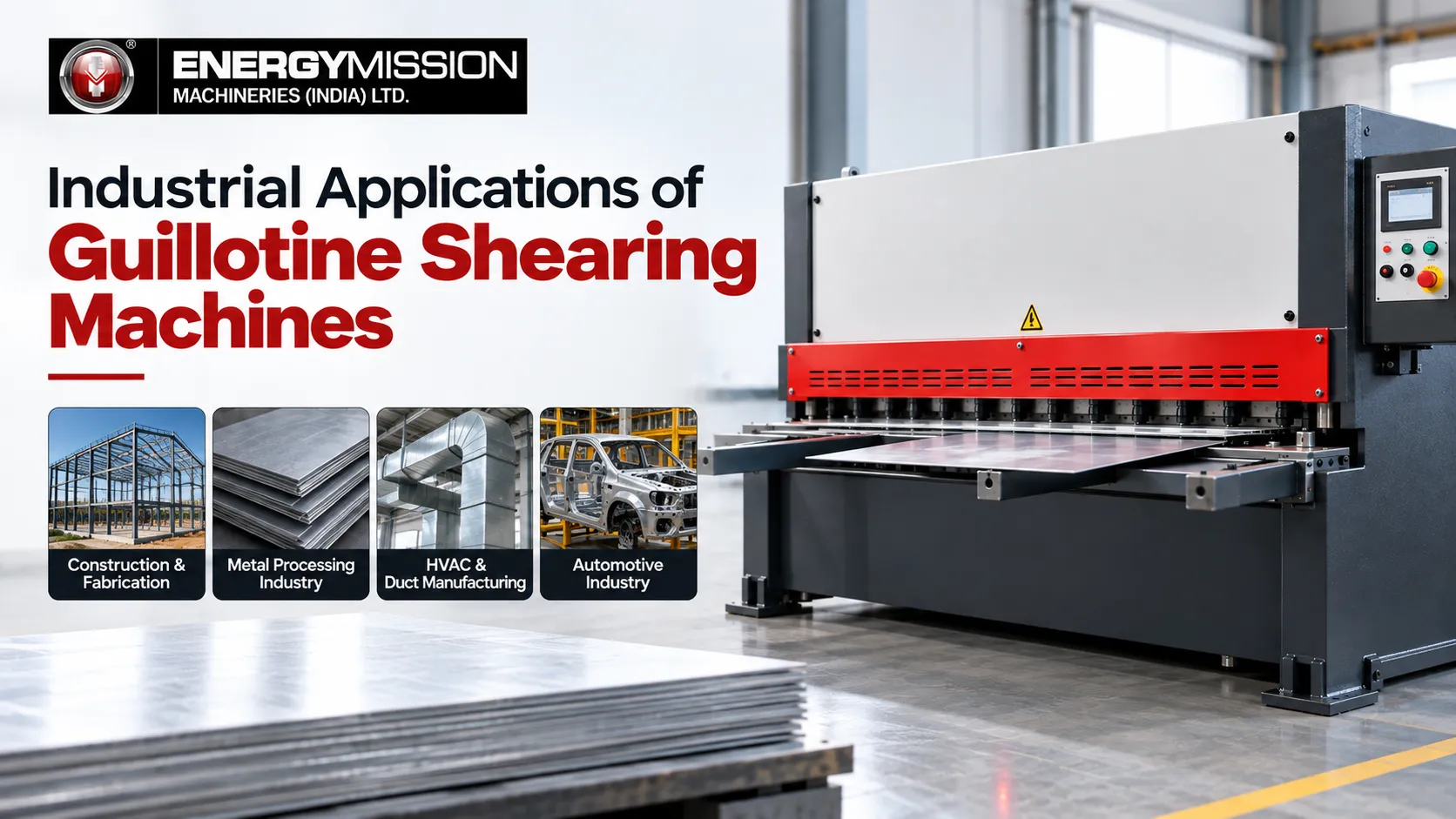
Guillotine shears are found across virtually every metal-working industry. Here is where they are used most:
Automotive and Auto Ancillary
Car body panels, chassis brackets, and structural components require flat sheet blanks cut to precise dimensions before forming or bending. A CNC guillotine shear feeds into press brake lines and stamping presses as the first operation.
Electrical Panel Manufacturing
Electrical enclosures, switchgear panels, and distribution boards require sheets cut to exact sizes repeatedly and consistently. The sheet metal electrical panel industry in India is one of the largest users of guillotine shears – particularly in cities like Ahmedabad, Pune, Coimbatore, and Faridabad.
Construction and Infrastructure
Steel plates for structural fabrication, roofing sheets, and cladding are processed on heavy-duty hydraulic guillotine shears capable of handling 10–25 mm thick plates.
Agriculture Equipment Manufacturing
Tractor body panels, harvester components, and implements like ploughs and disc harrows all begin with flat sheet blanking on a guillotine shear before subsequent forming operations.
HVAC and Ducting
Galvanised and aluminium sheets for air-conditioning ducts and ventilation systems require high-speed, repetitive cutting – making mechanical and hydraulic guillotine shears the machine of choice.
Solar Panel Mounting Structures
With India’s solar energy sector growing rapidly, manufacturers of mounting structures and frames rely on CNC shears for accurate, high-volume cutting of aluminium and mild steel profiles.
People Also Ask: Guillotine Shear Questions Answered
What is the difference between a guillotine shear and a swing beam shear?
A guillotine shear uses a blade that travels vertically (or at a fixed rake angle) guided by rigid side frames. A swing beam shear uses a pivoted upper beam that swings in an arc. Guillotine shears generally offer better cut quality on thicker materials and are more suitable for heavy-duty industrial use. Swing beam shears are mechanically simpler and more affordable for lighter cutting work.
What materials can a guillotine shearing machine cut?
Guillotine shearing machines can cut mild steel, high-strength steel, stainless steel, aluminium, copper, brass, galvanised iron, and HR/CR sheet in various thicknesses. The machine must be rated for the tensile strength of the material being cut – for instance, cutting stainless steel requires a machine rated for approximately 1.5 to 2 times the capacity used for mild steel.
What is the maximum thickness a guillotine shear can cut?
Most standard hydraulic guillotine shears handle up to 6–16 mm mild steel. Heavy-duty industrial guillotine shears can cut up to 25 mm or more. CNC models with automatic blade gap adjustment maintain cut quality across the full range. Always consult the manufacturer’s capacity chart based on material tensile strength, not just thickness.
How accurate is a CNC guillotine shear?
A CNC guillotine shear with a servo-driven back gauge can achieve back gauge positioning accuracy of ±0.1 mm, which is suitable for precision component manufacturing. The actual cut squareness also depends on blade condition, blade gap setting, and material flatness.
What maintenance does a guillotine shearing machine require?
Key maintenance tasks include: regular blade gap inspection and adjustment, blade sharpening or replacement (typically every 50,000–100,000 cuts depending on material), hydraulic oil level and quality checks, hold-down clamp inspection, back gauge lead screw lubrication, and controller parameter backup for CNC models. A well-maintained hydraulic guillotine shear has a service life of 15–25 years.
How to Choose the Right Guillotine Shearing Machine
Choosing the wrong machine is an expensive mistake. Here is a practical framework from working with hundreds of fabrication buyers:
- Define Your Maximum Material Thickness and Type
Start here. The machine’s rated capacity in mild steel (N/mm²) must cover your thickest and hardest material. If you cut stainless steel or high-tensile steel, derate the machine capacity accordingly – typically by 40–50%. - Determine Your Sheet Size
Guillotine shears come in cutting lengths from 1250 mm to 4000 mm and beyond. Match the cutting length to your largest sheet size. Buying a machine that is too short forces you to make multiple cuts; too long wastes floor space and cost. - Assess Your Production Volume
For low-volume job shop work, a hydraulic NC shear is often sufficient. For high-volume production lines processing hundreds of sheets per shift, a CNC shear with servo back gauge and fast cycle time is essential for throughput. - Evaluate Accuracy Requirements
General structural work tolerates ±0.5 mm. Electrical enclosure manufacturing or auto component blanking may need ±0.1–0.2 mm. Choose CNC over NC if accuracy and repeatability are critical. - Consider Automation Integration
If the guillotine shear feeds into a press brake, laser, or punching line, look for models with output conveyors, sheet supports, and programmable back gauges that can sync with upstream or downstream equipment. - Budget and ROI
A hydraulic CNC guillotine shear in the ₹18–40 lakh range delivers ROI within 12–24 months in a production environment processing 500+ sheets per day, primarily through reduced operator time and scrap reduction. - After-Sales Support and Spare Parts
This is frequently underestimated by first-time buyers in India. Ensure the manufacturer or dealer has service engineers available in your state, maintains a spare parts inventory locally, and offers a warranty of at least 12 months. Machines from Indian manufacturers like Energy Mission Machineries carry a significant advantage here – faster service response, readily available spares, and local technical support without import delays. - Future Scalability
If you expect to process thicker or harder materials in 2–3 years, buy a machine with 20–30% more capacity than your current requirement. Upgrading too soon is costly.
Key Differences: Hydraulic vs Mechanical Guillotine Shear
|
Parameter |
Mechanical Guillotine Shear |
Hydraulic Guillotine Shear |
|
Drive System |
Flywheel + crankshaft |
Hydraulic cylinders |
|
Cutting Speed |
Faster (fixed cycle) |
Adjustable stroke speed |
|
Noise Level |
Higher |
Lower |
|
Energy Consumption |
Higher at idle |
Lower (pump runs on demand) |
|
Maintenance |
Clutch/brake servicing |
Hydraulic seals, oil |
|
Blade Gap Adjustment |
Manual |
Manual or motorised |
|
Suitable Thickness |
Up to 6 mm (typical) |
Up to 25 mm+ |
|
Initial Cost |
Lower |
Moderate to higher |
|
Ideal Use |
High-speed thin sheet cutting |
Heavy plate, precision work |
Industry FAQ: Real Questions from Fabrication Engineers and Buyers
Q1. Can a guillotine shear cut chequered plates or textured sheets?
Yes, but with limitations. Chequered plates can be sheared, but the raised pattern may cause uneven clamping, which can affect cut straightness. For best results, place the textured face downward on the cutting table and use adequate hold-down pressure.
Q2. How often do guillotine shear blades need to be replaced?
Blade life depends on material hardness, thickness, and blade gap setting. For mild steel cutting, blades typically need regrinding every 30,000–80,000 cuts. A standard 4-edge blade can be rotated three times before replacement is needed. Proper blade gap (typically 5–10% of material thickness) significantly extends blade life.
Q3. What is the right blade gap for cutting stainless steel?
For stainless steel, the blade gap should be set at 5–7% of material thickness – slightly tighter than for mild steel. Incorrect blade gap causes either a ragged edge (too large a gap) or excessive blade stress and chipping (too small a gap).
Q4. Is a CNC guillotine shear suitable for a small fabrication workshop?
It depends on production volume and part complexity. If you are cutting repetitive parts in batches of 50 or more, a CNC shear pays back its higher cost through time savings within months. For truly low-volume, varied one-off cutting, an NC hydraulic shear may offer better value.
Q5. What is the difference between a guillotine shear and a plate rolling machine?
These are different machines for different operations. A guillotine shear cuts flat sheets into blanks. A plate rolling machine bends those blanks into cylinders, cones, or curves. In a typical fabrication workflow, the guillotine shear precedes the plate rolling machine. Energy Mission manufactures both machines and can supply integrated solutions.
Q6. What safety features should a modern guillotine shear have?
Essential safety features include: laser safety light curtain across the blade zone, two-hand anti-tie-down controls, blade guard, foot pedal with safety cover, emergency stop, hold-down clamp interlocks, and CE/IS certification. Never operate a guillotine shear without functional hold-down clamps – unsecured sheets can spring up and cause serious injury.
Q7. Can a hydraulic guillotine shear cut aluminium?
Yes. Aluminium is softer than mild steel, so a machine rated for 6 mm mild steel can typically cut aluminium up to 10–12 mm (verify with the manufacturer’s aluminium capacity rating). Blade gap should be reduced slightly for aluminium to achieve a clean, burr-free edge.
Q8. What is the typical power requirement for a hydraulic guillotine shear?
A standard hydraulic guillotine shear for 6 mm × 2500 mm capacity typically requires a 7.5–11 kW motor and runs on 415V, 3-phase power supply. Larger machines for 12–16 mm capacity may require 15–22 kW motors. Always verify the electrical supply at your facility before installation.
Key Takeaways: Guillotine Shearing Machine Summary
- A guillotine shear cuts flat metal sheets using a straight blade moving at a rake angle – no heat, no waste, clean edges.
- The four main types are mechanical, hydraulic, NC, and CNC – each suited to different production volumes and accuracy needs.
- CNC guillotine shears offer back gauge accuracy of ±0.1 mm and are ideal for high-precision, high-volume production.
- Blade gap setting is critical – it should be 5–10% of material thickness for mild steel and slightly less for stainless steel and aluminium.
- Key buying factors in India include machine capacity, cutting length, back gauge accuracy, after-sales service availability, and spare parts support.
- For Indian buyers, machines from domestic manufacturers offer faster service response, no import delays on spares, and Make in India pricing advantages.
- A well-maintained hydraulic guillotine shear has a working life of 15–25 years and delivers strong ROI in production environments.
- Always size your machine with 20–30% extra capacity to accommodate future material requirements.
Conclusion
A guillotine shearing machine is one of the most fundamental and productive investments a sheet metal fabrication business can make. The right machine – matched to your material thickness, sheet size, production volume, and accuracy requirements – can dramatically reduce your cutting time, improve edge quality, and eliminate material waste.
The choice between mechanical, hydraulic, NC, and CNC models is not about features alone – it is about matching machine capability to your real production environment. A ₹12 lakh NC hydraulic shear is the right machine for a small job shop. A ₹35 lakh CNC hydraulic shear is the right machine for an auto component manufacturer running two shifts. Neither is universally better – context is everything.
Invest time in understanding your material range, your tolerance requirements, and your after-sales support needs before committing to any machine. And always work with a manufacturer who can back you up after the machine is installed.
Why Choose Energy Mission Machineries for Your Guillotine Shearing Needs?
Energy Mission Machineries (India) Ltd. has been designing and manufacturing sheet metal fabrication machinery for over 25 years. The company’s CNC Shearing Machines and Hydraulic Shearing Machines are built for Indian manufacturing conditions – robust construction, reliable hydraulic systems, and controllers that operators across skill levels can work with from day one.
What sets Energy Mission apart:
- 25+ years of manufacturing experience in sheet metal machinery
- Customisation capability – machines built to your specific capacity, cutting length, and automation requirements
- Exports to 30+ countries including UAE, Saudi Arabia, Oman, Qatar, Kuwait, Bahrain, and across Africa
- Strong after-sales network across India with trained service engineers and spare parts availability
- Free technical consultation – the team helps you select the right machine for your application before you buy
If you are evaluating a guillotine shearing machine for your facility, contact Energy Mission for a no-obligation technical consultation and quotation. Whether you need a 2500 mm hydraulic shear for general fabrication or a 4000 mm CNC shear for a high-volume production line, the right solution starts with the right conversation.