
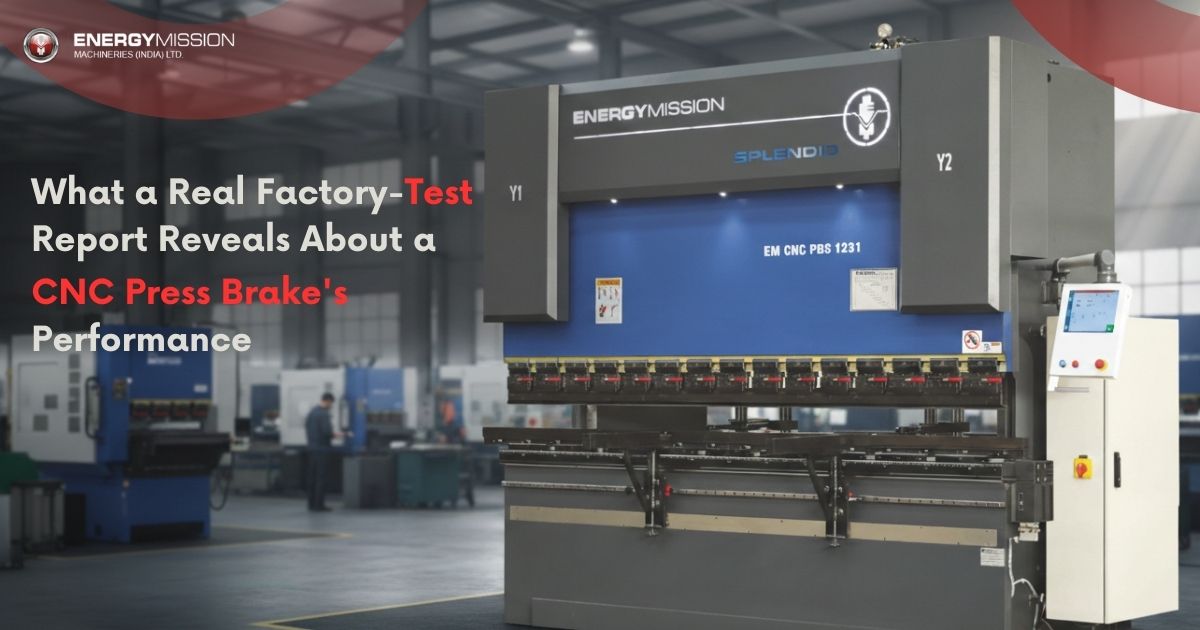
Most buyers judge machines by brochure specs alone, and that’s often their first mistake. Numbers on paper don’t always translate to real-world reliability. What truly matters is how a machine performs under actual working conditions, and that’s where a factory-test report becomes invaluable. Unlike marketing claims, a genuine test report provides measurable evidence of a machine’s capabilities. At Energy Mission, transparency isn’t an option; it’s built into every machine we deliver.
What Is a Factory-Test Report for a CNC Press Brake Machine?
A factory-test report is a documented record of a machine’s performance during quality control checks before shipment. It includes critical data points like bending accuracy, processing speed, load capacity, repeatability across multiple cycles, and safety compliance. Think of it as your machine’s report card,d proof that it can handle the jobs you need it for.
Every reputable CNC Press Brake Machine Manufacturer should provide this documentation. It shows that the machine has been tested beyond basic assembly checks. The report validates what the equipment can genuinely achieve in terms of precision, speed, and material handling across different thickness ranges.
Key Performance Metrics a Factory-Test Report Reveals
Bending Accuracy & Angle Consistency
Angle deviation is one of the most telling metrics. A quality machine should achieve bending angles within ±0.5 degrees of the target. But accuracy on a single bend means little if it can’t be repeated. Repeatability testing across dozens or hundreds of bends shows whether the machine can maintain that precision under continuous operation. This consistency separates industrial-grade equipment from basic models.
Back Gauge Precision
The back gauge determines where the sheet metal sits before bending. Positioning accuracy should fall within ±0.01mm for high-performance machines. Multi-axis movement stability is equally important; any drift or lag in the X, R, or Z axis will impact part quality. A reliable Optima Series should demonstrate stable movement across all axes during testing.
Ram Parallelism & Stroke Stability
Ram alignment directly affects bending quality. If the ram isn’t parallel to the table, you’ll see uneven bends along the length of the workpiece. Factory-test reports measure this parallelism under both no-load and full-load conditions. Stroke stability ensures the ram travels the same distance every cycle, which is essential for producing identical parts in batch production.
Speed + Productivity Numbers
Cycle time tells you how fast the machine completes a full bending sequence. But real output often differs from claimed output. A test report should include actual cycle times measured during continuous operation, not just theoretical maximums. This data helps you calculate true production capacity for your facility.
What Materials and Thickness Testing Actually Shows
Mild Steel, Stainless Steel & Aluminium Results
Each material behaves differently under bending forces. Mild steel is the baseline standard, but stainless steel requires more tonnage and shows different springback characteristics. Aluminium, while softer, can crack if the tooling radius isn’t appropriate. A comprehensive test report includes results across all three materials, showing how the machine adapts to each.
Thickness Range Validation
Thin sheet bending demands precision and control at lower tonnages. Heavy plate bending requires maximum force and structural rigidity. A machine rated for 6mm capacity should prove it can handle that thickness with clean results,s not just barely manage it. Testing should cover the full range, from 0.5mm up to the maximum rated thickness, using appropriate tooling for each.
Real-World Signs of a High-Quality CNC Press Brake Machine
When you inspect test samples, look for clean bend lines with no cracking or surface distortion. There should be no tool marks, scratches, or dents on the finished parts. Springback should be minimal and predictable, showing that the machine’s crowning system and tonnage control are working correctly.
Listen to the machine during operation. Smooth, consistent sound indicates proper hydraulic function and mechanical alignment. Excessive vibration or grinding noises suggest problems that will worsen over time. The Splendid Series demonstrates these quality indicators through rigorous testing protocols.
Common Red Flags Hidden in Factory-Test Reports
Be cautious ifthe measurement data is vague or missing entirely. Phrases like “within industry standards” without actual numbers are meaningless. A legitimate report includes specific values: angle measurements, positioning data, and cycle times.
Watch for reports showing only a single sample bend. One perfect part doesn’t prove repeatability. You need to see multiple tests, preferably conducted on different days. Missing tooling details raise questions about what punch radius was used? What die opening? These factors dramatically affect results.
If the report doesn’t mention material grade, it’s incomplete. Testing 2mm “steel” could mean soft commercial-grade or could mean high-strength alloy. The difference matters significantly when you’re bending your actual production materials.
Factory-Test Checklist Before Choosing a Press Brake Machine Manufacturer
Must-Ask Questions
Start with the basics: Can you share a full test report PDF, not just summary highlights? Is the test performed under actual working load, or just empty strokes? Most importantly, can you request a test bend using your specific part design and material? Any hesitation in answering these questions should make you reconsider.
Documents You Should Request
Beyond the factory test report, ask for the quality inspection checklist that covers mechanical assembly and electrical systems. Calibration certificates prove that measuring instruments used during testing are accurate. If you’re exporting or have safety requirements, CE certification and compliance documentation matter. These documents together paint a complete picture of manufacturing quality.
Why Energy Mission Shares Performance Proof (Not Just Claims)
At Energy Mission, we believe that transparency builds trust faster than any sales pitch. That’s why our factory-test reports include raw data, not filtered highlights. Every Efficient Series ships with complete testing documentation, showing exactly what it achieved during quality control. Our customers can verify performance before the machine leaves our facility, which eliminates surprises after installation.
CNC Press Brake Machine vs Standard Press Brake Machine – What Testing Separates
CNC systems bring measurable advantages in accuracy, automation, and repeatability. Test reports for CNC models typically show tighter tolerances and better consistency across production runs. The Tandem configuration demonstrates this through synchronised dual-machine testing that would be impossible with manual controls.
Standard press brake machines rely heavily on operator skill. While capable equipment can produce quality parts, its test reports show more variation between runs. This isn’t necessarily a weakness—it reflects the different use cases these machines are designed for. Understanding the key differences between suppliers and manufacturers can also guide your decision.
FAQs About CNC Press Brake Factory Testing
What is the ideal accuracy for a CNC press brake machine?
For most industrial applications, bending accuracy should be within ±0.5 degrees for angles and ±0.1mm for positioning. High-precision work may require tighter tolerances of ±0.25 degrees. The key is consistency; accuracy means little if the machine can’t repeat it across thousands of cycles.
Should a press brake machine manufacturer provide a factory-test report?
Absolutely. Any Press Brake Machine Manufacturer confident in their quality provides detailed test reports. This documentation proves the machine meets specifications and helps you verify performance before delivery. Without it, you’re buying on faith rather than evidence.
What does repeatability mean in press brake testing?
Repeatability measures how consistently a machine produces identical results across multiple cycles. A test might show 50 or 100 bends of the same part, measuring angle variation and dimensional consistency. Low variation indicates reliable automation and quality control systems.
How do I verify a CNC press brake machine manufacturer’s quality?
Request factory-test reports, calibration certificates, and customer references. Visit the facility if possible to observe testing procedures firsthand. Ask specific questions about tolerances, materials tested, and what happens if a machine fails quality checks. Transparent manufacturers welcome scrutiny.
Can I request a test bend of my own part before purchase?
Most reputable manufacturers allow this, though they may require material samples from you. Testing your actual production part is the best way to verify the machine can handle your specific requirements. It’s worth the extra time and reveals how the manufacturer approaches custom applications.
Final Buying Tip – Choose a Manufacturer That Proves Performance
Don’t settle for promises when you can demand proof. A CNC Press Brake Machine Manufacturer confident in their product will gladly share detailed test reports and arrange live demonstrations. Compare actual performance data, not just specifications. Ask hard questions about repeatability, material handling, and long-term accuracy.
The difference between a good purchase and a great one often comes down to the evidence you review before signing. Whether you’re considering the Magnum for heavy-duty applications, evaluating the Prudent Series for versatile operations, or comparing models like the NC Front Cylinder versus the NC Rear Cylinder configurations, always request comprehensive testing documentation. Even traditional Hydraulic Press Brake options should come with verifiable performance records.
Ready to see real performance data? Contact us to request factory-test reports and schedule a demonstration with material samples from your actual production needs.