
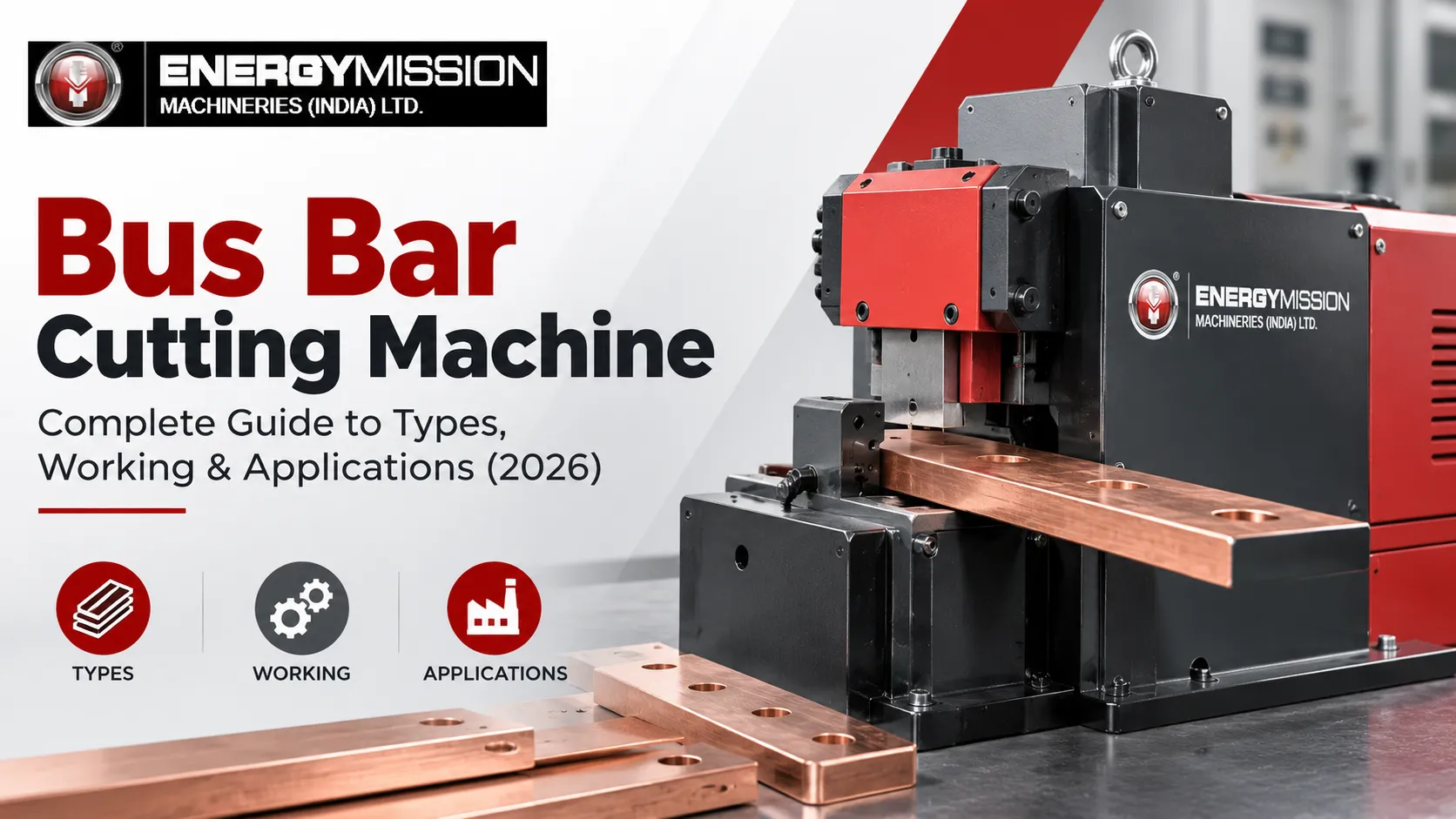
If you manufacture switchgear panels, power distribution boards, MCC panels, or transformer assemblies, you already know that busbar fabrication is one of the most time-consuming and error-prone operations on your shop floor. Cutting copper or aluminium busbars with a hacksaw or angle grinder – still common in smaller shops across India – wastes material, creates burrs that need hours of filing, and produces cuts that rarely meet the dimensional tolerances required for proper contact surface area.
A bus bar cutting machine solves all of this. The right machine cuts copper, aluminium, and mild steel busbars cleanly, accurately, and fast – with no burrs, no material waste, and no operator fatigue. This guide covers everything an electrical panel manufacturer, switchgear fabricator, or busbar processor needs to know before selecting a machine in 2026.
What Is a Bus Bar Cutting Machine?
A bus bar cutting machine is a specialised piece of industrial equipment designed to cut flat copper, aluminium, or mild steel busbars to precise lengths. Unlike general-purpose cutting equipment such as angle grinders or cold saws, a busbar cutting machine is purpose-built to handle the specific cross-sections, material properties, and surface finish requirements of busbars used in electrical distribution systems.
Busbar (also spelled bus bar) refers to a thick strip or bar of copper, aluminium, or tinned copper used to conduct electricity within switchboards, distribution panels, transformer terminals, busduct systems, and MCC (Motor Control Centre) panels. Busbars carry high current loads – from a few hundred amperes to several thousand amperes – and must be cut, punched, and bent to precise dimensions to ensure proper contact resistance and electrical continuity.
Most bus bar cutting machines available today are part of a broader busbar processing machine – a multi-function unit that combines cutting, punching, and bending operations in a single compact machine. Understanding this distinction helps buyers decide whether they need a standalone cutting unit or a complete processing solution.
Types of Bus Bar Cutting Machines
The market offers several types of busbar cutting machines, each suited to different production volumes, material specifications, and budgets.
1. Manual Bus Bar Cutting Machine
A manual busbar cutter uses a hand-operated lever or foot pedal to actuate a hardened steel blade that shears through the busbar in a single stroke. These machines are compact, require no electrical power, and are well-suited for low-volume or field maintenance work.
Best for: Maintenance teams, small panel shops, field installations.
Limitation: Operator fatigue over extended use; limited to smaller cross-sections (typically up to 100mm × 10mm for copper).
2. Hydraulic Bus Bar Cutting Machine
A hydraulic busbar cutting machine uses a hydraulic cylinder to drive a hardened blade through the busbar material. The hydraulic system generates far more force than manual operation, allowing the machine to cut larger cross-sections cleanly – copper busbars up to 200mm × 12mm or larger, depending on machine specification.
Hydraulic busbar cutters are available as standalone units or as the cutting station within a 3-in-1 busbar processing machine. The cutting action is smooth and consistent, which minimises burr formation and material distortion at the cut face.
Best for: Medium to high-volume production shops, switchgear manufacturers, panel builders.
3. CNC Busbar Cutting Machine (Automated)
A CNC busbar cutting machine integrates a servo-driven feed system with a programmable controller, allowing the operator to input the required cut lengths and quantities. The machine then automatically feeds the busbar stock, positions it precisely, and performs the cut – eliminating manual measurement and handling between cuts.
CNC busbar cutting machines are available as standalone units or as part of fully automated CNC busbar processing lines. These systems can process multiple busbar sizes with minimal setup changes and are suited to high-volume, repeat-production environments.
Best for: Large switchgear manufacturers, busduct fabricators, high-volume panel builders.
4. 3-in-1 Busbar Processing Machine (Cut + Punch + Bend)
The most commonly specified machine in Indian busbar fabrication shops today is the 3-in-1 busbar processing machine, which combines three operations in one unit:
- Cutting station – shears the busbar to length
- Punching station – punches bolt holes, slots, or custom patterns
- Bending station – bends the busbar to required angles (flat-wise or edge-wise)
This combination dramatically reduces material handling time, floor space requirements, and capital investment compared to buying three separate machines. For most panel manufacturers in India, a 3-in-1 busbar processing machine is the most practical and cost-effective solution.
How Does a Bus Bar Cutting Machine Work?
A bus bar cutting machine works on the shearing principle – a hardened, precision-ground moving blade is driven against a fixed lower blade with a controlled gap (clearance), causing the busbar material to separate cleanly along the shear line. The key to a burr-free cut is the blade gap: too wide a gap causes excessive burring and material rollover; too narrow causes blade chipping and premature wear.
The Shearing Process Step by Step
- Busbar positioning – The operator (or CNC feed system) positions the busbar under the cutting blade against a back stop or length gauge set to the required dimension.
- Blade descent – The hydraulic cylinder or manual lever drives the upper blade downward into the busbar cross-section.
- Material separation – The busbar shears cleanly across its width. The blade geometry and clearance determine the quality of the cut face.
- Return stroke – The upper blade retracts automatically (hydraulic) or via a spring return (manual), and the cut piece is ejected or collected.
- Next cycle – The busbar is advanced to the next cut position.
What Determines Cut Quality?
- Blade material and hardness – High-speed steel (HSS) or carbide-tipped blades for copper and aluminium; tool steel blades for mild steel busbars.
- Blade clearance – Typically 5–10% of material thickness for copper; slightly more for aluminium.
- Cutting speed – Hydraulic machines with controlled descent speed produce cleaner cuts with less material deformation than fast manual cutting.
- Material condition – Annealed copper cuts cleaner than work-hardened copper; always store busbars correctly to avoid surface hardening.
Expert Tip: In Indian electrical panel shops, one of the most common causes of poor cut quality is running worn or improperly set blades. A blade that has sheared 10,000 cuts without inspection will cause burring that takes longer to file clean than the cutting itself. Build blade inspection into your weekly maintenance schedule.
Bus Bar Cutting Machine Applications: Who Uses These Machines?
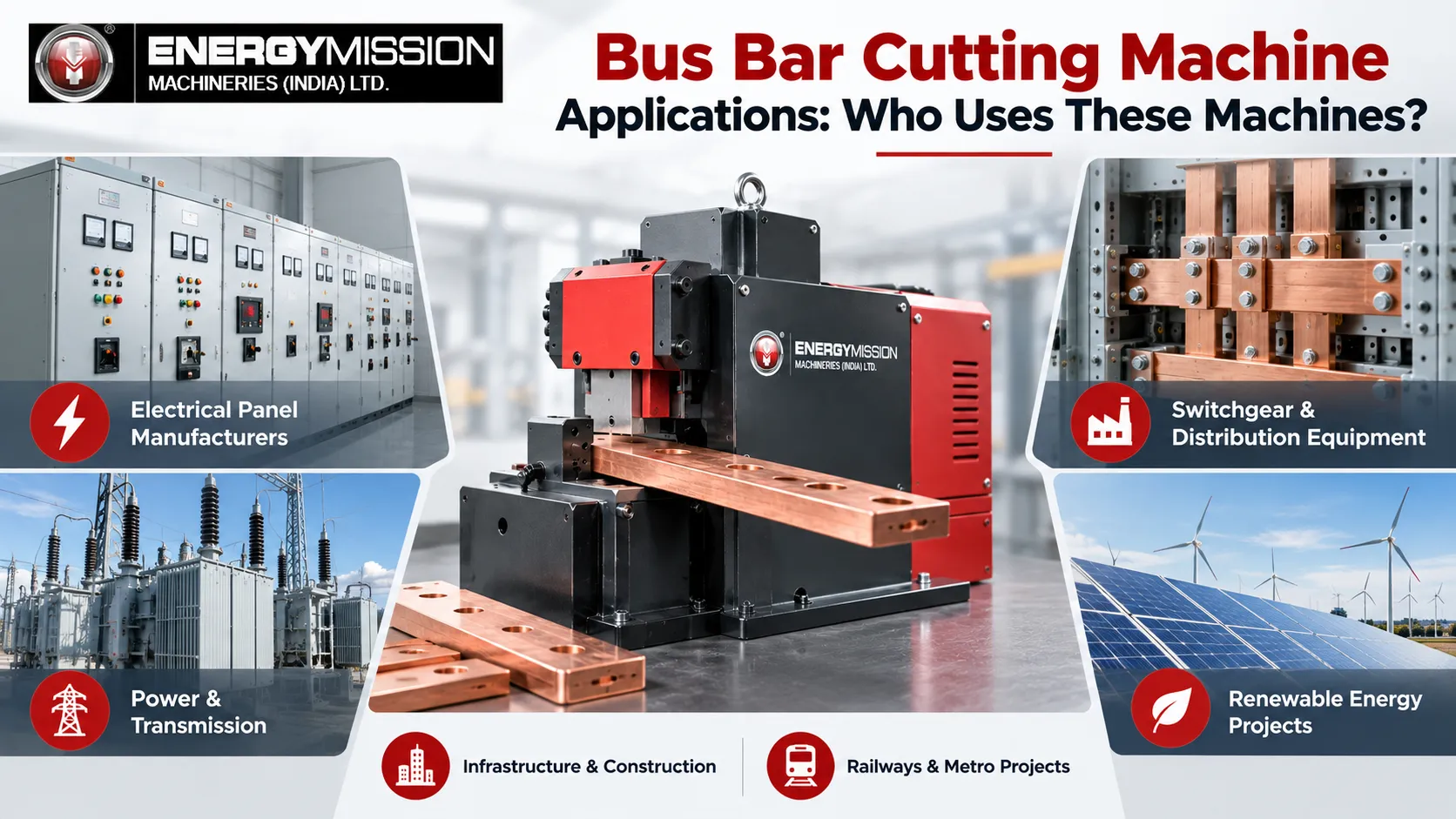
Bus bar cutting machines are used across a wide range of electrical and power sector manufacturing operations. The primary user segments in India include:
- Switchgear and switchboard manufacturers – LV and MV panels, ACBs, MCCBs, distribution boards
- MCC (Motor Control Centre) panel builders – Industrial automation, pump stations, compressor panels
- Transformer manufacturers – HV/LV winding terminals, tap changer connections, termination busbars
- Busduct and rising main manufacturers – Compact busduct, sandwich busduct, air-insulated busduct
- EPC contractors and electrical contractors – Site fabrication of distribution systems for industrial plants, data centres, hospitals
- Renewable energy equipment manufacturers – Solar inverter panels, battery storage systems, EV charging infrastructure
The rapid growth of India’s power sector infrastructure, industrial automation, renewable energy installations, and data centre construction in 2026 has significantly expanded domestic demand for busbar processing equipment.
Comparison Table: Manual vs Hydraulic vs CNC Bus Bar Cutting Machine (as of 2026)
|
Feature |
Manual Busbar Cutter |
Hydraulic Busbar Cutter |
CNC Busbar Cutting Machine |
|
Power Source |
Manual/foot pedal |
Electric hydraulic pump |
Electric servo + hydraulic |
|
Max Copper Cross-Section |
80mm × 8mm |
200mm × 16mm+ |
250mm × 20mm+ |
|
Cut Quality |
Fair (operator dependent) |
Good (consistent) |
Excellent (precise, repeatable) |
|
Production Speed |
Low |
Medium-High |
High |
|
Cut Length Accuracy |
±1–2mm (manual measure) |
±0.5mm |
±0.1mm (servo feed) |
|
Operator Skill Required |
Low |
Low-Medium |
Medium |
|
Footprint |
Small |
Medium |
Medium-Large |
|
Price Range (India) |
₹30,000 – ₹80,000 |
₹1.5L – ₹6L (standalone) |
₹8L – ₹25L+ |
|
Best Application |
Maintenance, field work |
Panel shops, switchgear |
High-volume, repeat production |
|
Part of 3-in-1 Machine? |
No |
Yes (most common config) |
Yes (advanced models) |
What Materials Can a Bus Bar Cutting Machine Cut?
A bus bar cutting machine can cut copper, aluminium, tinned copper, and mild steel busbars. Copper and aluminium are the most common busbar materials in electrical applications. The machine must be specified for the material type, because blade geometry, blade clearance, and cutting force requirements differ significantly between copper and mild steel.
Key material considerations:
- Copper busbars – Most common in HV/LV switchgear. Copper is soft but dense, requiring sharp, well-maintained blades. Electrolytic tough pitch (ETP) copper (99.9% purity) is standard.
- Aluminium busbars – Used where weight reduction is important (busduct systems, large panels). Aluminium work-hardens and may produce longer burrs than copper if blade clearance is not optimised.
- Tinned copper busbars – The tin coating prevents oxidation. Cutting tinned busbars requires care to avoid smearing the tin coating onto the cut face, which can affect contact resistance.
- Mild steel busbars – Used in earthing systems and structural busbar applications. Requires higher cutting force and harder blade material.
What Is the Price of a Bus Bar Cutting Machine in India?
Bus bar cutting machine prices in India range from approximately ₹30,000 for a manual cutter to ₹25 lakh or more for a fully automated CNC busbar processing line. The most commonly purchased configuration – a hydraulic 3-in-1 busbar processing machine with cutting, punching, and bending stations – is priced between ₹1.8 lakh and ₹5 lakh depending on capacity and features.
Price is driven by:
- Maximum busbar cross-section capacity (e.g., 100×10mm vs 200×16mm copper)
- Hydraulic system quality and power – pump capacity, cylinder sealing, pressure control
- Number of punching dies included – standard round die set vs custom die shapes
- Controller type – basic NC timer vs CNC servo controller
- Brand and manufacturing quality – Indian-manufactured machines offer the best value for most panel shops
- After-sales service availability in your region
What Size Bus Bar Cutting Machine Do I Need?
The correct bus bar cutting machine size depends on the maximum busbar cross-section (width × thickness) you regularly process, plus the maximum current rating of your panels. Specify the machine for the largest busbar you will ever cut – not the average.
A practical sizing guide for Indian panel manufacturers:
|
Panel Current Rating |
Typical Busbar Size (Copper) |
Recommended Machine Capacity |
|
Up to 400A |
50mm × 6mm |
100mm × 10mm machine |
|
400A – 1000A |
80mm × 10mm |
100mm × 12mm machine |
|
1000A – 2000A |
120mm × 12mm |
150mm × 12mm machine |
|
2000A – 4000A |
160mm × 16mm |
200mm × 16mm machine |
|
4000A and above |
200mm × 20mm+ |
250mm × 20mm+ machine |
Always verify the required busbar cross-section with your design engineer before specifying the machine.
How to Choose the Right Bus Bar Cutting Machine
1. Define Your Maximum Busbar Cross-Section
This is the non-negotiable starting point. Measure the widest and thickest busbar you will process, and select a machine rated beyond that size. A machine running at 100% rated capacity on every cut will wear faster and produce poorer cut quality.
2. Decide: Standalone Cutter or 3-in-1 Processing Machine?
If your shop also punches holes and bends busbars – and almost every panel shop does – a 3-in-1 busbar processing machine is almost always more cost-effective and floor-space-efficient than buying separate cutting, punching, and bending equipment. The only case for a standalone cutter is a dedicated cut-to-length operation feeding other machines.
3. Assess Production Volume
Low volume (under 50 busbars per day) → Manual or basic hydraulic cutter is sufficient.
Medium volume (50–200 busbars per day) → Hydraulic 3-in-1 processing machine.
High volume (200+ busbars per day with repeat dimensions) → CNC busbar cutting/processing machine with programmable feed.
4. Evaluate Punching Requirements
If your busbars require multiple hole patterns, elongated slots, or custom punch shapes, verify that the punching station on the machine you’re buying supports these. Check what dies are included and what custom tooling is available from the manufacturer.
5. Budget and ROI
A hydraulic 3-in-1 busbar processing machine at ₹2.5–4 lakh typically pays back in 12–18 months for a busy panel shop, through reduced manual labour, lower material waste (no angle grinder kerf loss), and faster throughput. The productivity gain from eliminating hacksaw cutting and manual filing is usually significant – many shops report cutting busbar fabrication time by 60–70% after switching to a hydraulic processing machine.
6. After-Sales Support
Hydraulic busbar machines require periodic maintenance: hydraulic oil changes, blade replacement, pump pressure checks, and die wear inspection. Before buying, confirm:
- Is the manufacturer’s service team reachable in your state?
- Are replacement blades, dies, and hydraulic seals available off the shelf?
- What is the warranty period and coverage?
Indian-manufactured busbar processing machines have a decisive advantage here – spare parts are generally available within 24–72 hours from the manufacturer or regional dealers, compared to weeks for imported machines.
7. Future Capacity
If you expect to take on larger panel ratings or busduct contracts in the next 2–3 years, buy a machine with 20–30% more capacity than your current maximum requirement. Upgrading machines is expensive – over-specifying slightly upfront is almost always the better investment.
Key Takeaways
- A bus bar cutting machine shears copper, aluminium, or mild steel busbars to precise lengths using a hardened blade driven by manual, hydraulic, or CNC mechanisms.
- The three main types are manual cutters, hydraulic cutters, and CNC busbar cutting machines – each suited to different production volumes and accuracy needs.
- Most Indian switchgear and panel manufacturers benefit most from a hydraulic 3-in-1 busbar processing machine that combines cutting, punching, and bending.
- Machine capacity must be specified based on maximum busbar cross-section (width × thickness in mm) and material type (copper, aluminium, or mild steel).
- Prices in India range from ₹30,000 (manual) to ₹25 lakh+ (CNC automated), with the hydraulic 3-in-1 sweet spot between ₹1.8–₹5 lakh.
- Blade condition, blade clearance, and hydraulic system maintenance are the three biggest factors affecting long-term cut quality.
- After-sales support and spare parts availability are critical buying factors for Indian buyers – prioritise manufacturers with local service presence.
Frequently Asked Questions (FAQs)
Q1. What is the difference between a bus bar cutting machine and a busbar processing machine?
A bus bar cutting machine performs only the cutting operation – shearing busbars to length. A busbar processing machine (often called a 3-in-1 machine) combines cutting, punching, and bending operations in one unit. For most panel fabrication shops, a 3-in-1 processing machine is the more practical and cost-effective choice, since all three operations are required in standard busbar fabrication.
Q2. Can a bus bar cutting machine cut both copper and aluminium?
Yes. Most hydraulic busbar cutting machines can cut both copper and aluminium busbars using the same blade set, as both are non-ferrous soft metals with similar shearing characteristics. Blade clearance may need slight adjustment between materials. Cutting mild steel busbars (used in earthing applications) requires a harder blade material and higher cutting force – verify with the manufacturer before using a copper-rated machine on mild steel.
Q3. How often do bus bar cutter blades need to be replaced?
Blade replacement frequency depends on material volume, busbar cross-section, and blade quality. In a medium-volume panel shop cutting approximately 100 copper busbars per day, good-quality HSS blades typically last 3–6 months before needing replacement or regrinding. Signs of blade wear include increased burr formation, rough cut faces, and a noticeably louder cutting sound. Many blade sets can be reground 2–3 times before replacement, which reduces ongoing tooling costs.
Q4. What hydraulic pressure does a busbar cutting machine typically require?
Most hydraulic busbar processing machines operate at working pressures between 180 bar and 250 bar. The maximum required pressure depends on the busbar cross-section and material. Copper busbars up to 100×10mm typically require around 150–180 bar; larger sections up to 200×16mm may require 200–240 bar. The machine’s hydraulic power pack (motor + pump) is sized to deliver the required pressure – never attempt to cut beyond the machine’s rated capacity, as this stresses the hydraulic seals and cylinder bores.
Q5. Is a CNC bus bar cutting machine worth the investment for a small panel shop?
For a small panel shop processing fewer than 50 busbars per day with varying dimensions and no significant repeat orders, a CNC busbar cutting machine is generally not cost-justified. A hydraulic 3-in-1 processing machine delivers the necessary productivity and accuracy at a fraction of the cost. CNC busbar machines become genuinely worth the investment when production volume exceeds 150–200 busbars per day, when cut length accuracy better than ±0.5mm is required, or when the shop processes large repeat batches that benefit from stored programs.
Q6. What is the maximum copper busbar size that a standard 3-in-1 busbar processing machine can handle?
Standard 3-in-1 busbar processing machines in the Indian market are typically rated for copper busbar cross-sections up to 100mm × 12mm or 150mm × 12mm. Heavier-duty models handle up to 200mm × 16mm. For busbars above this size – common in large transformer terminations and high-current busduct systems – specialised heavy-duty hydraulic busbar processing machines or custom-built equipment is required.
Q7. How much floor space does a bus bar processing machine require?
A standard hydraulic 3-in-1 busbar processing machine typically occupies a footprint of approximately 600mm × 400mm to 800mm × 600mm for the machine unit itself. However, you must account for material handling clearance: a busbar stock length of 3 metres or 6 metres needs clear run-in space on the infeed side and collection space on the outfeed side. Plan for a minimum clear working area of approximately 4–5 metres in the busbar feed direction.
Q8. What maintenance schedule should I follow for a hydraulic bus bar cutting machine?
Recommended maintenance schedule: daily – check hydraulic oil level, inspect blade condition, clean the machine of copper/aluminium chips; weekly – inspect hydraulic hoses and fittings for leaks, lubricate back stop and guide surfaces; monthly – check hydraulic system pressure, inspect die condition and alignment; every 500 operating hours or annually – change hydraulic oil and filter, inspect and re-torque all fasteners, check blade clearance and adjust if necessary. Following this schedule consistently extends machine life and maintains cut quality.
Conclusion
A bus bar cutting machine – whether a standalone hydraulic cutter or part of a full 3-in-1 processing system – is one of the highest-leverage equipment investments a switchgear manufacturer or panel builder can make. The productivity gain over manual cutting methods is not marginal: it is transformational. Shops that make the transition consistently report faster throughput, lower material waste, better dimensional consistency, and reduced dependency on skilled manual labour.
The buying decision is straightforward once you have three pieces of information: your maximum busbar cross-section, your daily production volume, and whether you need punching and bending alongside cutting. Get these right, choose a machine from a manufacturer with strong after-sales support, and the investment pays back quickly.
Talk to a Busbar Machine Expert
Energy Mission Machineries (India) Ltd. has been manufacturing busbar processing equipment and sheet metal fabrication machines for 25+ years. The company’s busbar processing machines are used by switchgear manufacturers, panel builders, transformer manufacturers, and busduct fabricators across India, UAE, Saudi Arabia, Oman, Qatar, Kuwait, Bahrain, and export markets in Africa and Southeast Asia.
Energy Mission offers machine customisation for specific busbar cross-sections, die configurations, and production requirements – backed by a strong after-sales service network across India and access to spare parts, blades, and dies. The technical team provides free consultation to help you select the right machine for your specific application.
Contact Energy Mission Machineries for a technical recommendation or project quotation