
If you’re in the market for a metal sheet bending machine, you’ve probably already discovered that the choices are overwhelming – CNC, hydraulic, manual, hybrid, various tonnages, different bed lengths, dozens of tooling options. Most buyers either overspend on features they’ll never use, or underbuy and hit a production wall six months later.
I’ve spent more than 15 years working with fabrication shops across India – from small job shops in Rajkot to large auto ancillary manufacturers in Pune – and the single most common issue I see is buyers making machine decisions based on price alone, without understanding how machine capacity, accuracy, and automation match their actual production needs.
This guide will walk you through everything you need to make a confident, informed decision.
What Is a Metal Sheet Bending Machine?
A metal sheet bending machine (also called a press brake or sheet bending press) is a machine tool used to bend flat sheets of metal – typically mild steel, stainless steel, or aluminium – into precise angles and profiles. The machine uses a punch (upper tool) and a die (lower tool) to apply controlled force to the metal, causing it to deform at a defined angle.
In fabrication, almost every finished product requires some form of bending: electrical enclosures, bus ducts, HVAC components, agricultural equipment chassis, automotive brackets, structural steel parts. Without a bending machine, none of these parts can be produced accurately or at scale.
The metal sheet bending machine is arguably the most important piece of equipment in any sheet metal fabrication shop.
Types of Metal Sheet Bending Machines (2026 Overview)
Not all bending machines are the same. The type you need depends on your material, thickness, batch size, and accuracy requirements.
1. Manual Press Brake
A manual press brake (also called a hand-operated or mechanical bench press brake) uses a flywheel or hand lever mechanism to generate bending force. These machines are suitable for very light gauges – typically up to 2mm mild steel – and low-volume production.
Best for: Small job shops, light sheet work, training environments.
Limitation: No repeatability control; operator-dependent accuracy.
2. Hydraulic Press Brake Machine
A hydraulic press brake uses hydraulic cylinders to drive the ram (the moving upper beam). Hydraulic machines offer consistent force throughout the stroke, better control over bending speed, and can handle heavier plate thicknesses – from 2mm up to 25mm and beyond, depending on machine tonnage.
These are the most common machines found in Indian fabrication shops. They’re robust, relatively easy to maintain, and available in a wide range of tonnage (40 tonnes to 1000 tonnes+).
Best for: Medium to heavy fabrication, general-purpose shops, structural component manufacturing.
3. CNC Press Brake Machine
A CNC press brake machine (Computer Numerical Control press brake) adds programmable precision to the hydraulic or electric bending system. The machine controller stores bend programs, controls the back gauge position automatically, manages the Y-axis (ram depth) with servo accuracy, and can recall programs for repeat jobs.
Modern CNC press brakes offer back gauge accuracy of ±0.1mm and angular repeatability of ±0.5°, which is critical for parts like electrical panels, precision enclosures, and aerospace components.
Best for: Medium to high-volume production, repeat orders, complex multi-bend parts, when quality consistency is non-negotiable.
4. Electro-Hydraulic Synchronised (EHS) CNC Press Brake
The EHS press brake is the current industry standard for precision bending in 2026. It uses proportional servo valves and linear encoders on both sides of the machine to synchronise the left and right cylinders in real time. This eliminates the “parallelism error” that plagues older hydraulic machines.
Best for: Precision panel fabrication, stainless steel components, aerospace subcontracting.
5. Electric Press Brake (All-Electric)
All-electric press brakes use servo-electric drives instead of hydraulic systems. They consume up to 50% less energy than hydraulic machines and require virtually no hydraulic oil maintenance. However, they’re typically limited to lighter tonnages (up to 150T) and have a higher upfront cost.
Best for: High-precision, low-tonnage applications; energy-conscious manufacturers.
Comparison Table: Hydraulic vs CNC vs Electric Press Brake (as of 2026)
|
Feature |
Hydraulic Press Brake |
CNC Press Brake (EHS) |
Electric Press Brake |
|
Tonnage Range |
40T – 1000T+ |
40T – 800T |
20T – 150T |
|
Accuracy (Y-axis) |
±0.5mm |
±0.01mm |
±0.005mm |
|
Back Gauge Accuracy |
±0.2mm |
±0.1mm |
±0.05mm |
|
Programming |
Manual/NC |
Full CNC (3D software) |
Full CNC |
|
Energy Consumption |
High |
Medium |
Low |
|
Maintenance Cost |
Medium |
Medium |
Low |
|
Upfront Cost (India) |
₹8L – ₹35L |
₹18L – ₹80L+ |
₹40L – ₹1.2Cr+ |
|
Best Application |
General fabrication |
Precision, repeat jobs |
High precision, light gauge |
|
Operator Skill Needed |
Medium |
Medium-High |
Medium-High |
How Does a Metal Sheet Bending Machine Work?
The bending process in a press brake follows the principle of air bending, bottom bending, or coining – three distinct methods with different accuracy and tooling force requirements.
Air Bending is the most common method used today. The punch presses the material into a V-die opening but does not touch the bottom of the die. The final bend angle is controlled by how far the punch descends (the Y-axis depth). Air bending requires less tonnage and allows one set of tooling to produce a range of angles – making it ideal for general-purpose work.
Bottom Bending presses the metal fully into the die shape, requiring more force but producing more consistent angles. Springback (the tendency of metal to partially return toward its original shape after bending) is reduced compared to air bending.
Coining applies extremely high pressure – up to 5–8 times more than air bending – to fully embed the punch shape into the metal. It virtually eliminates springback and produces the tightest tolerances, but is rarely used in production due to tool wear and energy cost.
Expert Tip: For most Indian fabrication shops doing enclosures, panels, and structural parts, air bending with a CNC press brake covers 90% of production requirements. Save coining for only the most critical precision parts.
What Tonnage Do You Need? Understanding Machine Capacity
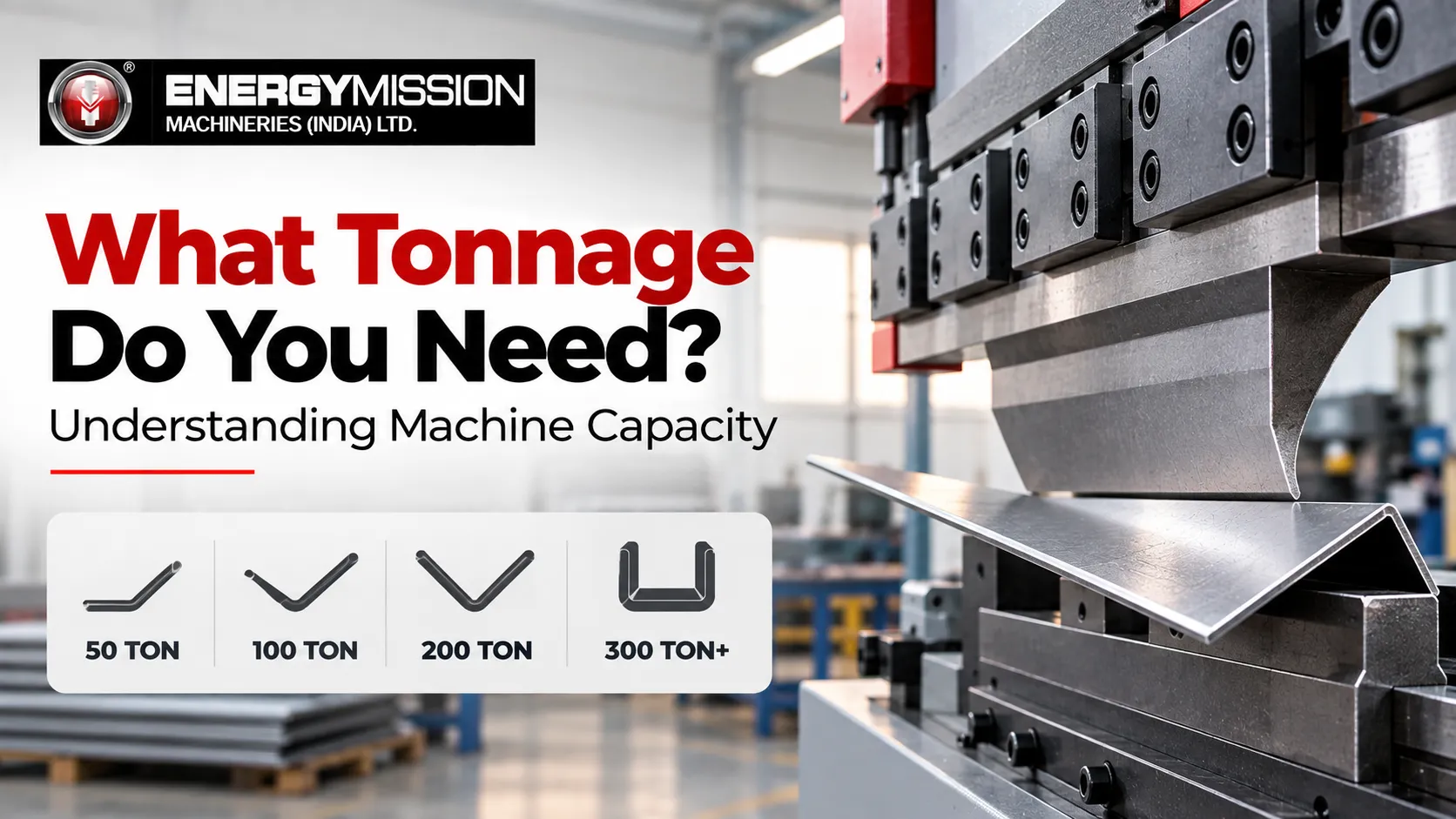
Tonnage refers to the bending force the machine can apply. Choosing the wrong tonnage is the single most expensive mistake buyers make.
The required tonnage depends on three variables: material type, material thickness, and bend length (the length of the part being bent).
A general formula used in the industry:
Tonnage (T/metre) = (thickness² × tensile strength) ÷ (8 × V-die opening)
For mild steel, a commonly referenced rule of thumb is:
- 1mm MS, 1 metre bend length ≈ 8 tonnes
- 2mm MS, 1 metre bend length ≈ 32 tonnes
- 3mm MS, 1 metre bend length ≈ 72 tonnes
- 6mm MS, 1 metre bend length ≈ 288 tonnes
Always add a 20–25% safety margin over calculated tonnage. Running a machine at 100% rated capacity continuously shortens its life significantly.
Key Capacity Parameters to Specify
- Nominal Tonnage (e.g., 100T, 200T, 320T)
- Bending Length (e.g., 2500mm, 3200mm, 4000mm)
- Y-axis Stroke (how far the ram travels)
- Throat Depth (distance from the centre of the ram to the side frame – critical for large parts)
- Daylight Opening (gap between upper and lower beam – determines the maximum tool height you can use)
What Is the Price of a Metal Sheet Bending Machine in India?
The price of a metal sheet bending machine in India ranges from approximately ₹4 lakh for a basic manual/hydraulic machine to ₹1.5 crore or more for a high-tonnage CNC press brake with advanced controller and tooling. The most common range for a production-grade hydraulic CNC press brake (80T–160T, 2500mm) is ₹18 lakh to ₹45 lakh, depending on the controller, back gauge axes, and manufacturer.
Pricing in 2026 is influenced by:
- Machine tonnage and bending length – these are the biggest cost drivers
- Controller type – DA-53T, DA-66T, E21, or advanced 3D offline programming systems
- Number of back gauge axes – X, R, Z1/Z2 add flexibility but cost more
- Brand and country of origin – Indian-manufactured machines offer significant cost advantage vs imports, with comparable quality for most applications
- After-sales service coverage – critical for minimising downtime
Which Industries Use Metal Sheet Bending Machines in India?
Metal sheet bending machines are used across virtually every manufacturing sector in India. The most active sectors include:
- Electrical panel and switchgear manufacturers (Gujarat, Maharashtra, Delhi NCR)
- Auto ancillary and body fabricators (Pune, Chennai, Gurugram, Ahmedabad)
- HVAC and ducting manufacturers
- Agricultural equipment manufacturers (Punjab, Rajasthan, Maharashtra)
- Construction equipment and structural steel fabricators
- Railway coach and metro component manufacturers
- Furniture and storage rack fabricators
- Defence and aerospace subcontractors
India’s “Make in India” push has significantly expanded domestic demand for bending equipment, particularly as more global OEMs shift component sourcing to Indian suppliers who must meet tighter dimensional tolerances.
What Is the Difference Between a Press Brake and a Sheet Bending Machine?
A press brake and a sheet bending machine refer to the same category of equipment – both describe a machine that bends sheet metal using a punch and die system. “Press brake” is the internationally standard term used in engineering and manufacturing globally. “Sheet bending machine” is the term more commonly used by buyers, traders, and smaller fabricators in India and other regional markets.
Technically, some manufacturers differentiate between a “press brake” (which bends flat sheet into profiles using bottom tooling) and a “folding machine” or “panel bender” (which grips and folds the material differently). But in common usage across India, both terms refer to the same type of equipment.
How to Choose the Right Metal Sheet Bending Machine
This is the section most buyers need to spend the most time on. Let me walk through the key decision factors.
1. Identify Your Material and Thickness Range
Know the minimum and maximum material thickness you will regularly bend. If you work with 1–3mm MS sheets 80% of the time but occasionally need to bend 6mm, spec your machine for 6mm – not 3mm.
Also identify your material types: mild steel, stainless steel, aluminium, galvanised sheet, and HRPO (Hot Rolled Pickled and Oiled) all have different tensile strengths that affect tonnage requirements.
2. Define Your Maximum Bend Length
The bending length of the machine must exceed your longest part. If your largest component is 2000mm wide, buy at least a 2500mm machine. Never buy exact – always have margin.
3. Assess Your Production Volume and Repeat Order Pattern
If you run the same parts repeatedly (panels, brackets, enclosures in batches of 50+), a CNC press brake with stored programs and automatic back gauge positioning will dramatically reduce setup time and scrap.
If you primarily do one-off or prototype fabrication with constant part changeovers, a simple NC or hydraulic machine may be more cost-effective.
4. Evaluate Automation Needs
For high-volume production:
- Multi-axis back gauge (X, R, Z1/Z2) allows automatic repositioning between bends
- Offline programming software (such as BendCAM or Cybelec ModEva) lets engineers program parts at a workstation, not on the machine floor
- Automatic tool clamping reduces setup time from 30 minutes to under 5 minutes
5. Budget and ROI Calculation
A CNC press brake typically costs 2–3× more than a basic hydraulic machine. The ROI comes from:
- Reduced setup time (from 30–45 min per job to 5–10 min)
- Lower scrap rates (from ±1° angular variation to ±0.3°)
- Higher throughput (more bends per shift)
- Less dependence on experienced operators
A typical payback period for a CNC upgrade in a busy Indian fabrication shop is 18–36 months.
6. After-Sales Support and Spare Parts
This is a buying factor that Indian customers consistently underestimate – until the machine breaks down.
Before buying, verify:
- Is the manufacturer’s service team present in your state or region?
- How long does it take to get critical spares (hydraulic seals, controller cards, back gauge motors)?
- Is the controller a proprietary system or a standard platform (Delem, CybTouch, Estun)?
- What is the warranty period and what does it cover?
Indian-manufactured machines from established companies have a significant advantage here – same-day or next-day spare parts availability compared to weeks for imported machines.
7. Future Scalability
If you plan to grow production volumes or bid for higher-precision contracts in the next 3–5 years, buy a machine that can grow with you. A CNC machine with an upgradeable controller and tool system is a more future-proof investment than a basic hydraulic machine that you’ll replace in 3 years.
Expert Tips from the Shop Floor
After visiting hundreds of fabrication shops, here are the practical observations that don’t make it into spec sheets:
- Tooling is not an afterthought. A good machine with poor tooling produces poor parts. Budget 10–15% of the machine cost for a quality punch and die set.
- Controller usability matters. A controller that your operators find confusing will be left in manual mode. Always ask for a live demonstration with your actual operators before buying.
- Machine weight is a quality indicator. A heavier machine frame indicates heavier weld quality and more rigid structure, which translates to better angular repeatability under load.
- Don’t ignore the throat depth. Many buyers discover after purchase that their machine’s throat depth is insufficient for the depth of the parts they need to bend. This is a non-negotiable specification to verify upfront.
- Check the crowning system. On longer bending lengths (3200mm+), the machine beam naturally deflects under load. A hydraulic or mechanical crowning system compensates for this to ensure consistent angle along the full length of the bend.
Key Takeaways
- A metal sheet bending machine (press brake) bends flat metal sheets using a punch and die, and is essential in virtually every fabrication sector.
- The main types are manual, hydraulic, CNC hydraulic, electro-hydraulic synchronised, and all-electric – each suited to different production volumes and accuracy needs.
- Tonnage selection must account for material thickness, material type, and bend length – always include a 20–25% safety margin.
- CNC press brakes offer better accuracy (±0.1mm back gauge), faster setups, and lower scrap rates compared to basic hydraulic machines.
- Machine prices in India range from ₹4 lakh (manual/basic hydraulic) to ₹1.5 crore+ (high-tonnage CNC), with the production-grade sweet spot between ₹18–₹45 lakh.
- After-sales support, spare parts availability, and controller standardisation are critical buying factors for Indian buyers.
- Tooling quality, crowning systems, throat depth, and operator-friendly controllers are shop-floor factors that significantly impact long-term productivity.
Frequently Asked Questions (FAQs)
Q1. What is the difference between an NC press brake and a CNC press brake?
An NC (Numerical Control) press brake has a basic digital controller that can set Y-axis depth and back gauge position but stores limited or no programs. A CNC press brake has a full computer controller (such as Delem DA-66T or Cybelec ModEva) that stores hundreds of bend programs, controls multiple axes simultaneously, and can interface with CAD/CAM software for offline programming. For repeat production work, CNC offers significantly higher productivity and consistency.
Q2. How do I calculate the required tonnage for my application?
The standard formula is: Tonnage per metre = (Thickness² × Tensile Strength) ÷ (8 × V-Die Opening). For mild steel, a simplified rule of thumb is 8T/m per mm of thickness squared. Always add 20–25% safety margin, and verify the calculation with your machine manufacturer before final specification.
Q3. What V-die opening should I use for different material thicknesses?
The general industry standard is a V-die opening of 6–8× the material thickness for mild steel. For 2mm MS, use a 12–16mm V-opening. For 6mm MS, use a 36–48mm V-opening. A narrower die gives a tighter bend radius but requires significantly more tonnage. A wider die reduces tonnage requirement but may compromise angular accuracy in air bending.
Q4. Can a CNC press brake bend stainless steel and aluminium?
Yes. CNC press brakes handle mild steel, stainless steel, aluminium, galvanised sheet, copper, and brass. Each material has a different tensile strength and springback behaviour. Stainless steel has approximately 50–70% higher tensile strength than mild steel, so you need proportionally more tonnage. Aluminium has less tensile strength than MS but springback behaviour can be tricky – programmable angle correction on modern CNC controllers compensates for this automatically.
Q5. What is the typical back gauge configuration on a CNC press brake?
Entry-level CNC press brakes typically come with a 2-axis back gauge (X + R axes – in/out and up/down movement). Mid-range machines offer 4-axis back gauges (X, R, Z1, Z2) where Z1 and Z2 allow the two back gauge fingers to move independently, enabling angular or stepped reference surfaces. High-end machines offer 5- or 6-axis back gauges for complex part geometries.
Q6. How long does it take to set up a CNC press brake for a new job?
Setup time on a CNC press brake for a new job (tooling selection, mounting, program input, trial bend, adjustment) typically takes 15–30 minutes for an experienced operator. For repeat jobs with stored programs, setup can be as fast as 5 minutes. Machines with automatic tool clamping and offline programming systems can reduce new job setup to under 10 minutes.
Q7. Is it worth buying an Indian-manufactured press brake vs an imported machine?
For most standard fabrication applications in India, domestically manufactured CNC press brakes from established manufacturers offer excellent value. They are priced 30–50% lower than equivalent European or Taiwanese imports, offer identical working accuracy for standard applications, and critically – spare parts and service are available locally, often within 24–48 hours. Imported machines may offer marginal advantages in ultra-precision or very heavy tonnage applications, but for the vast majority of Indian fabricators, a quality Indian-manufactured machine is the more practical and commercially rational choice.
Q8. What maintenance does a hydraulic press brake require?
Regular hydraulic press brake maintenance includes: daily checking of hydraulic oil level and system pressure; weekly inspection of hydraulic hoses, cylinder seals, and back gauge guide surfaces; monthly changing of hydraulic oil filters; annual hydraulic oil change (or every 2000 operating hours); periodic inspection and adjustment of upper and lower beam parallelism; and regular cleaning and lubrication of back gauge linear guides and ball screws. A well-maintained hydraulic press brake has an operational life of 15–25 years.
Conclusion
Choosing the right metal sheet bending machine comes down to honest self-assessment: how thick are your materials, how long are your parts, how much volume are you running, and how much accuracy do your customers actually require?
A basic hydraulic machine serves general fabrication well. A CNC press brake pays for itself when you have repeat orders, tighter tolerances, or a need to reduce operator dependency. The electro-hydraulic synchronised machines represent the current standard for precision work in 2026.
Don’t let price be the only decision driver. A ₹5 lakh machine that causes ₹2 lakh in annual scrap and rework costs you more than a ₹20 lakh machine that runs cleanly for 20 years.
Invest time in specifying correctly – material, thickness, length, volume, and accuracy – before you talk to any supplier.
Talk to a Metal Sheet Bending Machine Expert
Energy Mission Machineries (India) Ltd. has been manufacturing sheet metal fabrication equipment for 25+ years. The company designs and manufactures CNC Press Brake Machines, Hydraulic Press Brake Machines, CNC Shearing Machines, Plate Rolling Machines, Ironworker Machines, Busbar Processing Machines, and related equipment – with the ability to customise machines to specific production requirements.
Energy Mission exports to 30+ countries including UAE, Saudi Arabia, Oman, Qatar, Kuwait, Bahrain, and markets across Africa and Southeast Asia. Every machine is backed by strong after-sales support and spare parts availability across India.
Whether you need help selecting the right tonnage, understanding controller options, or getting a quotation for a custom machine – the technical team at Energy Mission offers free consultation to help you make the right decision.
Contact Energy Mission Machineries for a machine recommendation or quotation