

Investing in an industrial shearing setup is a high-stakes decision for any fabrication facility. When cutting blanks at scale, minor machine defects such as frame deflection, unstable hold-down pressure, or poor blade clearance adjustment lead to severe edge twist, excessive burrs, and premature tooling failure. These errors slow down downstream processes like bending and welding, turning what should be a high-throughput cutting station into an expensive bottleneck.
Selecting trustworthy hydraulic cutting machine manufacturers requires looking beyond glossy brochures and basic tonnage specifications. A machine that looks sturdy on paper can quickly develop hydraulic oil leaks, cylinder seal blowouts, and uneven blade wear if the builder cut corners on structural stress-relieving, valve block engineering, or blade metallurgy.
In this comprehensive technical guide, we break down the 7 critical quality checks every plant head, production manager, and procurement engineer must conduct before signing a purchase order. You will learn how to inspect frame rigidity, evaluate hydraulic circuits, check blade tolerances, assess automation packages, and determine true total cost of ownership (TCO) to ensure your cutting investment delivers reliable precision for years to come.
The True Cost of Poor Machine Sizing and Quality Compromises
In industrial metal cutting, a low initial purchase price can be deceiving. When fabrication units choose unverified suppliers based purely on a cheap quote, they often encounter hidden operational expenses within the first 12 to 18 months.
Direct and Indirect Financial Losses
- Edge Deformation & Downstream Rework: Excessive camber, bow, and twist along sheared strips force operators to spend extra labor hours grinding edges or flattening plates before they can enter a CNC Press Brake Machine.
- Tooling Downtime: Inferior cutting blades lose their edge rapidly, requiring frequent flipping, regrinding, and shimming costing valuable production hours every month.
- Hydraulic Pressure Drops: Substandard power packs and unbranded manifold blocks fail to sustain uniform hold-down clamping, causing sheets to slip mid-stroke and ruining expensive raw material.
7 Critical Quality Checks Before Choosing Hydraulic Cutting Machine Manufacturers in India
1. Frame Rigidity, Plate Thickness, and bStress-Relieving Standards
The frame of a hydraulic shear absorbs thousands of tons of dynamic shock loads over its operational lifecycle. If the frame flexes even fractions of a millimeter during cutting, the preset blade gap will widen dynamically mid-stroke.
What to Inspect:
- Steel Grade and Side Frame Thickness: Verify that the side housings, table beam, and upper crosshead are fabricated from heavy, high-tensile steel plates (such as IS 2062 Grade E250/E350).
- Stress-Relieving Process: Ask the manufacturer whether the welded frame undergoes thermal furnace stress-relieving or shot-blasting with vibration stress relief (VSR) prior to machining. Un-relieved steel retains internal residual stresses from welding, which gradually warp the machine bed over 1 to 2 years of shop temperature cycles.
- Single-Setup Machining: Ensure that the guide tracks, cylinder seats, and table surfaces are machined on large CNC Floor Boring or Double-Housing Plano-Milling centers in a single setup to maintain true geometric squareness.
2. Hydraulic System Architecture, Manifold Design, and Cylinders
The hydraulic circuit is the core powertrain of a hydraulic shearing machine. A poorly designed hydraulic system generates excessive heat, leading to premature seal degradation, oil thinning, and erratic ram strokes.
Technical Indicators of a Quality Hydraulic Power Pack:
- Manifold Block Integration: Top-tier hydraulic metal cutting machine suppliers use cartridge valves fitted onto compact, forged steel manifold blocks. This design minimizes external high-pressure piping, dramatically reducing potential leak points.
- Component Pedigree: Look for world-class hydraulic components—such as Rexroth, Yuken, Parker, or Polyhydron valves and pumps—which guarantee steady pressure delivery and easy spare parts availability.
- Honed Cylinders and Precision Seals: Cylinders should be manufactured from seamless, micro-honed heavy-duty forged tubes paired with wear-resistant Polyurethane and PTFE seals (e.g., Merkel, Hallite, or Parker). These withstand continuous pressure cycles without internal oil bypass.
- Oil Filtration and Cooling Systems: Quality systems feature dual return-line filtration (10 to 25 microns) with visual clogging indicators, magnetic drain plugs, and adequate reservoir volume ($3\times\text{ to }4\times$ the pump flow rate per minute) to prevent oil overheating during multi-shift operations.
3. Blade Metallurgy, Edge Count, and Rake Angle Engineering
A cutting machine is only as good as the metallurgical properties of its blades. High-alloy sheet materials—such as stainless steel (SS 304/316) or high-yield structural plates—rapidly chip low-grade tooling.
Blade Quality Metrics:
- Material Composition: For standard mild steel, High Carbon High Chromium (HCHCr / D3) blades provide dependable wear resistance. For mixed fabrication involving structural high-tensile steel or stainless steel, demand High Carbon High Chrome with Molybdenum/Vanadium (D2 or H13 modified) hardened to 58–60 HRC.
- Four-Edge Usability: Check that both the upper and lower blades are rectangular with four ground cutting edges. This design allows you to rotate the blades four times before requiring regrinding, cutting your tooling operating costs in half compared to two-edge blades.
- Rake Angle Adjustment Mechanism: High-capacity guillotine shearing machines must feature adjustable rake angles (from $0.5^\circ$ to $2.5^\circ$). A shallow rake angle reduces twist and camber on thin sheet strips, while a steeper rake angle lowers the required cutting force on heavy plates.
4. Hold-Down Clamping Dynamics and Surface Protection
A major reason for inaccurate shearing cuts is the lateral shifting of the plate as the upper blade enters the material. Hold-down cylinders must apply proportional, uniform clamping force before the cutting blade touches the metal.
Expert Shop-Floor Tip: When cutting pre-coated, polished stainless steel or commercial aluminum sheets, specify polyurethane-lined hold-down feet and spherical ball-transfer tables. These prevent cosmetic scratching, surface gouges, and sheet dragging marks during positioning.
5. Backgauge Drive Mechanisms and CNC Automation Integration
The backgauge directly dictates your blank-to-blank dimensional repeatability. Low-quality machines utilize standard lead screws driven by uncalibrated AC motors, which develop mechanical backlash, lead wear, and positioning drift over time.
|
Backgauge Specification |
Economy Workshop Grade |
Industrial Heavy-Duty Standard |
|
Drive Mechanism |
Standard Trapezoidal Lead Screw |
Ground Class Precision Ball Screws |
|
Guideway Type |
Cast Iron Slide Channels |
Hardened LM Profile Guides (THK/Hiwin) |
|
Motorization |
Induction AC Motor with Brake |
Digital AC Servo Motor with Closed-Loop Encoder |
|
Positioning Accuracy |
$\pm 0.35\text{ to } 0.50\text{ mm}$ |
$\pm 0.05\text{ to } 0.10\text{ mm}$ |
|
Retraction Function |
Fixed stop (Risk of jamming) |
Auto-retract upon stroke execution |
When cutting narrow strips off long sheets, look for an automated backgauge retraction (swing-away) feature. As the upper blade completes its downward stroke, the backgauge fingers automatically swing up, allowing the severed piece to fall away without binding between the lower blade and the gauge bar.
6. Safety Compliance, Interlocks, and Ergonomic Support
Safety is a critical operational factor in high-tonnage sheet metal shearing. Industrial hydraulic cutting machine manufacturers in India must supply equipment that complies with international workplace safety norms (CE/OSHA standards).
Optical Shadow-Line Lighting: A focused LED shadow line projects the exact cutting edge directly onto the sheet surface, allowing operators to align scribed marks quickly on custom cuts.
- Front Sheet Supports with Squaring Arm: Heavy front extension arms fitted with measuring scales, flip-up stops, and front-mounted roller balls reduce operator fatigue, enhance squaring precision, and protect hands during plate feeding.
- Rear Sheet Support Systems (Pneumatic Thin-Sheet Supports): When shearing thin sheets ($< 1.5\text{ mm}$), material sagging under its own weight causes gauge inaccuracies before the blade strikes. A pneumatic thin-sheet support system holds the trailing edge level with the backgauge until the hold-downs lock the plate.
7. Factory Acceptance Testing (FAT) and Pre-Delivery Inspection Protocols
Never dispatch a machine based on a dry-cycle video run alone. Perform an on-site Factory Acceptance Test (FAT) at the manufacturer’s facility using actual test plates of your maximum specified thickness and tensile grade.
Mechanical vs. Hydraulic vs. CNC Swing Beam vs. CNC Variable Rake Guillotine
Choosing the correct shearing mechanism directly influences edge squareness, cycle speed, and tooling longevity.
|
Evaluation Parameter |
Mechanical Shearing Machine |
Hydraulic Swing Beam Shear |
Hydraulic Variable Rake Guillotine |
|
Structural Cutting Action |
Flywheel-driven crank action |
Upper beam rotates on pivot bearings |
Upper beam descends vertically along precision slides |
|
Rake Angle Flexibility |
Fixed (Often high, causing twist) |
Fixed factory angle ($1.0^\circ\text{ to }1.5^\circ$) |
Fully variable CNC-controlled ($0.5^\circ\text{ to }2.5^\circ$) |
|
Blade Geometry |
2-edge or 4-edge |
2-edge upper / 4-edge lower |
4-edge upper / 4-edge lower |
|
Edge Distortion (Twist/Camber) |
High on narrow strips |
Moderate on narrow strips |
Minimum (Optimized via shallow rake) |
|
Blade Gap Adjustment |
Manual bolt adjustments |
Quick single-point lever adjustment |
Automatic CNC motorized gap setting |
|
Best-Fit Applications |
Light sheet shops, roofing panels |
General fabrication up to 6–10 mm |
Precision cutting, heavy plate, multi-shift production |
How to Choose the Right Machine: Industrial Buyer’s Framework
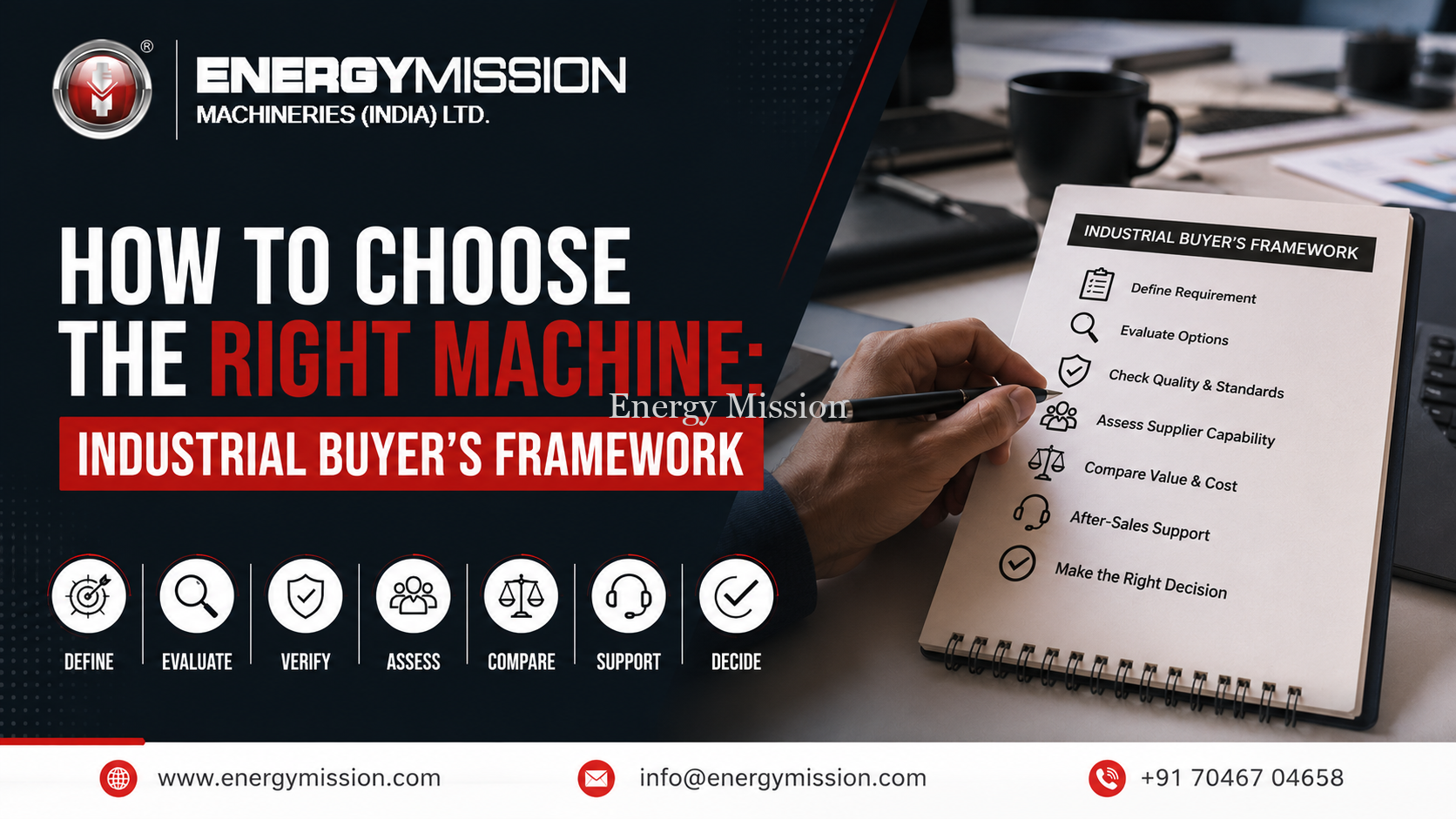
When evaluating an industrial hydraulic cutting machine price against your production targets, use this structured framework to determine the right capacity and machine class.
1. Sizing Machine Capacity for Real-World Materials
Cutting force depends on material shear strength ($\tau$). Stainless steel (AISI 304) requires roughly $1.4\times \text{ to } 1.5\times$ more cutting force than standard mild steel (IS 2062).
- If your shop cuts up to 6 mm Stainless Steel, do not purchase a machine rated for 6 mm mild steel.
- You need a machine rated for at least 8 mm to 10 mm Mild Steel capacity to handle the shear resistance without stalling the hydraulic system.
2. Matching Bending Length and Shear Width
Your shearing line should always mirror the capacity of your downstream forming assets. Pairing an undersized shearing machine with a high-capacity Hydraulic Press Brake Machine or a heavy-duty Plate Rolling Machine creates an immediate production imbalance.
Ensure the cutting length comfortably spans your longest standard plate sizes (typically 2500 mm, 3100 mm, or 4100 mm) with sufficient margin on the side throats for continuous strip slit-cutting.
3. Workflow Integration with Surrounding Equipment
- For integrated structural fabrication, combine your shearing station with an Ironworker Machine for fast punching, corner notching, and angle shearing.
- For copper or aluminum electrical panel manufacturing, utilize a dedicated Busbar Processing Machine to shear, bend, and punch busbars without edge distortion or conductive cross-section loss.
- For high-throughput manufacturing lines requiring seamless blank sizing, choose a high-precision CNC Shearing Machine equipped with front feeder tables and automated rear scrap-separators.
Technical Calculations: Shearing Force and Blade Clearance Formulas
Understanding the underlying physics allows engineers to double-check supplier machine recommendations against actual job shop requirements.
Expert Rule of Thumb: If the blade gap is set too tight, secondary shearing occurs—causing high machine tonnage, polished double-cut edges, and rapid blade edge breakdown. If the gap is too loose, the sheet rolls between the blades, creating large ragged burrs and excessive edge pull-down.
Industry FAQs: Engineering and Buyer Considerations
What causes severe twisting and camber when shearing narrow strips?
Twisting and camber are caused by excessive rake angles, wide blade clearances, or unaddressed residual stress in the raw metal coil. On a Variable Rake Guillotine Shear, reducing the blade rake angle to $0.5^\circ\text{ to }1.0^\circ$ minimizes this distortion on narrow cuts.
How often should industrial shearing machine blades be rotated or reground?
Under normal single-shift operation cutting mild steel, premium D2/HCHCr blades should be rotated every 6 to 9 months per edge. With a 4-edge reversible blade set, you can achieve 2 to 3 years of production before requiring a professional regrinding service. Cutting high-tensile stainless steel reduces this interval by 40–50%.
What is the primary operational difference between a Swing Beam Shear and a Variable Rake Guillotine?
A Swing Beam Shear uses a pivoted upper beam that moves along a fixed circular arc with a fixed rake angle (ideal for standard structural plates up to 10 mm). A Variable Rake Guillotine moves vertically in heavy slide guideways, allowing the operator to adjust the rake angle and blade gap to achieve cleaner, twist-free cuts across a wider range of thicknesses.
How does proper blade clearance affect hydraulic operating pressure?
Setting the correct blade clearance ensures that the upper blade initiates crack propagation at the optimal depth, allowing the plate to separate cleanly with minimum mechanical resistance. An incorrect clearance forces the hydraulics to sustain peak pressure throughout the entire stroke, increasing system heat and power draw.
Why do sheets slip or lose accuracy during heavy shearing strokes?
Sheet slippage happens when hold-down cylinder clamping force drops below required levels or when hold-down timing is out of sync with the main cutting beam. This issue is typically caused by worn hold-down seals, fatigued return springs, or an uncalibrated pressure sequence valve.
What should I check when evaluating the price of an industrial hydraulic cutting machine?
Evaluate the complete build specification: look at whether the frame was stress-relieved, the component brands used in the hydraulic manifold, the blade metallurgy (D2 vs. low-alloy steel), the backgauge design (servo ball-screw vs. lead screw), and the included warranty and after-sales support infrastructure.
Key Takeaways for Procurement and Production Teams
- Frame Rigidity Dictates Cutting Life: Always verify that machine frames are constructed from high-tensile plates and subjected to furnace or vibration stress-relieving before finish-machining.
- Inspect Hydraulic Component Sourcing: Insist on forged manifold blocks paired with globally recognized hydraulic valves and high-integrity piston seals to prevent mid-shift leaks.
- Prioritize 4-Edge D2/HCHCr Tooling: Reversible rectangular blades provide four usable cutting edges, lowering long-term tooling overhead and extending intervals between regrinds.
- Size Tonnage for Tougher Materials: Calculate machine capacity using stainless steel ratings ($1.4\times \text{ to } 1.5\times$ mild steel tonnage) if you plan to process mixed alloy grades.
- Demand Closed-Loop Backgauge Systems: AC Servo motors paired with precision ball screws and hardened linear motion guides deliver consistent $\pm0.05\text{ mm}$ repeatability without backgauge drift.
- Verify Safety and Support Infrastructure: Ensure machines include optical shadow line lights, interlocked physical safety guards, rear light curtains, and clear Factory Acceptance Testing (FAT) documentation.
Conclusion & Factory Engineering Consultation
Selecting the right hydraulic shearing machine is a long-term investment in your shop’s throughput, accuracy, and operational profitability. By evaluating machine builders against rigorous structural, hydraulic, and tooling standards, you protect your facility from costly maintenance delays, excessive scrap rates, and early equipment replacement.
Heavy-duty sheet metal fabrication ke liye standard aur customized machine capacity check karne ke liye hamara cutting machinery catalogue dekhein, where you can explore high-performance CNC Shearing Machine configurations tailored to your specific shop-floor needs.
Energy Mission Machineries (India) Ltd. is one of India’s premier industrial machine tool builders, backed by more than 25 years of manufacturing excellence. With an installed base of over 5,000 machines across India, the Middle East (UAE, Saudi Arabia, Oman, Qatar, Kuwait, Bahrain), Africa, and international export markets, we engineer industrial-grade Hydraulic Guillotine Shears, CNC Swing Beam Shears, Hydraulic Press Brakes, Plate Rolling Machines, and Busbar Processors engineered for reliable heavy-duty performance.
Looking to upgrade your sheet metal shearing line or calculate exact machine capacities for your upcoming projects?
Contact the Energy Mission Engineering Team today to discuss your production drawings, review machine specifications, or request a comprehensive technical quotation.