

Getting inaccurate bend angles during a production run is one of the most common headaches on any shop floor. When your parts come off the machine with slight angle variations, downstream welding slows down, assembly holes do not line up, and scrap bins fill up quickly.
Operating a sheet metal press brake successfully comes down to picking the right bending method for your job: air bending, bottoming, or coining.
Every bending technique handles metal springback, machine tonnage, and part accuracy differently. Picking the wrong method can cause uneven angles, tool damage, and machine wear.
This guide breaks down how air bending, bottoming, and coining work in simple, practical terms. You will learn the clear differences between them, how to pick the right tooling, and how to choose the right machine setup for your workshop.
Understanding Metal Springback on a Sheet Metal Bending Press Brake
Whenever you bend a piece of metal, the material stretches on the outside and compresses on the inside. Because metal has natural elasticity, it always tries to spring back slightly toward its flat shape once the machine releases pressure. This reaction is known as springback.
- Material Type: Harder materials like stainless steel spring back much more than soft mild steel or commercial aluminum.
- Bend Sharpness: A wider inside bend radius produces more springback than a sharp bend.
- Grain Direction: Bending along the grain of the sheet can cause uneven springback and occasional cracking compared to bending across the grain.
Controlling springback depends on which bending technique you use on your sheet metal bending press brake.
1. Air Bending with a Modern Sheet Metal Air Bending Machine
What is Air Bending?
Quick Definition: Air bending is a method where the punch presses the sheet into the V-die opening without pushing the metal all the way to the bottom of the die, using only three contact points.
In air bending, the metal touches only the punch tip and the two top edges of the bottom die. Because the sheet never touches the bottom of the die tool, the final bend angle depends entirely on how deep the top punch pushes down.
With a standard punch and die set, your CNC controller can form multiple different angles (such as 90°, 120°, or 60°) simply by changing the stroke depth.
Practical Advantages
- Versatility: You can bend several different angles using one set of punch and die tooling.
- Lower Machine Tonnage: It uses the least amount of pressing force, which protects your hydraulic system and extends machine life.
- Fast Setups: Fewer tool changes mean faster turnaround on mixed-batch production jobs.
Limitations to Watch For
- Sheet Thickness Variations: If raw sheet metal thickness varies slightly from the supplier, the resulting bend angle will shift slightly.
- Bed Crowning: On longer sheets (over 2.5 to 3 meters), the center of the bend can open up unless the machine has an automatic crowning system.
2. Bottom Bending (Bottoming) for Press Brake Sheet Metal Work
What is Bottom Bending?
Quick Definition: Bottoming is a bending method where the punch pushes the metal firmly against the angled side walls of the bottom V-die, leaving just a tiny gap at the very bottom root.
In bottoming, the metal is pressed into direct contact with the internal slopes of the V-die. The die angle is matched closely to your desired final part angle (for example, an 88° die to get a finished 90° corner after springback).
Because the material is held firmly against the rigid die faces, bottoming produces very consistent angles across the entire production batch.
Practical Advantages
- High Repeatability: It compensates well for minor sheet thickness variations across different metal batches.
- Tighter Corner Radii: It produces cleaner, tighter inside corners without needing massive stamping pressure.
- Consistent Batch Quality: Delivers steady angles on medium-to-high volume runs.
Limitations to Watch For
- Dedicated Tooling Needed: You must buy separate, matching punch and die sets for each specific bend angle.
- Higher Tonnage: Requires roughly 1.5 to 2.5 times more force than air bending, placing more load on your tooling.
3. Coining Process on a Heavy-Duty Sheet Metal Press Brake
What is Coining?
Quick Definition: Coining is a high-pressure stamping method where the punch tip presses deep into the metal, completely flattening the material into the bottom die cavity to eliminate springback.
Coining gets its name from how coins are stamped. The punch pushes into the sheet with extreme force, completely overcoming the metal’s elasticity. The material flows directly into the shape of the die, leaving zero air gaps.
Because the internal tension in the metal is completely crushed out, springback is eliminated.
Practical Advantages
- Pinpoint Accuracy: Delivers sharp, exact angles with tight tolerances.
- Zero Springback: Eliminates the need to calculate springback or adjust for rolling grain direction.
- Crisp Corners: Perfect for high-precision components that require ultra-sharp inside radii.
Limitations to Watch For
- Extreme Tonnage: Requires 5 to 8 times more force than air bending, which can quickly overload a machine if calculated incorrectly.
- Tooling Wear: Punches and dies wear out much faster due to the high stamping pressures.
- Thickness Limits: Practically limited to thin sheet gauges (usually under 2 mm mild steel).
Comparison: Air Bending vs. Bottoming vs. Coining
|
Feature / Factor |
Air Bending |
Bottoming |
Coining |
|
Tonnage Required |
Lowest ($1.0\times$) |
Medium ($1.5\times \text{ to } 2.5\times$) |
Extremely High ($5\times \text{ to } 8\times$) |
|
Tooling Flexibility |
High (1 tool makes many angles) |
Low (Needs dedicated matching tools) |
Very Low (Requires hardened precision dies) |
|
Springback Control |
Overbend slightly via depth |
Handled by matching die angle |
Fully eliminated |
|
Angle Consistency |
Good ($\pm 0.5^\circ$) |
Very Good ($\pm 0.3^\circ$) |
Excellent ($\pm 0.1^\circ$) |
|
Tool & Machine Wear |
Very Low |
Moderate |
High |
|
Best Production Use |
Custom fabrication & mixed jobs |
Repetitive standard parts |
High-precision specialty work |
Tooling and V-Die Selection on a Sheet Metal Press Brake
Selecting the right bottom V-die opening keeps your bends clean and prevents machine strain.
- For Thin Sheets (up to 3 mm): Use a die opening of $6\text{ to }8\times$ the sheet thickness.
- For Medium Sheets (3 mm to 6 mm): Use a die opening of $8\text{ to }10\times$ the sheet thickness.
- For Heavy Plates (8 mm and above): Use a die opening of $10\text{ to }12\times$ the sheet thickness to lower required forming force.
If your blanks are cut on a CNC Shearing Machine, keep the cutting blades sharp. Large burrs along sheared edges can sit unevenly on the V-die shoulders and cause angle variations across the bend.
How to Choose the Right Sheet Metal Press Brake for Your Shop
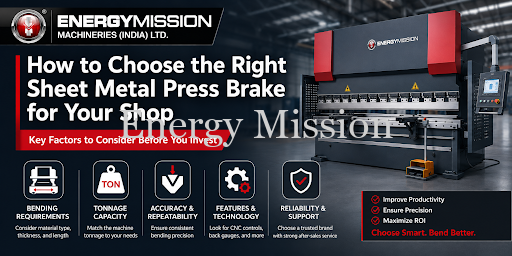
Selecting the best press brake depends on your daily production mix, material thickness, and part sizes.
1. Sizing Your Tonnage with a Safety Buffer
Always choose a machine with 20% to 30% more tonnage capacity than your everyday calculations require. If your thickest plate needs 120 tons to air-bend, invest in a 150-ton or 160-ton press brake. This extra headroom prevents hydraulic overheating and handles tougher steel batches without straining the frame.
2. Matching Bed Length and Crowning
If you regularly bend sheets 3 meters or longer, machine bed deflection will cause the center of your part to have a wider angle than the ends. Choosing a high-precision CNC Press Brake Machine with motorized or hydraulic auto-crowning keeps your bend angle straight from edge to edge.
3. Production Volume and Controller Needs
- Basic & Heavy Bending: A standard 2-axis Hydraulic Press Brake Machine is reliable, robust, and cost-effective for simple channels, brackets, and heavy plates.
- Complex Multi-Bend Parts: A multi-axis CNC machine with programmable backgauges saves substantial setup time on complex enclosures and panels.
4. Supporting Your Fabrication Line
A press brake works best alongside balanced upstream and downstream machinery:
- Use an Ironworker Machine for fast pre-punching, shearing, and corner notching.
- Use a Plate Rolling Machine when forming wide cylinders and circular shapes beyond standard tooling limits.
- Use a dedicated Busbar Processing Machine for clean bending, punching, and cutting of electrical copper busbars.
Industry FAQs: Common Sheet Metal Bending Press Brake Questions
Why does my bend angle change between different sheets of the same steel?
Raw steel sheets often vary slightly in thickness and hardness from the rolling mill. In air bending, even a 0.1 mm difference in thickness changes how deep the punch enters the die, leading to small angle shifts.
Can I bend multiple angles using the same punch and die set?
Yes, if you use air bending on a CNC press brake. Because the angle is controlled by punch depth rather than the tool shape, you can form 90°, 120°, and 45° bends using a single 85° or 30° toolset.
What is the 16% rule in air bending?
For standard mild steel, the inside radius of the bend naturally forms to approximately 16% of the bottom V-die opening width ($R \approx V / 6$).
Why are my parts opening up in the center of long bends?
This happens because the upper beam and lower bed deflect slightly under pressure during the bend. An automatic crowning system compensates for this bed flex to keep the angle uniform along the entire length.
When should I choose bottoming over air bending?
Choose bottoming when you are running high volumes of identical parts, need very tight inside radii, or want to minimize angle variations caused by fluctuating sheet thickness.
What die opening should I use for 6 mm mild steel?
For 6 mm mild steel, a standard opening of $8\times \text{thickness}$ (a 50 mm V-die) or $10\times \text{thickness}$ (a 60 mm V-die) delivers clean bends with comfortable tonnage levels.
Key Takeaways for Shop Owners and Fabricators
- Air Bending is the Most Flexible: It uses the least machine tonnage and allows you to create multiple bend angles with a single tooling set.
- Bottoming Delivers High Repeatability: It locks the sheet against the die walls to deliver consistent angles across large production batches.
- Coining is High-Pressure and Specialized: It completely eliminates springback, but uses extreme tonnage that increases tool and machine wear.
- Die Width Dictates Inside Radius: In air bending, the inside radius is determined by the bottom V-die opening width, not the punch nose.
- Always Include a 20–30% Tonnage Buffer: Sizing your machine above your minimum calculated load keeps your hydraulic system healthy and reliable for years.
Build a Reliable Fabrication Workshop with Energy Mission
Choosing the right bending method and the right machine capacity protects your profit margins, reduces rework, and keeps production moving smoothly.
Energy Mission Machineries (India) Ltd. is a leading manufacturer of CNC Press Brake Machines, Hydraulic Press Brakes, Shearing Machines, and complete Sheet Metal Fabrication Equipment. With over 25 years of manufacturing experience, thousands of installations across India, and global exports to the UAE, Saudi Arabia, Oman, Qatar, Kuwait, Bahrain, and Africa, our engineering team is here to help you select the ideal equipment for your production goals.
Need help selecting the right press brake or tooling configuration?
Contact the Energy Mission Engineering Team today to discuss your component drawings, calculate tonnages, or request a customized machine quote.