
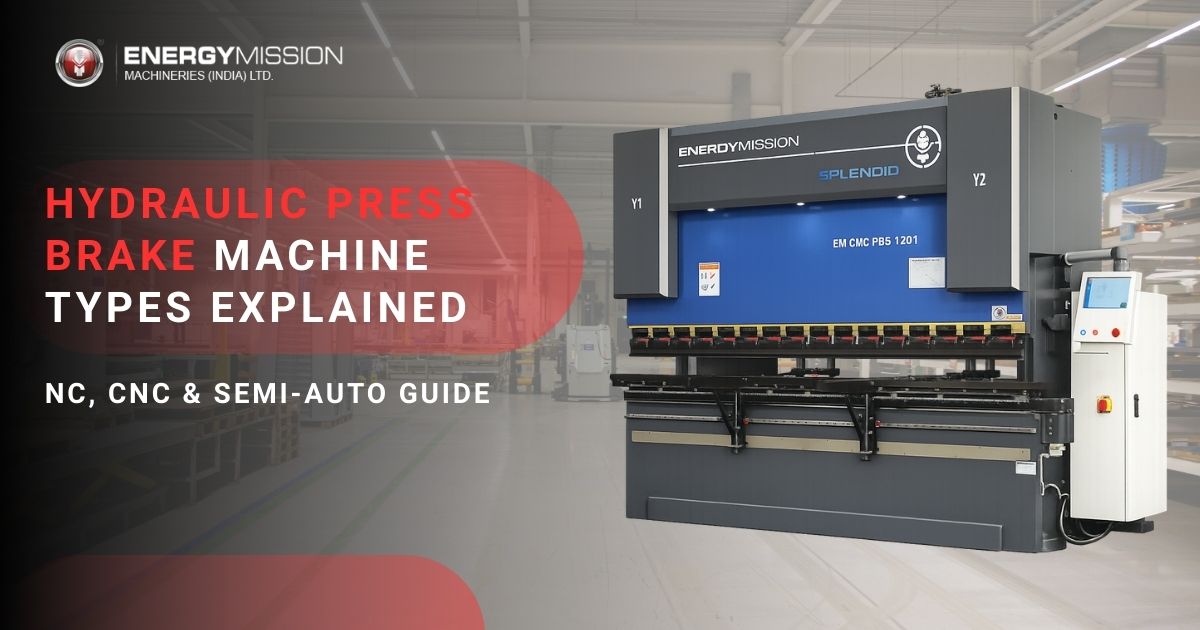
If you are buying a press brake machine for the first time or upgrading your existing setup one of the first decisions you face is choosing the right type. The market offers multiple variants, and each one serves a different production need, budget range, and operator skill level.
This guide breaks down the three main types of hydraulic press brake machines available in India today: NC (Numerical Control), CNC (Computer Numerical Control), and Semi-Automatic. By the end, you will know exactly which type fits your workshop, production volume, and bending requirements.
EnergyMission has been manufacturing and supplying press brake machines across India for years. This guide is built on real application experience not theory.
What is a Hydraulic Press Brake Machine?
A hydraulic press brake is a metal bending machine that uses hydraulic cylinders to apply force on a punch and die set, bending sheet metal to a required angle. The hydraulic system generates controlled force from as low as 40 tonnes to over 1000 tonnes making it suitable for thin aluminium sheets all the way to thick structural steel plates.
Unlike mechanical press brakes, hydraulic machines offer:
- Adjustable stroke speed and pressure at any point during the bend
- Full tonnage available throughout the entire stroke length
- Safer operation with programmable pressure limits
- Lower maintenance requirements over a long service life
The key difference between machine types is how the movement and positioning are controlled manually, numerically, or through a full computer system.
Type 1: NC Hydraulic Press Brake Machine
What is an NC Hydraulic Press Brake?
An NC Hydraulic Press Brake Machine uses a basic Numerical Control system to control the back gauge position and ram depth. The operator inputs values bend depth, back gauge position, speed through a simple control panel, and the machine executes those settings with reasonable accuracy.
The NC system does not store complex programs or run automatic sequences. Each bend is set up individually, and the operator controls the foot pedal to initiate each stroke.
Key Specifications of NC Press Brakes
- Control System: E21 or similar NC controller
- Axes: Typically X-axis (back gauge in/out) and Y-axis (ram depth)
- Accuracy: ±0.1mm to ±0.2mm (adequate for standard fabrication)
- Tonnage Range: 40T to 400T
- Bending Length: 1600mm to 4000mm
Who Should Buy an NC Hydraulic Press Brake?
The NC Hydraulic Press Brake Machine is the right choice if:
- Your production involves simple, repetitive bends with minimal angle variation
- You are a small to mid-scale fabricator with a tight capital budget
- Your operators are experienced and can work with manual settings
- You produce components in moderate volumes where full automation is not justified
Typical applications: General sheet metal fabrication, agricultural equipment parts, simple structural components, metal furniture frames.
Advantages of NC Press Brakes
- Lower machine cost compared to CNC variants
- Simpler operation less training required
- Reliable and easy to maintain
- Suitable for job shops handling varied, low-complexity work
Limitations
- Cannot store multiple bending programs
- Setup time is longer for complex multi-bend parts
- Accuracy is lower compared to CNC Synchro systems
- Not suitable for high-volume production or tight-tolerance parts
Type 2: 2 Axis NC Hydraulic Press Brake Machine
What Makes It “2 Axis”?
The 2 Axis NC Hydraulic Press Brake Machine is a step up from a basic NC machine. As the name suggests, it offers control over two independent axes:
- Y-axis: Controls the ram (upper beam) depth determines bend angle
- X-axis: Controls the back gauge position determines bend position on the sheet
With both axes under NC control, the operator can set up bends more precisely and consistently than with a fully manual machine. The back gauge moves to the programmed position automatically, reducing operator error and speeding up production.
Why the 2 Axis Configuration Matters
In standard sheet metal work, the two most critical variables in every bend are:
- How deep the punch goes (determines the angle)
- Where the sheet is positioned (determines the flange length)
The 2 Axis NC Hydraulic Press Brake controls both these variables numerically, which means once the operator sets the values correctly, every subsequent piece bends identically without manually repositioning the back gauge each time.
Ideal Applications for 2 Axis NC Press Brakes
- Medium-scale fabrication workshops
- Production of components with consistent flange dimensions
- Sheet metal enclosures, brackets, frames, and panels
- Applications where operator efficiency matters but full CNC is not justified
EnergyMission’s NC Press Brake Range
EnergyMission’s Prudent Series offers reliable 2 Axis NC Hydraulic Press Brake configurations that are built for Indian manufacturing conditions. The Prudent series is designed for fabricators who need accuracy and repeatability without the complexity and cost of a full CNC Synchro system.
For heavier applications, the Magnum Series from EnergyMission provides NC-controlled press brakes with higher tonnage ratings ideal for structural steel, heavy fabrication, and thick plate bending.
Type 3: Semi Automatic Press Brake Machine
What is a Semi Automatic Press Brake?
A Semi Automatic Press Brake Machine sits between a manual press brake and a fully automatic CNC machine. In a semi-automatic setup, certain functions back gauge positioning, ram stroke, speed ramping are handled automatically, while the operator still controls the actual bending cycle through a foot pedal or hand control.
The key distinction: the machine does the positioning work automatically, but a human operator remains in the loop for each bend cycle. This is different from a fully automatic system where a robotic arm or servo-driven feeder handles material loading and unloading as well.
How Does a Semi Automatic Press Brake Work?
- The operator inputs the bend parameters into the NC or basic CNC controller
- The back gauge moves automatically to the programmed position
- The operator places the sheet against the back gauge fingers
- The operator activates the foot pedal the machine bends
- The back gauge automatically repositions for the next bend in the sequence
- The operator repositions the part and activates the next stroke
This workflow significantly reduces the physical effort and skill required from the operator while keeping a human in control of each stroke for safety and quality checking.
Who Should Buy a Semi Automatic Press Brake Machine?
The Semi Automatic Press Brake Machine is the right fit if:
- You produce medium to high volumes of parts with multiple bend sequences
- Operator fatigue and consistency are concerns on long production runs
- You want faster throughput than a manual machine without the cost of full automation
- Your parts are too varied for a fully automatic system but too complex for a basic NC machine
Typical applications: Electrical enclosures, switchgear panels, HVAC ducting, metal furniture, automotive sheet metal components.
Advantages of Semi Automatic Press Brakes
- Faster production cycles than manual or basic NC machines
- Reduced operator skill requirement for complex multi-bend parts
- Consistent positioning improves part quality across production batches
- More affordable than full CNC automation
- Safer the operator retains control over each individual stroke
NC vs CNC vs Semi-Auto: Side-by-Side Comparison
| Feature | NC Hydraulic | 2 Axis NC | Semi-Auto Press Brake |
| Control Type | Numerical | Numerical (2-axis) | NC / Basic CNC |
| Back Gauge | Manual / Semi-auto | Auto X-axis | Fully Auto Positioning |
| Program Storage | None / Limited | Limited | Yes |
| Accuracy | ±0.1–0.2mm | ±0.1mm | ±0.05–0.1mm |
| Best For | Simple bends | Medium complexity | Multi-bend production |
| Operator Skill | Medium-High | Medium | Low-Medium |
| Cost | Lowest | Moderate | Moderate-High |
How to Choose the Right Press Brake Machine for Your Workshop
Choosing the right press brake machine comes down to four factors:
1. Production Volume
Low volume, high variety → NC Hydraulic Press Brake Medium volume, moderate variety → 2 Axis NC or Semi-Auto High volume, low variety → Semi-Auto or full CNC
2. Part Complexity
Single bend parts → NC is sufficient 2–4 bend sequences → 2 Axis NC handles it well 5+ bend sequences with tight tolerances → Semi-Auto or CNC
3. Operator Availability & Skill
Experienced operators → NC works fine Mixed skill levels → Semi-Auto reduces dependency on operator skill Unskilled labor environment → Consider full CNC or Semi-Auto with guided programming
4. Budget
NC Hydraulic Press Brake → Most affordable entry point 2 Axis NC → Moderate investment with good ROI for mid-scale shops Semi-Auto → Higher upfront cost, lower per-piece labor cost over time
EnergyMission Press Brake Machines: The Right Machine for Every Need
EnergyMission manufactures a complete range of hydraulic press brake machines designed for Indian industry conditions reliable in heat, dust, and variable power supply environments.
Prudent Series: Built for mid-scale fabricators, the Prudent delivers consistent NC-controlled bending at a practical price. Available in standard 2 Axis NC Hydraulic Press Brake configuration with options for upgrade.
Optima Series: The Optima steps up to CNC Synchro control for fabricators who need tighter tolerances and more complex bending programs. A natural upgrade path from NC machines as production demands grow.
Magnum Series: For heavy-duty bending at high tonnage, the Magnum handles structural steel, thick plates, and long bending lengths that lighter machines cannot manage.
All EnergyMission machines come with pan-India service support, genuine spare parts availability, and on-site installation and training.
Talk to EnergyMission Before You Buy
The right press brake machine is the one that matches your specific material, thickness, bending length, and production volume not just the one that fits your budget today.
EnergyMission’s technical team will assess your requirements and recommend the right machine from our range NC, Semi-Auto, or full CNC Synchro.
Browse Our Full Press Brake Range Visit www.energymission.com or contact us directly for pricing, specifications, and a free application consultation.
Frequently Asked Questions (FAQ)
Q1. What is the difference between an NC and a CNC hydraulic press brake?
An NC Hydraulic Press Brake Machine uses basic numerical control where the operator sets individual bend parameters manually for each bend. A CNC press brake stores full bending programs, runs automatic sequences, and offers higher accuracy through servo-driven axes. CNC machines are faster for complex, multi-bend parts in high volumes.
Q2. What does “2 Axis” mean in a press brake machine?
The 2 Axis NC Hydraulic Press Brake Machine controls two axes the Y-axis (ram depth, which determines bend angle) and the X-axis (back gauge position, which determines flange length). This two-axis control gives consistent, repeatable bends without manual back gauge adjustment between pieces.
Q3. Is a Semi Automatic Press Brake Machine suitable for small workshops?
A Semi Automatic Press Brake Machine is most cost-effective for medium to high production volumes. For small workshops with low volume and high part variety, an NC hydraulic press brake is usually the more practical choice. As production grows, upgrading to semi-auto or CNC makes financial sense.
Q4. What materials can a hydraulic press brake handle?
A hydraulic press brake can bend mild steel, stainless steel, aluminium, copper, brass, and galvanized sheet ranging from 0.5mm to 25mm+ thickness depending on machine tonnage. Material tensile strength affects required tonnage, so always specify your material when requesting machine recommendations.
Q5. Does EnergyMission provide after-sales support across India?
Yes. EnergyMission operates a pan-India service network with dedicated engineers in major industrial cities. Spare parts are stocked locally, and Annual Maintenance Contracts (AMC) are available for long-term customers.
Q6. How do I calculate the tonnage I need?
A standard formula: Tonnage = (1.42 × L × T²) / V, where L = bending length in meters, T = material thickness in mm, V = die opening in mm. Always add a 20–25% safety margin. EnergyMission’s technical team can do this calculation for you based on your exact material and part specifications.
Conclusion
Understanding the difference between an NC Hydraulic Press Brake Machine, a 2 Axis NC Hydraulic Press Brake, and a Semi Automatic Press Brake Machine is the first step to making the right buying decision. Each type serves a specific production profile and choosing the wrong one leads to either overspending or underperforming.
EnergyMission offers the full range from entry-level NC machines to heavy-duty CNC Synchro systems all engineered for Indian industry and backed by a reliable service network.