
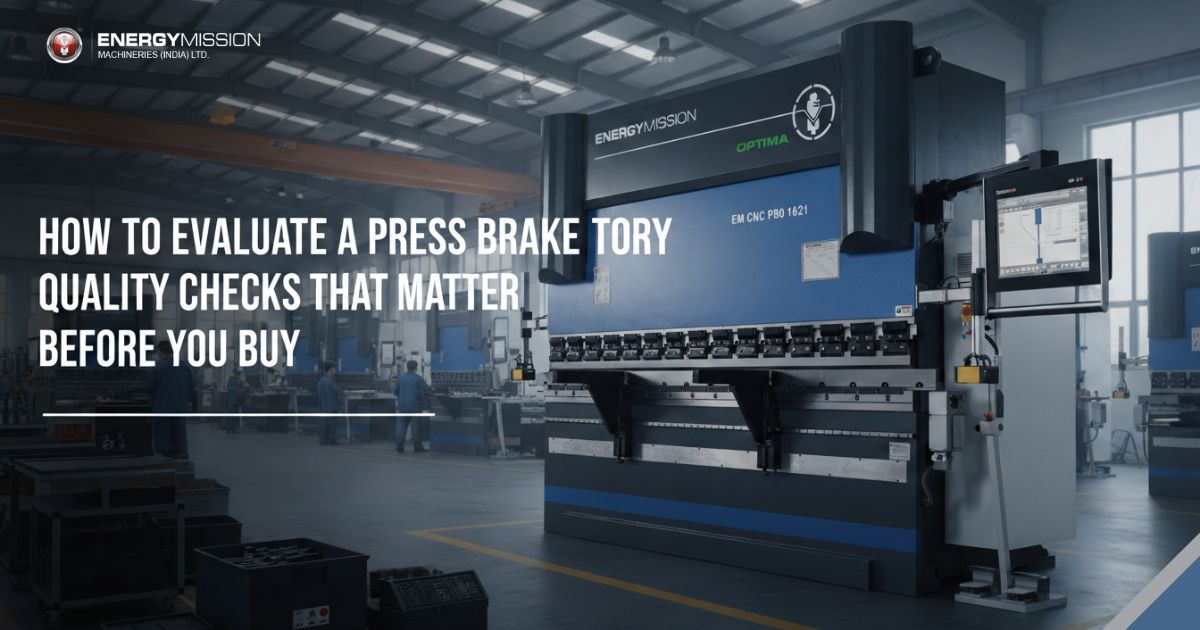
Buying a press brake machine is a significant investment, and choosing the wrong factory can lead to costly downtime, poor bending accuracy, and frustrating service gaps. Many buyers focus only on price and specifications, but overlook the factory’s actual manufacturing standards and quality control processes. Before you commit to a supplier, understanding how to evaluate a CNC press brake machine manufacturer ensures you get a reliable, high-performance machine that delivers consistent results for years. This guide walks you through the critical quality checks that separate professional manufacturers from low-quality assemblers.
Why Choosing the Right Press Brake Factory is a Big Deal
The quality of your press brake directly impacts your production accuracy, operator safety, and overall manufacturing speed. A well-built machine from a reputable press brake machine manufacturer maintains tight tolerances, reduces setup time, and minimises maintenance costs. On the other hand, poorly manufactured equipment leads to frequent breakdowns, inconsistent bending angles, and costly repairs that drain your budget.
When you partner with a factory that prioritises engineering excellence and rigorous testing, you gain access to machines built with precision-machined components, robust hydraulic systems, and reliable control systems. This translates to fewer production delays and higher customer satisfaction.
Manufacturer vs Supplier vs Trader (Quick Buyer Clarity)
Understanding the difference between a manufacturer, supplier, and trader is crucial. A CNC press brake machine manufacturer designs, fabricates, and assembles machines in its own facility with direct control over quality. Suppliers may source from multiple factories and rebrand equipment, while traders simply buy and resell without any manufacturing involvement.
Working directly with a real manufacturer offers better customisation options, faster technical support, and transparent quality documentation. You also get direct access to engineering teams who understand every component and can troubleshoot issues quickly.
12 Quality Checks to Evaluate a CNC Press Brake Factory
1) Factory Setup & In-House Production Capability
Visit or request detailed factory videos showing actual production areas, including welding bays, CNC machining centres, assembly lines, and painting booths. A genuine factory owns equipment for frame fabrication, precision machining, hydraulic assembly, and final testing. Avoid factories that only perform assembly with outsourced components, as they lack control over core quality.
2) Frame Material Quality & Stress Relief Process
The machine frame is the foundation of bending accuracy. Check if the factory uses heavy-duty steel (typically Q345 or equivalent) and performs stress relief through heat treatment or vibration ageing. This process eliminates internal stresses that cause frame deformation over time. Request material certificates and ask about the stress relief method used.
3) Machining Accuracy & Alignment Testing
Precision machining of the bed, ram, and side frames determines long-term accuracy. The factory should use large CNC milling machines or planers to achieve flatness and parallelism within 0.02mm per meter. Ask for machining tolerance reports and alignment test data performed after assembly.
4) Hydraulic System Component Standards
Quality hydraulic components directly affect machine reliability. Check whether the factory uses branded pumps (like Rexroth, Bosch, or equivalent), proportional valves, and high-grade seals. Poor hydraulic parts cause oil leaks, pressure drops, and inconsistent ram speed. Request component brand lists and system pressure test reports.
5) CNC Controller Options & Compatibility
Different control systems suit different production needs. Factories offering multiple controller options (such as Delem, ESA, Cybelec, or their own reliable systems) show flexibility and technical capability. Ensure the controller supports your programming requirements, has intuitive software, and includes features like automatic angle correction and crowning compensation.
6) Backgauge Build Quality & Repeatability
The backgauge system positions material accurately for each bend. Check if it uses ball screws or belt drives, encoder feedback systems, and solid construction. Test repeatability by asking for positioning accuracy specifications (typically ±0.01mm for quality machines). A poorly built backgauge slows production and causes dimensional errors.
7) Crowning System (Manual / CNC)
Long workpieces bend with a curve in the middle due to beam deflection. A crowning system compensates for this by creating a convex shape in the lower beam. Quality factories offer either manual wedge-type or CNC-controlled hydraulic crowning. This feature is essential for achieving uniform angles across the entire bend length, especially on machines with bending lengths over 2 meters.
If you’re considering different machine series, options like the Optima Series CNC Press Brake Machine or Splendid Series CNC Press Brake Machine often come with advanced crowning systems built for precision work.
8) Electrical Wiring & Safety Standards
Inspect electrical cabinet organisation, wire labelling, and use of branded components (Schneider, Siemens, or equivalent). The machine should include emergency stop buttons, light curtains or laser guards, foot pedal interlocks, and overload protection circuits. Poor wiring causes electrical failures and safety hazards.
9) Tooling Support & Standard Compatibility
Verify that the machine accepts standard tooling (like European or American standards) and check whether the factory provides or supports custom tooling fabrication. Some manufacturers offer proprietary tooling that locks you into expensive purchases. Compatibility with common punch and die standards gives you flexibility and cost control.
For machines with specific tooling needs, models such as the Efficient Series CNC Press Brake Machine are designed with versatile tool holders.
10) Trial Run & Bending Test Before Dispatch
A professional factory performs test bends using actual tooling before shipping. Request test bend samples with measured angles and dimensions. This proves the machine meets specifications and identifies potential issues before delivery. Factories that skip testing are gambling with your investment.
11) Quality Documentation & Inspection Reports
Ask for complete quality control documentation, including material certificates, machining reports, hydraulic pressure test results, electrical safety checks, and final inspection checklists. These documents demonstrate systematic quality control and provide reference data for future maintenance.
12) After-Sales Service, Spares & Training Support
Evaluate the factory’s commitment to post-purchase support. Do they offer installation assistance, operator training, remote troubleshooting, and readily available spare parts? A manufacturer with global service networks or strong technical teams ensures minimal downtime when issues arise.
For businesses needing specialised configurations, options like the Tandem CNC Press Brake Machine or Magnum CNC Press Brake Machine come with comprehensive support packages.
Questions You Should Ask Before Finalising the Manufacturer
Before signing any purchase order, clarify these critical points:
What is the production lead time from order confirmation to delivery? Can the factory provide references from customers in similar industries? What warranty coverage is included, and what does it actually cover? Will they send technicians for installation and commissioning? Is operator training included, and for how many people? How quickly can they ship spare parts, and what is the parts availability guarantee?
These questions reveal the factory’s operational capacity and customer service philosophy. If you’re comparing different manufacturers, understanding these differences helps, much like knowing the key differences between suppliers and manufacturers.
Red Flags That Indicate a Low-Quality Press Brake Factory
Be cautious of factories that refuse to provide testing videos or live factory tours. Missing quality control reports or vague specifications suggest poor manufacturing standards. Lack of spare parts inventory means you’ll face long delays during breakdowns. Some traders falsely claim to be manufacturers, so verify production capability through video calls or physical visits.
Other warning signs include extremely low prices that seem too good to be true, reluctance to provide customer references, no technical documentation in English or your language, and absence of international certifications like CE or ISO.
For those considering simpler hydraulic models, options such as the NC Front Cylinder Press Brake Machine, NC Rear Cylinder Press Brake Machine, or Hydraulic Press Brake Machine still require the same quality verification steps.
Why Energy Mission is a Trusted CNC Press Brake Machine Manufacturer
Energy Mission has built a reputation on quality-first manufacturing and transparent production processes. Every machine undergoes rigorous factory testing with documented bending trials before dispatch. The company maintains in-house machining, welding, and assembly facilities, ensuring direct quality control over every component.
Global customers rely on Energy Mission for reliable production machines backed by comprehensive technical support and readily available spare parts. Whether you need standard models or custom configurations, the factory team provides engineering consultation to match machines with your specific bending requirements.
Final Checklist (Quick Summary for Buyers)
Before making your final decision, verify the following: In-house production facility with machining and welding capability, stress-relieved frames with material certificates, precision machining tolerance reports for critical surfaces, branded hydraulic and electrical components, multiple CNC controller options, accurate backgauge with repeatability specs, functional crowning system for uniform bending, complete safety features and certifications, standard tooling compatibility, pre-dispatch bending test samples, full quality documentation package, strong after-sales support with spare parts availability.
FAQs
How do I verify a CNC press brake machine manufacturer?
Request a factory video tour showing production areas, ask for customer references you can contact directly, verify business licenses and certifications, and check if they have a physical factory address. A genuine manufacturer will readily provide this information and may even invite you for an in-person visit.
What quality checks matter most in a press brake machine?
Frame stress relief, machining accuracy, hydraulic component quality, and pre-dispatch testing are the top priorities. These factors determine long-term reliability, bending precision, and overall machine lifespan. Without these checks, you risk buying equipment that fails prematurely.
What documents should a manufacturer provide before dispatch?
Expect material certificates, machining tolerance reports, hydraulic pressure test results, electrical safety inspection sheets, calibration reports for CNC systems, test bend samples with measurements, user manuals, and warranty documentation. Complete documentation protects your investment and supports future maintenance.
Is factory testing necessary before buying a press brake machine?
Absolutely. Factory testing verifies that the machine meets specifications and identifies problems before shipping. Test bends prove actual performance rather than relying on paper specifications. Skipping this step often leads to expensive corrections after delivery.
Make the Right Choice with Confidence
Evaluating a press brake factory requires careful attention to manufacturing processes, quality control systems, and post-purchase support. By following these quality checks and asking the right questions, you protect your investment and ensure reliable production equipment.
Don’t settle for vague promises or incomplete information. Partner with a manufacturer that demonstrates quality through transparent processes and proven results. Contact Energy Mission for detailed consultation, factory testing reports, or to schedule a demonstration of our manufacturing capabilities.