
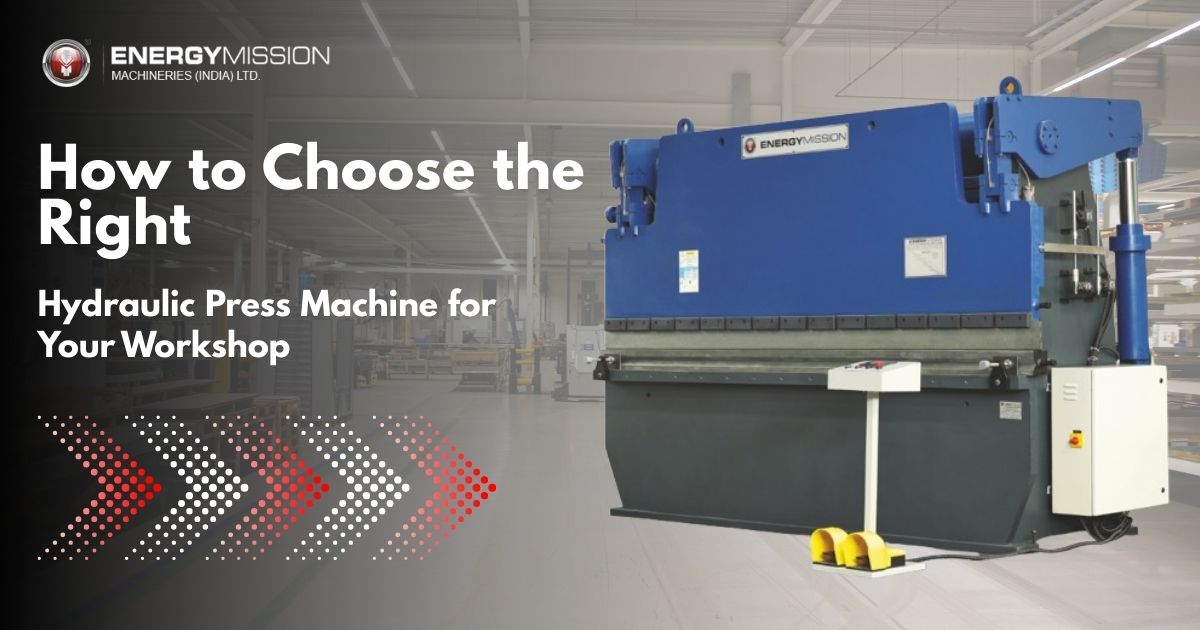
Every serious metal fabrication workshop reaches a point where manual bending and forming operations can no longer keep up with production demands. At that point, the decision to invest in a hydraulic press machine becomes not just logical it becomes necessary for survival in a competitive manufacturing market.
But the term “hydraulic press machine” covers a wide category of equipment. Choosing the right configuration the right tonnage, the right type, the right control system requires a clear understanding of your production requirements, your material, and what the machine actually needs to do in your workshop every day.
This guide walks you through everything you need to know before purchasing a hydraulic press machine with specific focus on the PBR Press Brake Machine category that is most relevant for sheet metal bending operations.
EnergyMission manufactures a complete range of hydraulic press brake machines designed for Indian fabrication conditions. This guide is based on real application experience not theoretical specifications.
What is a Hydraulic Press Machine?
A hydraulic press machine is an industrial machine that uses a hydraulic system pump, cylinders, valves, and fluid to generate and apply controlled force to a workpiece. The hydraulic system converts motor power into linear force, which is applied through a ram or beam to perform forming, bending, punching, pressing, or straightening operations on metal.
The core advantage of a hydraulic system over mechanical alternatives is controllability. A hydraulic press machine can:
- Apply full tonnage at any point in the stroke
- Hold pressure at a fixed position for forming or clinching operations
- Adjust speed at different points in the cycle fast approach, slow press, fast return
- Apply force in precise, programmable increments
- Stop instantly with no flywheel energy to dissipate
These characteristics make the hydraulic press machine the preferred choice for sheet metal bending, plate forming, deep drawing, straightening, and assembly pressing operations across industries.
Types of Hydraulic Press Machines Used in Metal Fabrication
Before evaluating specifications, it is important to understand the main types of hydraulic press machines used in fabrication workshops and which type matches which application.
1. Hydraulic Press Brake (PBR Press Brake Machine)
The PBR Press Brake Machine is the most common type of hydraulic press machine found in sheet metal fabrication workshops. PBR stands for Press Brake a machine specifically designed for bending sheet metal and plate using a punch and die set.
In a PBR Press Brake Machine, the hydraulic system drives the upper beam (carrying the punch) downward into the lower beam (carrying the die), bending the sheet metal to a programmed angle. The machine is designed specifically for bending with a long, narrow working area, precision back gauge for sheet positioning, and a control system that manages bend angle, back gauge position, and bending speed.
Key applications of a PBR Press Brake Machine:
- Sheet metal enclosures, panels, and cabinets
- Structural brackets and frames
- Automotive body components and brackets
- Electrical switchgear panels and bus ducts
- HVAC ducting and cladding components
- Agricultural equipment parts and chassis sections
EnergyMission’s press brake range covers the full spectrum from entry-level NC machines to advanced CNC Synchro systems all in the PBR Press Brake Machine category.
2. Hydraulic H-Frame Press
The hydraulic H-frame press is a general-purpose pressing machine with a vertical cylinder mounted in a rigid H-shaped frame. It is used for straightening, punching, pressing bearings, and assembly operations not for sheet metal bending. If your requirement is bending sheet metal into angles and profiles, an H-frame press is the wrong machine.
3. Hydraulic C-Frame Press
The C-frame press has an open-sided frame that allows easy access to the working area from three sides. It is used for blanking, punching, and forming operations on smaller workpieces. Again, not a bending machine a dedicated PBR Press Brake Machine is the correct choice for sheet metal bending.
4. Hydraulic Deep Drawing Press
Designed specifically for forming sheet metal into cups, shells, and three-dimensional forms by drawing the sheet into a die cavity. This is a specialized operation distinct from bending and requires a dedicated machine type.
The takeaway: If your primary requirement is bending sheet metal into angles, channels, and profiles you need a hydraulic press machine in the PBR Press Brake Machine configuration specifically. This is the most widely used hydraulic press machine type in Indian fabrication workshops.
How a PBR Press Brake Machine Works
Understanding the working principle helps you ask better questions when evaluating machines and ensures you specify the right configuration.
In a PBR Press Brake Machine, the working cycle follows this sequence:
Ram Descent: The hydraulic system drives the upper beam (ram) downward at fast approach speed until the punch contacts the sheet metal.
Bending Stroke: As the punch contacts the material, the system switches to slow pressing speed. The punch presses into the die opening, bending the sheet metal to the programmed angle. The angle is determined by how deep the punch travels into the die controlled by the Y-axis setting on the NC or CNC controller.
Dwell (if required): On some materials and tooling setups, the machine holds pressure at the bottom of the stroke to allow springback compensation.
Return Stroke: The ram returns to the open position at fast speed. The operator repositions the sheet for the next bend or removes the finished part.
Back Gauge Positioning: Throughout this cycle, the back gauge is positioned at the programmed X-axis dimension determining the flange length of each bend. On NC machines, the operator sets this value numerically. On CNC machines, the back gauge positions automatically as part of the stored bending program.
This controlled, repeatable cycle is what makes a hydraulic press machine in the press brake configuration so much more productive than manual bending methods.
7 Factors to Consider When Choosing a Hydraulic Press Machine
1. Tonnage — Match the Force to Your Material
Tonnage is the bending force the machine generates. Getting this right is the most critical specification decision.
The standard calculation: Tonnage = (1.42 × L × T²) / V
Where L = bending length in meters, T = material thickness in mm, V = die opening in mm.
Always add a 20–25% safety margin. Under-specifying tonnage is the most expensive buying mistake it limits your material range and puts the machine under constant stress, leading to early wear and hydraulic system failures.
Practical tonnage guide:
- 3mm mild steel, 2000mm length → 80–100 Tonne
- 6mm mild steel, 2500mm length → 200–250 Tonne
- 10mm mild steel, 3200mm length → 350–400 Tonne
- 12mm stainless steel, 2500mm length → 400–500 Tonne
2. Bending Length — Always Specify Your Widest Part
The bending length of the PBR Press Brake Machine must be at least 200–300mm longer than your widest workpiece. This clearance accommodates tooling installation and safe material handling.
Standard bending lengths range from 1600mm to 6000mm. If most of your work is under 2000mm wide, a 2500mm machine gives adequate capacity without unnecessary cost and floor space requirements.
3. Control System — NC vs CNC
The control system determines how the machine is programmed and operated.
NC (Numerical Control): The operator inputs bend parameters individually ram depth, back gauge position, speed. Suitable for standard fabrication work with moderate complexity. Lower cost, simpler operation. EnergyMission’s Prudent Series uses reliable NC controllers well-suited for Indian fabrication environments.
CNC (Computer Numerical Control): Stores complete multi-bend programs, runs automatic sequences, offers graphical programming and 3D visualization on advanced controllers. Suitable for complex parts, high volumes, and tight tolerances. EnergyMission’s Optima Series delivers CNC-level performance with an intuitive controller interface.
Choosing between NC and CNC:
- Low to medium volume, standard bends, tight budget → NC
- High volume, complex multi-bend parts, tight tolerances → CNC
4. Back Gauge Configuration
The back gauge positions the sheet metal before each bend. Key specifications:
- Travel range: 50mm to 700mm minimum for general work
- Positioning accuracy: ±0.1mm for NC; ±0.02mm for servo CNC
- Drive type: Ball screw with servo motor gives better accuracy and longer service life
- Axis count: X-axis (in/out) is standard; R-axis (height), Z-axis (left/right), and X’ axis are available on advanced configurations for complex bending
5. Hydraulic System Quality
The hydraulic system is the heart of a hydraulic press machine. Quality components pump, valves, cylinders, seals determine accuracy, reliability, and service life.
Check:
- What brand of hydraulic pump and valves is used?
- Are seals European-grade or standard?
- Is the hydraulic circuit designed for low heat generation?
- What is the hydraulic oil capacity and recommended change interval?
Poor-quality hydraulic components lead to oil leaks, pressure fluctuations, inconsistent bend angles, and premature system failure.
6. Frame Construction & Rigidity
The machine frame carries all bending forces on every single stroke for the entire service life of the machine. Frame rigidity directly determines long-term accuracy.
Look for:
- Heavy welded steel construction
- Stress-relief heat treatment after welding
- Precision-machined cylinder mounting surfaces
- Quality linear guides for the ram
A flexing frame loses parallelism over time resulting in tapered bends, inconsistent angles, and premature tooling wear.
7. After-Sales Support & Spare Parts
A hydraulic press machine is a long-term production asset. At some point it will need service hydraulic seals, controller components, back gauge parts, tooling. The speed and reliability of after-sales support determines your total cost of ownership over the machine’s life.
Before buying from any manufacturer or supplier, confirm:
- Are service engineers available in your region?
- What is the typical response time for a service call?
- Are hydraulic seals and back gauge components available from local stock?
- Is an Annual Maintenance Contract (AMC) available?
EnergyMission operates a pan-India service network with dedicated engineers and stocked spare parts across major industrial cities ensuring fast response and minimal downtime for customers.
EnergyMission’s Hydraulic Press Machine Range for Indian Fabricators
EnergyMission manufactures a complete range of PBR Press Brake Machines and hydraulic press machines designed and built for Indian manufacturing conditions, handling heat, dust, voltage variations, and the demand for minimal maintenance.
Prudent Series — Reliable NC Performance at a Practical Price
The Prudent Series is EnergyMission’s entry-to-mid range PBR Press Brake Machine built for fabricators who need consistent, accurate NC bending without the complexity or cost of a full CNC system.
Key features:
- Robust welded steel frame with precision-machined surfaces
- Reliable hydraulic system with quality European-spec components
- Standard NC controller with digital back gauge positioning
- Available in tonnage range from 40T to 400T
- Bending lengths from 1600mm to 4000mm
Best for: Small to mid-scale fabrication shops, general sheet metal work, workshops upgrading from manual press brakes, fabricators with straightforward bending requirements.
Optima Series — Production-Grade Accuracy for Demanding Applications
The Optima Series steps up to higher build quality, more precise hydraulic control, and a more capable controller designed for fabricators running production shifts who require consistent accuracy over years of heavy use.
Key features:
- Heavy-duty frame construction with superior rigidity
- High-precision hydraulic system for consistent bend angles
- Advanced NC/CNC controller with program storage and recall
- Servo-driven back gauge with ball screw for ±0.1mm positioning accuracy
- Options for CNC Synchro control on higher specifications
Best for: Production fabricators, OEM component suppliers, job shops running multiple shifts, fabricators supplying to automotive, electrical, or defence industries with tight dimensional requirements.
Get the Right Machine for Your Application
Choosing the right hydraulic press machine, whether you need a standard PBR Press Brake Machine for general work or a high-precision CNC system for production bending, starts with a clear understanding of your material, thickness, bending length, and production volume.
EnergyMission’s technical team will assess your exact requirements and recommend the right machine from our range at the right specification and the right price for your application.
Browse Our Full Press Brake Machine Range
Visit Energymission or contact us directly for pricing, specifications, and a free application consultation.
Frequently Asked Questions (FAQ)
Q1. What is a PBR Press Brake Machine?
A PBR Press Brake Machine is a hydraulic press machine specifically designed for bending sheet metal and plate. PBR stands for Press Brake referring to the machine’s function of braking (bending) sheet metal using a punch and die set driven by a hydraulic system. It is the most widely used type of hydraulic press machine in sheet metal fabrication workshops.
Q2. What is the difference between a hydraulic press machine and a mechanical press?
A hydraulic press machine uses hydraulic cylinders to generate and apply force giving precise control over speed, pressure, and position throughout the stroke. A mechanical press uses a flywheel, crankshaft, and clutch mechanism delivering fast cycling but with less control over force application. Hydraulic machines are preferred for bending, forming, and deep drawing where controlled force and stroke position are critical.
Q3. How do I calculate the tonnage I need for my bending application?
Use the formula: Tonnage = (1.42 × L × T²) / V, where L = bending length in meters, T = material thickness in mm, and V = die opening in mm. Always add a 20–25% safety margin to the calculated value. EnergyMission’s technical team can perform this calculation for you based on your specific material grade, thickness, and bending length.
Q4. What is the difference between the Prudent and Optima series from EnergyMission?
The Prudent Series is EnergyMission’s practical NC press brake reliable, cost-effective, and suited for standard fabrication work. The Optima Series offers higher build quality, more precise hydraulic control, and a more capable controller designed for production fabricators requiring consistent accuracy across high-volume, multi-shift operations.
Q5. Can a hydraulic press brake machine handle stainless steel and aluminium?
Yes. A hydraulic press machine in the press brake configuration handles mild steel, stainless steel, aluminium, copper, brass, and other metals. Stainless steel and high-tensile materials require higher tonnage than mild steel at the same thickness. Always specify your material when requesting machine recommendations EnergyMission’s team will confirm the right tonnage for your material grade.
Q6. Does EnergyMission provide installation and training?
Yes. EnergyMission provides on-site installation, commissioning, and operator training for all machine deliveries across India. The technical team ensures the machine is correctly set up for your application and that your operators are fully trained before handover. Annual Maintenance Contracts (AMC) are also available for ongoing support.
Conclusion
A hydraulic press machine particularly in the PBR Press Brake Machine configuration is a long-term production investment. Getting the selection right from the start correct tonnage, appropriate bending length, right control system, quality hydraulic components, and reliable after-sales support determines your production efficiency and part quality for the next 10–15 years.
EnergyMission manufactures hydraulic press machines built for Indian industry with a complete range from the practical Prudent Series to the production-grade Optima Series all backed by in-house engineering, genuine spare parts, and a pan-India service network.