
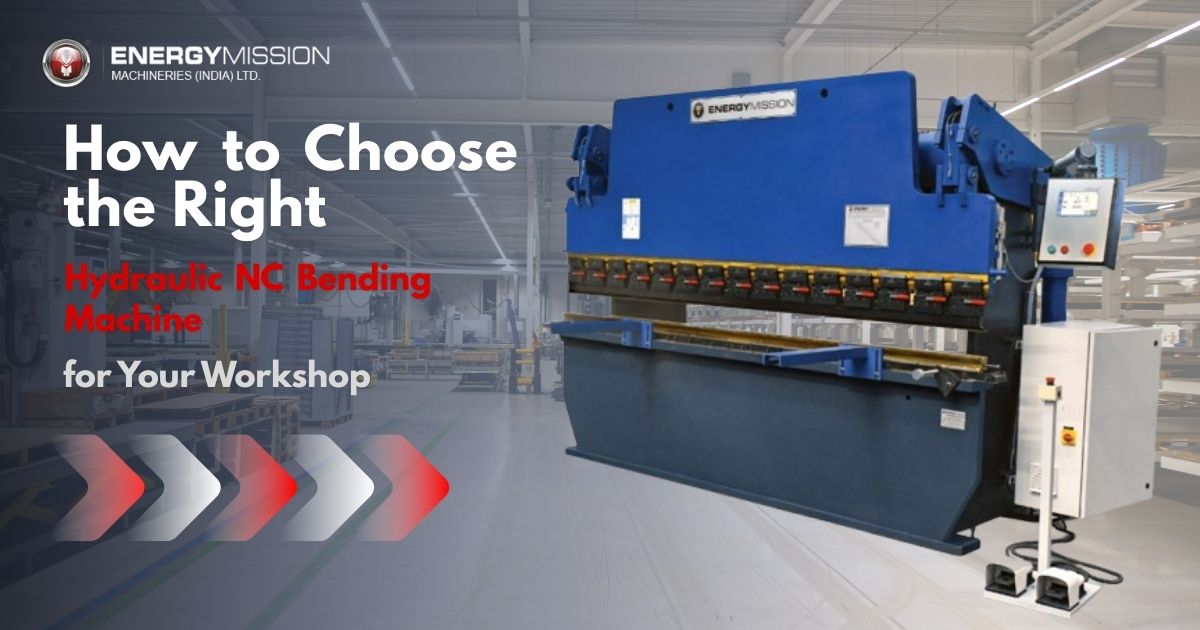
Buying a sheet metal bending machine is one of the most important capital investments a fabrication workshop makes. Get it right, and the machine pays for itself in production efficiency, part quality, and reduced scrap. Get it wrong, and you spend years working around a machine that does not fit your actual requirements.
This guide is written specifically for workshop owners, production managers, and procurement teams evaluating a Hydraulic NC Bending Machine for the first time or upgrading from an older machine. It covers how NC hydraulic bending machines work, what specifications matter, how to match the machine to your production profile, and what to look for in a manufacturer.
EnergyMission manufactures a complete range of press brake and sheet-bending machines for the Indian industry, from entry-level NC machines to full CNC Synchro systems. This guide draws on years of application experience across fabrication industries.
What is a Hydraulic NC Bending Machine?
A Hydraulic NC Bending Machine is a press brake machine that uses a hydraulic system to drive the upper beam (ram) downward onto a punch and die set, bending sheet metal to a programmed angle. The “NC” Numerical Control refers to the control system that manages key machine parameters: ram depth (bend angle), back gauge position (flange length), and bending speed.
Unlike manual press brakes where the operator sets everything by hand, an NC Hydraulic Sheet Bending Machine accepts numerical inputs from the operator depth, position, speed and executes them with consistent, repeatable accuracy on every stroke.
This combination of hydraulic power and numerical control makes these machines the backbone of sheet metal fabrication across industries in India and globally.
How is it Different from a CNC Press Brake?
A CNC press brake stores full multi-step bending programs, runs automatic sequences, and uses servo-driven axes for higher accuracy. An NC Hydraulic Sheet Bending Machine is simpler the operator sets parameters for each bend individually, and the machine executes them accurately. NC machines do not run automatic bend sequences, but they deliver reliable, repeatable results at a lower cost and with less operational complexity.
For most small to medium fabrication workshops, an NC Hydraulic Bending Machine is the most practical and cost-effective choice.
How Does an NC Hydraulic Sheet Bending Machine Work?
Understanding the working principle helps you ask the right questions when evaluating machines. Here is the operation sequence:
Step 1 — Parameter Input: The operator enters the required bend depth (Y-axis), back gauge position (X-axis), and bending speed into the NC controller. Modern NC controllers like the E21 display these values digitally and allow fine adjustments with immediate feedback.
Step 2 — Back Gauge Positioning: The back gauge moves automatically to the programmed X-axis position. The operator places the sheet metal against the back gauge fingers this sets the flange length accurately without manual measurement.
Step 3 — Bending Stroke: The operator activates the foot pedal. The hydraulic system drives the upper beam downward at the programmed speed. The punch contacts the sheet and bends it into the die opening to the programmed depth which determines the bend angle.
Step 4 — Return Stroke: The upper beam returns to its open position. The operator repositions the sheet for the next bend or removes the finished part.
Step 5 — Repeat: Because the back gauge and ram depth are set numerically, every subsequent piece bends identically without the operator manually checking or adjusting between parts.
This working principle is why an NC Hydraulic Sheet Bending Machine dramatically reduces scrap rates and part-to-part variation compared to a manual press brake.
7 Key Factors to Consider When Choosing a Sheet Metal Bending Machine
This is the core of the buying decision. Evaluate each factor carefully before selecting a machine.
1. Tonnage — Matching Force to Your Material
Tonnage is the bending force the machine applies. It must match your material thickness, tensile strength, and bending length. The standard calculation formula is:
Tonnage = (1.42 × L × T²) / V
Where L = bending length in meters, T = material thickness in mm, V = die opening in mm.
Always add a 20–25% safety margin to the calculated tonnage. Under-specifying tonnage is the most common buying mistake it limits your material thickness range and puts the machine under constant stress.
Practical guide:
- Up to 3mm mild steel, 2500mm length → 80–100 Tonne machine
- Up to 6mm mild steel, 2500mm length → 160–200 Tonne machine
- Up to 10mm mild steel, 3200mm length → 300–400 Tonne machine
2. Bending Length — Your Widest Part Determines the Machine
The bending length must be at least 200–300mm longer than your widest workpiece. This clearance allows for tooling installation, material handling, and safe operation.
Standard bending lengths for Hydraulic NC Bending Machines range from 1600mm to 4000mm. If most of your work is under 1500mm wide, a 2000mm or 2500mm machine gives you adequate capacity with lower cost and floor space requirements.
3. NC Controller — The Brain of the Machine
The NC controller determines how easy the machine is to set up and operate. Key things to check:
- Axis count: Basic machines offer Y-axis (ram depth) control only. A 2-axis NC machine adds X-axis (back gauge) control this is the minimum recommended configuration for production work
- Display type: Digital LED or LCD display with clear readout of all axis positions
- Parameter memory: Can the controller store at least basic job parameters for recurring work?
- Ease of use: Can an average operator learn the controller in one day?
Common NC controllers on Indian market machines include the E21, DA-41S, and similar entry-level systems. EnergyMission’s Prudent Series uses reliable NC controllers that balance functionality with ease of operation for the Indian fabrication environment.
4. Back Gauge Configuration — Accuracy of Flange Length
The back gauge is what positions the sheet before each bend. On a basic sheet metal bending machine, the back gauge is manually set. On an NC Hydraulic Sheet Bending Machine, the back gauge moves to the programmed position automatically.
Key back gauge specifications:
- X-axis travel range: Minimum 50mm to 500mm; better machines go to 700mm or 800mm
- Positioning accuracy: ±0.1mm or better
- Back gauge fingers: Should be adjustable in height and lateral position
- Drive type: Ball screw with stepper or servo motor gives better accuracy and longer life than rack-and-pinion drives
5. Open Height & Stroke — Clearance for Your Tooling
Open height is the distance between the bottom of the upper beam and the top of the lower beam when the machine is fully open. Stroke is how far the upper beam travels in each cycle.
If you work with deep box bending, tall punches, or special tooling, you need sufficient open height. Insufficient open height limits your tooling options and makes deep box work impossible or unsafe.
Standard open heights on NC machines range from 320mm to 450mm. Verify this against your tallest tooling setup before ordering.
6. Frame Rigidity & Build Quality
The machine frame carries all bending forces on every stroke for thousands of cycles per day, for years. Frame quality directly affects:
- Long-term accuracy a flexing frame loses parallelism over time
- Maintenance requirements poor welds crack, misaligned structures wear faster
- Safety a weak frame is a structural hazard at high tonnage
Look for: heavy welded steel construction, stress-relief heat treatment after welding, precision-machined mounting surfaces for the hydraulic cylinders and guides.
EnergyMission’s Optima Series is built on a heavy welded frame with precision-machined guide surfaces delivering long-term accuracy and low maintenance across demanding production shifts.
7. After-Sales Support & Spare Parts
This factor is consistently underestimated by buyers and consistently regretted afterward. A Hydraulic NC Bending Machine is a long-term production asset. At some point, it will need service: a hydraulic seal, a controller component, a back gauge motor.
When evaluating any sheet metal bending machine manufacturer or supplier, ask:
- Do you have service engineers in my state or region?
- What is your typical response time for a breakdown call?
- Are spare parts available from stock, or do they need to be imported?
- Do you offer Annual Maintenance Contracts (AMC)?
A machine from a manufacturer with poor after-sales support can sit idle for weeks waiting for a spare part costing far more in lost production than the price difference between suppliers.
NC Hydraulic Bending Machine vs Manual Press Brake: When to Upgrade
Many workshops start with a manual press brake and move to an NC Hydraulic Sheet Bending Machine as volumes and complexity grow. Here are the clear signals that it is time to upgrade:
- You are producing the same part in batches of 20+ pieces and spending significant time on setup and checking
- Scrap rates are high due to inconsistent operator performance between shifts
- You are losing jobs because customers require tighter dimensional tolerances than your manual machine can achieve
- Your operators are spending more time measuring and adjusting than actually bending
- You are turning away work that requires multiple bends with precise flange dimensions
If two or more of these describe your current situation, the productivity gain from an NC Hydraulic Bending Machine will typically deliver full payback within 12–24 months.
EnergyMission’s NC Hydraulic Sheet Bending Machine Range
EnergyMission offers two primary NC press brake series for fabricators looking for reliable, production-grade sheet metal bending machines:
Prudent Series — Practical NC Performance
The Prudent Series is EnergyMission’s answer for cost-conscious fabricators who need reliable NC-controlled bending without paying for features they do not need. Built with a robust hydraulic system, standard NC controller, and automatic back gauge, the Prudent delivers consistent bending accuracy for standard sheet metal work.
Best for: Small to mid-scale fabrication shops, general sheet metal work, workshops upgrading from manual press brakes for the first time.
Optima Series — Production-Grade Accuracy
The Optima steps up to higher build quality, more precise hydraulic control, and a more capable NC controller. It is designed for fabricators who run production shifts, require tighter tolerances, and need a machine that stays accurate over years of heavy use.
Best for: Production fabricators, OEM suppliers, job shops running multiple shifts, workshops requiring consistent quality across high volumes.
Both series are available in a range of tonnage and bending length configurations — and EnergyMission’s technical team will help you select the right specification for your exact application.
Get Expert Guidance Before You Buy
Choosing the right Hydraulic NC Bending Machine is a decision that affects your production for the next 10–15 years. EnergyMission’s technical team is available to assess your material, thickness, bending length, and production volume and recommend the exact machine specification that fits your workshop.
Browse Our Full Press Brake & Bending Machine Range
Visit Energy Mission or contact us directly for pricing, specifications, and a free application consultation.
Frequently Asked Questions (FAQ)
Q1. What is the difference between an NC and CNC hydraulic bending machine?
An NC Hydraulic Sheet Bending Machine uses numerical control where the operator sets individual bend parameters depth, back gauge position, speed for each bend separately. A CNC machine stores complete multi-bend programs, runs automatic sequences, and uses higher-accuracy servo-driven axes. NC machines are simpler, more affordable, and suitable for standard fabrication work. CNC machines are justified for complex parts, high volumes, and tight tolerances.
Q2. What sheet metal thickness can a hydraulic NC bending machine handle?
This depends on the machine’s tonnage rating and bending length. A 100-tonne Hydraulic NC Bending Machine with a 2500mm bending length typically handles up to 3–4mm mild steel. A 250-tonne machine handles up to 6–8mm. Always specify your material type and tensile strength stainless steel and high-strength steel require significantly higher tonnage than mild steel at the same thickness.
Q3. How accurate is an NC hydraulic sheet bending machine?
A well-built NC Hydraulic Sheet Bending Machine achieves back gauge positioning accuracy of ±0.1mm and ram depth repeatability of ±0.1mm. This is adequate for the vast majority of sheet metal fabrication work. For applications requiring tighter tolerances ±0.01mm a CNC Synchro press brake is more appropriate.
Q4. What is a 2-axis NC bending machine?
A 2-axis NC machine controls two axes: the Y-axis (ram depth, which determines bend angle) and the X-axis (back gauge position, which determines flange length). This is the standard minimum configuration recommended for production work on a sheet metal bending machine. Basic single-axis NC machines control only the ram depth, leaving back gauge positioning to the operator.
Q5. How long does it take to learn how to operate an NC bending machine?
An operator with basic sheet metal experience can learn the fundamentals of an NC Hydraulic Bending Machine in one to two days. EnergyMission provides on-site installation and operator training with every machine delivery ensuring your team is productive from day one.
Conclusion
Choosing the right sheet metal bending machine comes down to matching the machine’s capability to your actual production requirements not buying the cheapest option or over-specifying a machine you do not need.
Evaluate tonnage, bending length, NC controller capability, back gauge accuracy, frame quality, and after-sales support systematically and you will make a decision that serves your workshop well for over a decade.