
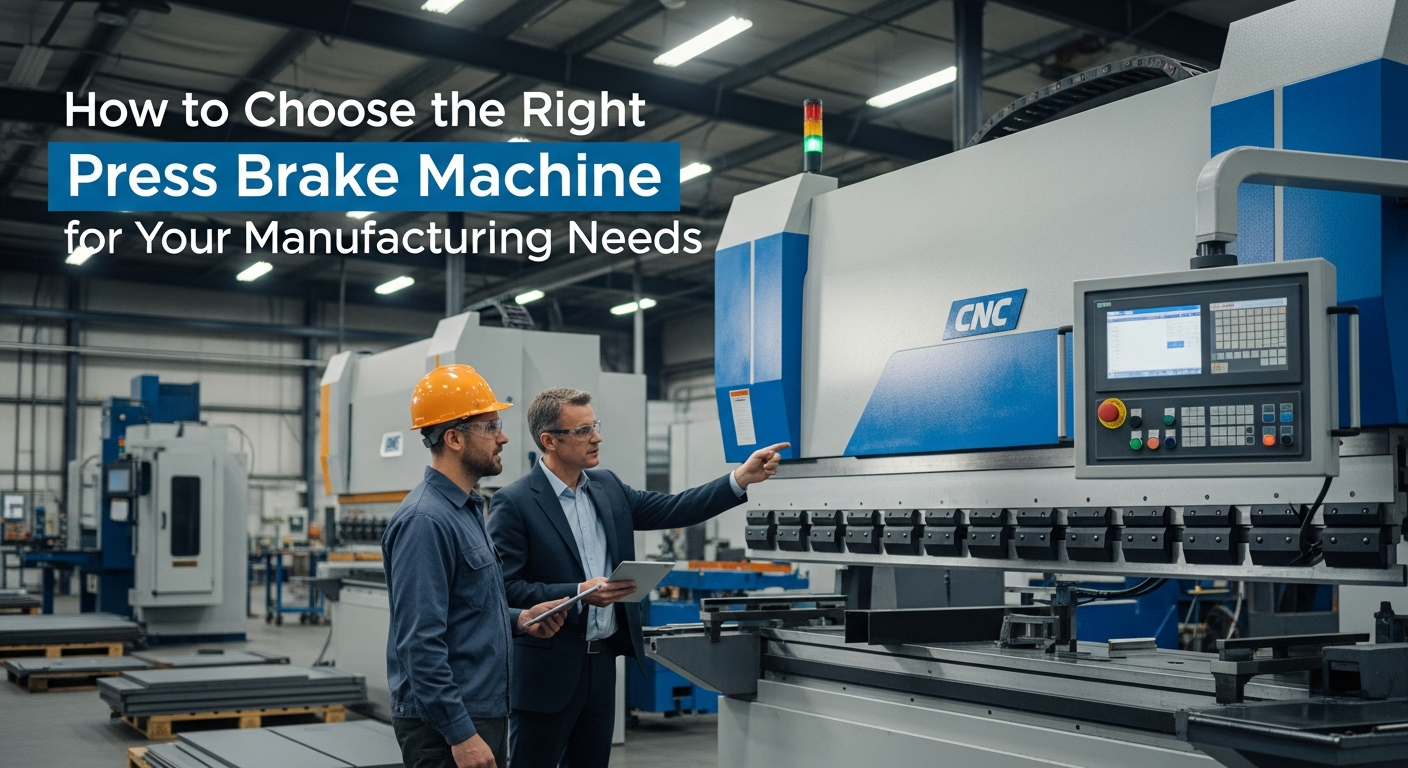
Selecting the right metal bending equipment represents a significant investment decision that impacts your facility’s productivity, product quality, and profitability for years to come. With numerous options available from various press brake manufacturers, understanding the critical selection criteria helps you make an informed choice that aligns with your specific operational requirements and business goals.
This comprehensive guide walks you through the essential factors to consider when purchasing a press brake machine, from calculating tonnage requirements to evaluating control systems and after-sales support.
Understanding Your Manufacturing Requirements
Before evaluating specific machines, take time to assess your current and future production needs. This foundational analysis prevents costly mistakes and ensures the equipment you purchase truly serves your business objectives.
Start by examining the types of parts you currently produce. Document the material types you work with most frequently, including mild steel, stainless steel, aluminum, and any specialty alloys. Record the thickness range of materials you bend, from the thinnest gauge to the heaviest plate. Measure the longest parts you typically handle, as this determines the working length you’ll need.
Review your production volume to determine whether you need a machine optimized for high-speed repetitive work or one that offers flexibility for varied job shop applications. Consider your typical batch sizes and changeover frequency between different parts. This information shapes decisions about control systems, tooling setups, and automation features.
Smart manufacturers look beyond current needs when investing in capital equipment. Consider your business growth projections for the next five to ten years. Purchasing a press brake with some capacity reserve provides room for growth without requiring another major investment soon. However, balance this against the reality that oversized equipment costs more to purchase and operate while potentially limiting accuracy on smaller parts.
Calculating Tonnage Requirements
Tonnage capacity represents the force the machine can apply to bend material. Selecting the correct tonnage ensures you can handle your thickest materials while avoiding the expense of excessive capacity.
Use this standard formula to calculate required tonnage: Tonnage = (Material Thickness² × Material Constant × Bend Length) / Die Width. The material thickness is measured in millimeters, and the bend length is the dimension along which you’re creating the bend.
Material constants vary by type: mild steel uses 1.35, stainless steel requires 2.0 due to higher yield strength, and aluminum needs only 0.8. The die width typically follows the rule of eight times material thickness for standard air bending applications.
Consider bending 4mm mild steel across a 2000mm length using a 32mm die opening. The calculation becomes: (4² × 1.35 × 2000) / 32 = 1,350 tons. This represents the theoretical minimum, but you should add a 20-30% safety margin, bringing the requirement to approximately 1,700-1,750 tons.
Real-world materials don’t always match published specifications. Material hardness can vary between suppliers and even between batches from the same source. Select a press brake machine with adequate capacity reserve to handle these variations without straining the equipment. Operating a machine near its maximum capacity continuously accelerates wear and reduces accuracy over time.
Working with a reputable press brake supplier like EnergyMission provides access to tonnage charts and calculation assistance that account for specific bending scenarios and material variations.
Determining Working Length
The working length defines the maximum dimension of parts you can bend. This specification directly impacts machine cost, so selecting the appropriate length requires careful analysis.
Review your part drawings to identify the longest bend dimension you currently produce. Add 200-300mm to this measurement to account for tooling setup and material positioning requirements. This buffer prevents situations where parts technically fit but prove impractical to produce due to fixturing constraints.
Press brake equipment comes in standard lengths, typically ranging from 1000mm for small shop applications up to 6000mm or more for structural fabrication. Common sizes include 1250mm, 1500mm, 2000mm, 2500mm, 3000mm, and 4000mm. Selecting the next size up from your calculated requirement provides operational flexibility.
Longer machines cost significantly more, not just for the initial purchase but also for installation, tooling, and ongoing operation. The frame and ram must be proportionally stronger to prevent deflection across the extended length, adding weight and expense.
Ready to find the perfect machine for your needs? Contact EnergyMission to discuss your specific production requirements with our technical specialists.
Evaluating Machine Types and Technologies
Different press brake machine types offer distinct advantages depending on your application requirements and operational priorities.
Hydraulic press brake machines dominate industrial applications due to their versatility and precise control. These systems use hydraulic cylinders to drive the ram, providing variable stroke adjustment that accommodates different material thicknesses without mechanical changes. The primary advantages include full tonnage available throughout the stroke, overload protection that prevents damage, and precise speed control for different bending phases.
Servo-electric machines represent the latest evolution in metal bending technology. These systems eliminate hydraulic components entirely, using servo motors and mechanical drives to move the ram. The result is exceptional energy efficiency, with typical savings of 50-70% compared to conventional hydraulic systems. Maintenance requirements drop significantly since there’s no hydraulic oil to change or seals to replace. Precision and repeatability exceed hydraulic systems, with positioning accuracy under 0.01mm achievable.
Mechanical systems use a flywheel and clutch mechanism to deliver bending force. These machines excel at high-speed repetitive work where the stroke length remains constant. They’re typically the most economical option for dedicated production applications but have limitations including fixed stroke length that reduces flexibility.
Control System Selection
The control system determines how you program, operate, and monitor your press brake machine. Matching the control capability to your application complexity prevents both overpaying for unused features and struggling with inadequate functionality.
Basic manual controls rely on operator skill and experience to set bend angles and positioning. NC (Numerical Control) systems add programmable back gauge positioning, allowing automatic material placement for multiple bends. The operator still controls bending parameters manually but benefits from consistent material positioning.
CNC (Computer Numerical Control) represents the standard for modern production environments. These systems control all machine functions through software, including ram position, bending speed, back gauge movement, and pressure application. Graphical programming interfaces simplify setup by showing 3D representations of the part and bending sequence. Operators can simulate the entire bending process before producing the first part, identifying potential collisions or sequence problems.
Advanced CNC systems include angle measurement and correction, automatically adjusting the ram position to compensate for springback and achieve the programmed angle. This capability dramatically reduces setup time and scrap while improving consistency.
Back Gauge and Positioning Systems
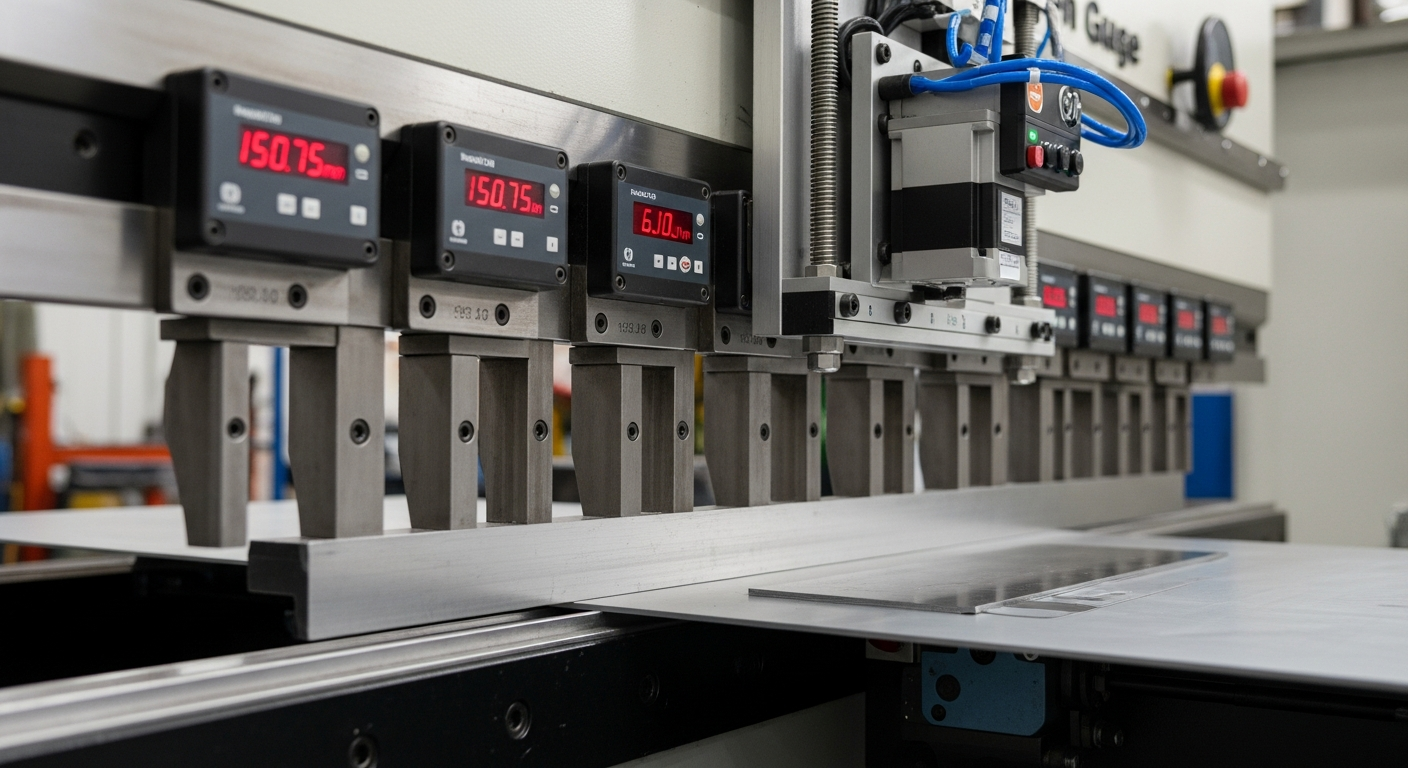
The back gauge positions material accurately before each bend, directly impacting productivity and part accuracy. Basic back gauges provide X-axis movement (toward and away from the tooling). More sophisticated systems add R-axis (up and down) and Z-axis (left and right) movement. Multi-axis capability allows positioning around previously formed bends and handling complex part geometries without manual repositioning.
Automatic back gauges move to programmed positions without operator intervention, improving consistency and reducing cycle time. For job shops handling varied work, the flexibility and speed of automatic positioning justifies the additional investment. Production facilities running similar parts continuously may find manual systems adequate, though automatic positioning still delivers value through reduced operator fatigue and improved consistency.
Safety Features and Compliance
Modern press brake equipment incorporates multiple safety systems to protect operators while maintaining productivity. Light curtains create an invisible barrier in front of the tooling. If anything breaks the light beam during the bending cycle, the machine stops immediately. This technology allows fast, efficient operation while preventing hand injuries.
Two-hand control stations require the operator to use both hands to initiate the bending cycle, keeping hands away from the danger zone. Emergency stop buttons must be easily accessible from all operator positions. The machine should stop immediately when activated and remain locked out until deliberately reset.
Even with comprehensive safety systems, proper operator training remains essential. Leading press brake manufacturers like EnergyMission provide thorough training programs covering both safe operation and productive techniques.
Evaluating Manufacturers and Suppliers
The manufacturer and supplier you choose impacts not just the machine you receive but your entire ownership experience. Research potential manufacturers’ history and reputation in the industry. How long have they been producing metal fabrication equipment? What’s their market presence and customer base?
EnergyMission brings extensive experience in metal fabrication equipment with a comprehensive product range covering various capacity and technology levels. This breadth ensures you’re selecting from proven designs rather than experimental offerings.
Consider the support infrastructure before making your purchase decision. Is technical support readily available when you need it? Can you reach knowledgeable personnel who understand your equipment and applications? How quickly can you obtain spare parts when needed? Downtime costs quickly exceed the price differences between suppliers, making reliable support a critical selection factor.
Comprehensive training programs get your operators productive quickly while establishing safe work practices from the start. Quality manufacturers provide training covering machine operation, programming, tooling selection, basic troubleshooting, and preventive maintenance.
Total Cost of Ownership Analysis
Purchase price represents only part of the total investment in metal bending equipment. Beyond the base machine price, factor in delivery and installation costs, initial tooling purchases, and any required facility preparation such as foundation work or electrical service upgrades.
Energy consumption varies significantly between machine types and technologies. Servo-electric systems use substantially less power than hydraulic equivalents, creating ongoing savings that accumulate over years of operation. Maintenance costs include routine items like hydraulic oil changes, filter replacements, and lubrication, plus eventual component replacements as parts wear.
More capable equipment often justifies higher initial cost through improved productivity and quality. Faster cycle times, reduced setup requirements, and better first-part accuracy all contribute to lower per-part costs and improved competitiveness.
Take the next step toward the perfect bending solution for your facility. Request a consultation with EnergyMission to discuss your specific requirements and receive personalized recommendations.
Frequently Asked Questions
1. What size press brake do I need for my shop?
Calculate the required tonnage using the formula: (Material Thickness² × Material Constant × Bend Length) / Die Width, then add 20-30% capacity reserve. For working length, measure your longest typical bend and add 200-300mm. A press brake machine that handles your thickest material at your longest bend length with appropriate reserve serves most shop requirements.
2. How much does a press brake machine cost?
Costs vary widely based on capacity, working length, and technology. Small manual machines start around $15,000-$20,000, while mid-range CNC hydraulic systems typically cost $50,000-$150,000. Large production machines with advanced automation can exceed $300,000. Contact EnergyMission for specific pricing based on your requirements.
3. Should I choose hydraulic or servo-electric technology?
Hydraulic systems offer proven reliability, lower initial cost, and adequate performance for most applications. Servo-electric technology provides superior energy efficiency (50-70% savings), minimal maintenance, cleaner operation, and better precision. Choose servo-electric if energy costs are significant and production volumes are high. Hydraulic remains the practical choice for budget-conscious purchases.
4. What maintenance does a press brake require?
Daily maintenance includes checking hydraulic fluid levels and inspecting tooling. Weekly tasks cover lubrication and hose inspection. Monthly maintenance verifies pressure settings and ram alignment. Annual service includes complete hydraulic system maintenance, precision measurements, and control system updates. Servo-electric machines eliminate hydraulic maintenance but still require lubrication and mechanical inspections.
5. How long does it take to learn press brake operation?
Basic operation skills develop within 1-2 weeks of training and practice for experienced metal fabricators. Programming proficiency takes 1-3 months depending on part complexity and controller sophistication. Quality training programs from manufacturers like EnergyMission accelerate this learning curve significantly.
Conclusion
Choosing the right press brake for your manufacturing facility requires careful analysis of your current needs, future growth plans, and operational priorities. Understanding tonnage calculations, working length requirements, control system options, and the differences between machine technologies allows you to make an informed decision that serves your business for years to come.
The selection process extends beyond machine specifications to include evaluation of press brake manufacturers and their support capabilities. Partnering with established suppliers who provide comprehensive training, responsive technical support, and readily available parts protects your investment and maximizes equipment uptime.
EnergyMission offers extensive experience helping manufacturers select optimal bending solutions for their applications, with a complete range of press brake equipment spanning various capacities and technologies backed by industry-leading support and training programs.
Request a detailed quotation for high-performance press brake equipment tailored to your specifications.