
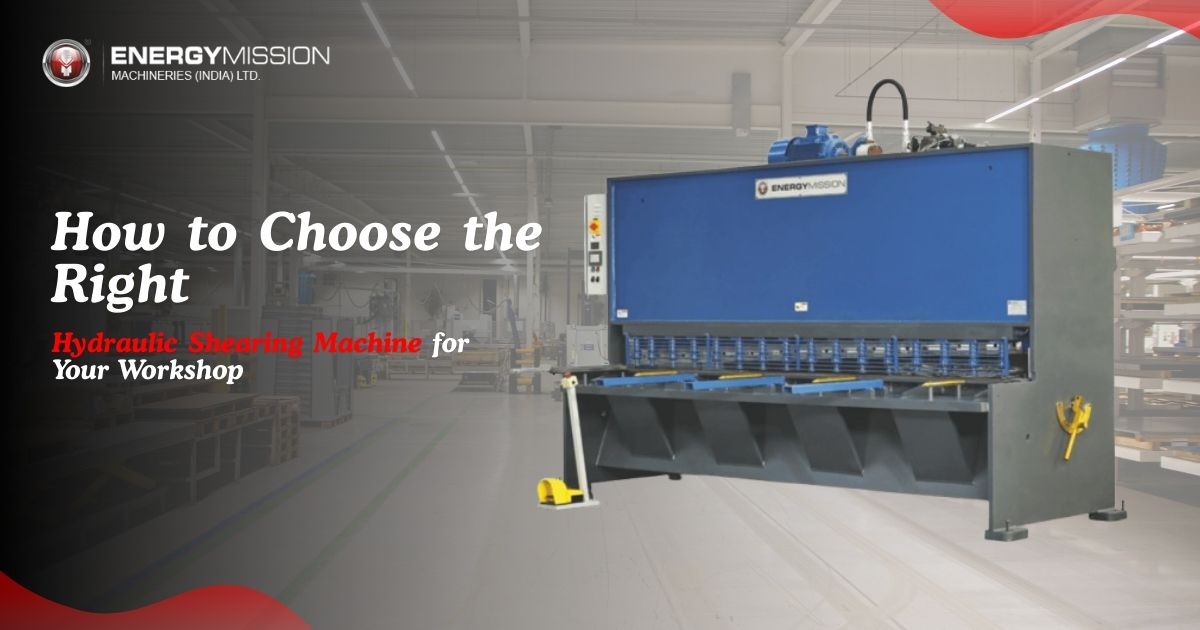
Cutting sheet metal accurately, cleanly, and consistently is a fundamental requirement in almost every metal fabrication operation. The machine responsible for this work is the hydraulic shearing machine, and choosing the right one for your workshop is a decision that affects your production quality, output speed, and operational cost for years to come. Workshops exploring different configurations can review the complete range of hydraulic shearing machines offered by manufacturers.
This guide is written for workshop owners, production engineers, and procurement teams evaluating a hydraulic shearing machine for the first time or replacing an existing machine. It covers the different types available, the specifications that matter, and the questions every buyer should ask before placing an order.
EnergyMission is a trusted hydraulic shearing machine manufacturer with a range of machines built specifically for the demands of Indian and international fabrication environments. This guide is based on real application experience not specifications from a brochure.
What is a Hydraulic Shearing Machine?
A hydraulic shearing machine is an industrial metal cutting machine that uses a hydraulic system to drive a moving blade downward against a fixed blade, shearing sheet metal along a straight line. Modern fabrication facilities often rely on advanced hydraulic shearing machine systems to achieve consistent cutting accuracy and production efficiency.
Unlike mechanical shearing machines that use a flywheel and clutch mechanism, a hydraulic guillotine shearing machine applies cutting force through hydraulic cylinders giving the operator precise control over blade gap, cutting angle, and hold-down pressure throughout the cut.
Key advantages of hydraulic over mechanical shearing:
- Adjustable blade gap for different material thicknesses
- Variable cutting angle (rake angle) for cleaner cuts on different materials
- Programmable back gauge for accurate, repeatable cut lengths
- Lower vibration and noise during operation
- Safer no flywheel energy to dissipate in an emergency stop
- Full cutting force available at any point in the stroke
These advantages make the hydraulic guillotine shearing machine the standard choice for any serious sheet metal cutting operation.
Types of Hydraulic Shearing Machines
Understanding the different types helps you match the right machine to your production requirements.
1. Hydraulic Guillotine Shearing Machine
The hydraulic guillotine shearing machine is the most widely used configuration in fabrication workshops. Many modern production facilities prefer CNC-controlled cutting solutions, such as CNC shearing machines, for higher precision and programmable cutting operations. In this design, the upper blade is mounted on a moving beam that travels vertically (or at a slight angle) to meet the fixed lower blade, similar to the action of a guillotine.
The guillotine design delivers clean, straight cuts with minimal material distortion. The blade gap and rake angle are both adjustable. The blade gap is set based on material thickness, and the rake angle is set based on material type and thickness to minimise the cutting force required.
Best For: General sheet metal cutting, standard mild steel and stainless steel sheets, fabrication shops with varied material thicknesses
A guillotine hydraulic shearing machine is the most practical all-round cutting machine for workshops processing sheet metal from 1mm to 20mm+ in thickness. EnergyMission’s guillotine shearing machines are designed for reliable, high-cycle operation in production environments across India.
2. Semi-Automatic Hydraulic Sheet Shearing Machine
A semi-automatic hydraulic sheet shearing machine adds automatic back gauge positioning to the standard hydraulic guillotine configuration. Workshops looking for digital control and repeatable cutting accuracy often upgrade to NC shearing machines that provide programmable back gauge positioning and improved production efficiency. In this setup:
- The operator inputs the required cut length into the NC controller
- The back gauge moves automatically to the programmed position
- The operator feeds the sheet against the back gauge fingers
- The operator activates the cutting cycle the machine shears and the back gauge repositions for the next cut
This semi-automatic operation dramatically reduces the time and effort required to produce batches of identically cut pieces. The operator does not need to manually measure and adjust the back gauge between cuts the machine handles positioning automatically.
Best For: Medium to high production volumes, batch cutting of identical lengths, workshops looking to reduce operator skill dependency and improve throughput consistency
The semi automatic hydraulic sheet shearing machine is the right upgrade path for workshops that have outgrown a basic manual or hydraulic machine and need faster, more consistent batch cutting without the cost of full automation.
3. HVR Hydraulic Shearing Machine
The HVR hydraulic shearing machine is a high-performance variant designed for demanding production environments where cutting speed, accuracy, and durability are all critical. HVR machines typically feature:
- Higher cutting speeds more strokes per minute for faster production
- Heavy-duty frame construction for long-term rigidity under high-cycle operation
- Advanced NC or CNC control with program storage and recall
- Precision ball screw back gauge with servo motor drive for high positioning accuracy
- Variable rake angle adjustment for optimized cutting across different materials
The HVR hydraulic shearing machine is suited for production facilities running multiple shifts, cutting a wide range of material thicknesses, and requiring machine uptime and accuracy that basic guillotine machines cannot deliver over the long term.
Best For: High-volume production facilities, steel service centers, OEM manufacturers, industries requiring fast cycle times and tight cut length tolerances
7 Key Factors to Consider When Choosing a Hydraulic Shearing Machine
Whether you are sourcing from a hydraulic shearing machine supplier or buying directly from a hydraulic shearing machine manufacturer, it is important to evaluate the machine specifications carefully before making a purchase. You can explore the complete range of hydraulic shearing machines available for different cutting capacities and applications, and evaluate these seven factors before making your decision.
1. Maximum Cutting Thickness & Width
This is the most fundamental specification. The machine must cut your thickest material across your full sheet width. Always specify your material mild steel, stainless steel, or aluminium as material tensile strength directly affects cutting force requirements.
Important: A machine rated at 6mm mild steel will cut approximately 4–5mm stainless steel and 8–10mm aluminium at the same cutting force. Always clarify material-specific capacity with the manufacturer.
2. Blade Gap Adjustment
The blade gap the clearance between the upper and lower blades must be set correctly for each material thickness. Too small a gap causes blade damage and poor cut quality. Too large a gap causes material burr and distortion.
On quality hydraulic guillotine shearing machines, the blade gap is adjustable via a handwheel or motorized system with a graduated scale. Check that the adjustment range covers your full thickness range and that the scale is clear and repeatable.
3. Rake Angle
The rake angle is the angle between the upper blade and the lower blade as viewed from the front. A higher rake angle reduces cutting force but increases material distortion on thin sheets. A lower rake angle gives cleaner cuts on thin material but requires more force on thick plates.
Better hydraulic shearing machines offer variable rake angle adjustment allowing the operator to optimize cut quality across different materials and thicknesses. This is a feature worth paying for if you cut a variety of materials regularly.
4. Back Gauge System
The back gauge determines cut length accuracy and production speed. Key specifications:
- Travel range: Standard is 20mm to 800mm; better machines go to 1000mm+
- Positioning accuracy: ±0.1mm for NC back gauges; ±0.02mm for servo-driven systems
- Drive type: Servo motor with ball screw gives better accuracy and longer life
- Control: NC digital readout minimum for production work
On a semi automatic hydraulic sheet shearing machine, the back gauge is the key productivity feature it must be accurate, fast, and reliable across millions of cycles.
5. Hold-Down System
The hold-down clamps the sheet against the cutting table before and during the cut, preventing movement. Insufficient hold-down force causes the sheet to lift during cutting resulting in inaccurate cuts and safety hazards.
Hydraulic hold-down systems that apply clamping force proportional to cutting force are the best design. Check that the hold-down fingers are evenly spaced across the full cutting width and that the system applies adequate force for your heaviest material.
6. Blade Material & Geometry
The cutting blades are wear items that need periodic replacement. Quality blades made from high-speed tool steel or tungsten carbide-tipped material last significantly longer than standard blades reducing downtime and long-term consumable costs.
Check: Is the blade design 4-sided (can be rotated for 4 cutting edges before replacement)? Are replacement blades readily available from the hydraulic shearing machine supplier? What is the typical blade life at your production volume?
7. After-Sales Service & Spare Parts Availability
A hydraulic shearing machine runs thousands of cycles per shift. Over time, hydraulic seals wear, blades need replacement, back gauge components require servicing. The availability of fast, reliable after-sales support determines how much production downtime you experience over the machine’s life.
Before buying from any hydraulic shearing machine manufacturer or supplier, ask:
- Do you have service engineers based in my region?
- What is your typical response time for a breakdown?
- Are hydraulic seals, blades, and back gauge components available from stock in India?
- Do you offer Annual Maintenance Contracts?
EnergyMission operates a pan-India service network with dedicated engineers and stocked spare parts minimizing machine downtime for customers across the country.
Hydraulic Guillotine vs Semi Automatic Shearing: Which is Right for You?
| Feature | Hydraulic Guillotine | Semi Automatic Hydraulic |
| Back Gauge | Manual setting | Automatic NC positioning |
| Batch Cutting Speed | Slower | Significantly faster |
| Operator Skill Required | Higher | Lower |
| Cut Length Consistency | Operator-dependent | Consistent ±0.1mm |
| Production Volume | Low to Medium | Medium to High |
| Setup Time | Longer | Shorter |
| Cost | Lower | Moderate |
Simple rule: If you cut varied lengths in small quantities with skilled operators a standard hydraulic guillotine shearing machine is sufficient. If you cut batches of identical lengths at medium to high volume a semi automatic hydraulic sheet shearing machine delivers better productivity and lower per-piece cost.
Secondary Buying Considerations
Beyond the seven primary factors, these additional points are worth checking:
Foot Pedal vs Hand Control: Most hydraulic shearing machines offer both foot pedal and hand button operation. Foot pedal operation keeps both hands free for sheet positioning important for large sheet handling.
Light Curtain Safety System: On production machines, a light curtain in front of the blade provides safety protection without slowing the operator down. Check whether this is standard or optional on your shortlisted machines.
Sheet Support Arms: Front support arms that fold down help the operator handle large sheets safely. Rear support arms catch the cut piece as it falls. Both are practical additions for larger format cutting.
Squaring Arm: A squaring arm on the front of the machine allows the operator to align the sheet square to the blade before cutting important for accurate rectangular blanks.
Why Choose EnergyMission as Your Hydraulic Shearing Machine Manufacturer?
EnergyMission has built a strong reputation as a reliable hydraulic shearing machine manufacturer delivering high-performance machines designed for demanding fabrication environments. Businesses looking for a wide selection of machines can explore the complete shearing machine product category to compare different models and configurations.
What sets EnergyMission apart:
- Complete Range: Hydraulic guillotine, semi-automatic, and HVR configurations across a full range of cutting thicknesses and widths
- In-House Engineering: All machines designed and built under one roof with strict quality control at every stage
- Heavy-Duty Construction: Robust welded steel frames with precision-ground blade mounting surfaces for long-term accuracy
- Reliable Hydraulic Systems: Quality hydraulic components with well-designed circuits for smooth, leak-free operation
- Pan-India Service: Dedicated service engineers in major industrial cities with stocked spare parts for fast response
- Application Support: Technical team helps you select the right machine for your material, thickness, width, and production volume
Talk to EnergyMission Before You Buy
The right hydraulic shearing machine is the one matched to your actual production requirements your material, your thickness, your sheet width, your daily cutting volume, and your operator setup.
EnergyMission’s technical team will assess your requirements and recommend the right machine from our range at the right specification and the right price.
Explore the complete range of hydraulic shearing machines including CNC, NC, and guillotine models designed for different fabrication requirements.
Contact us at EnergyMission for specifications, pricing, and a free application consultation today.
Frequently Asked Questions (FAQ)
Q1. What is the difference between a guillotine shearing machine and a swing beam shearing machine?
A hydraulic guillotine shearing machine moves the upper blade in a straight vertical path delivering clean, accurate cuts with minimal material distortion. A swing beam machine moves the blade in an arc which is mechanically simpler but causes slight distortion on the cut edge, particularly on thicker materials. For accurate, clean cutting in production environments, the guillotine design is the preferred choice.
Q2. What material thickness can a hydraulic shearing machine cut?
This depends on the machine’s tonnage and blade length. Standard hydraulic guillotine shearing machines cut mild steel from 1mm up to 20mm+ depending on the model. Always specify your material stainless steel and high-tensile materials require higher cutting force than mild steel at the same thickness. EnergyMission’s technical team can confirm exact capacity for your material grade.
Q3. How often do shearing machine blades need replacement?
Blade life depends on material type, thickness, cutting volume, and blade gap setting. In typical fabrication environments cutting mild steel, blades may last several months before requiring rotation or replacement. Using the correct blade gap setting for each material thickness is the single most important factor in extending blade life.
Q4. What is an HVR hydraulic shearing machine?
The HVR hydraulic shearing machine is a high-performance variant featuring faster cutting speeds, heavier frame construction, and advanced NC or CNC control. It is designed for high-volume production environments running multiple shifts where standard guillotine machines cannot deliver the required throughput and accuracy over sustained long-term operation.
Q5. What is a semi automatic hydraulic sheet shearing machine?
A semi automatic hydraulic sheet shearing machine adds automatic NC back gauge positioning to the standard hydraulic guillotine configuration. The back gauge moves to the programmed cut length automatically after each stroke allowing the operator to cut batches of identical lengths quickly and consistently without manually adjusting the back gauge between cuts.
Q6. Does EnergyMission supply hydraulic shearing machines outside India?
Yes. EnergyMission supplies hydraulic shearing machines to customers across South Asia, the Middle East, and Africa. Contact the sales team for export pricing, shipping arrangements, and after-sales support options available for international customers.
Conclusion
Choosing the right hydraulic shearing machine for your workshop requires a clear understanding of your material, cutting thickness, sheet width, production volume, and the level of automation that fits your operation.
Whether you need a standard hydraulic guillotine shearing machine for general fabrication, a semi automatic hydraulic sheet shearing machine for batch production efficiency, or an HVR hydraulic shearing machine for high-volume demanding applications the right choice exists in the market.