
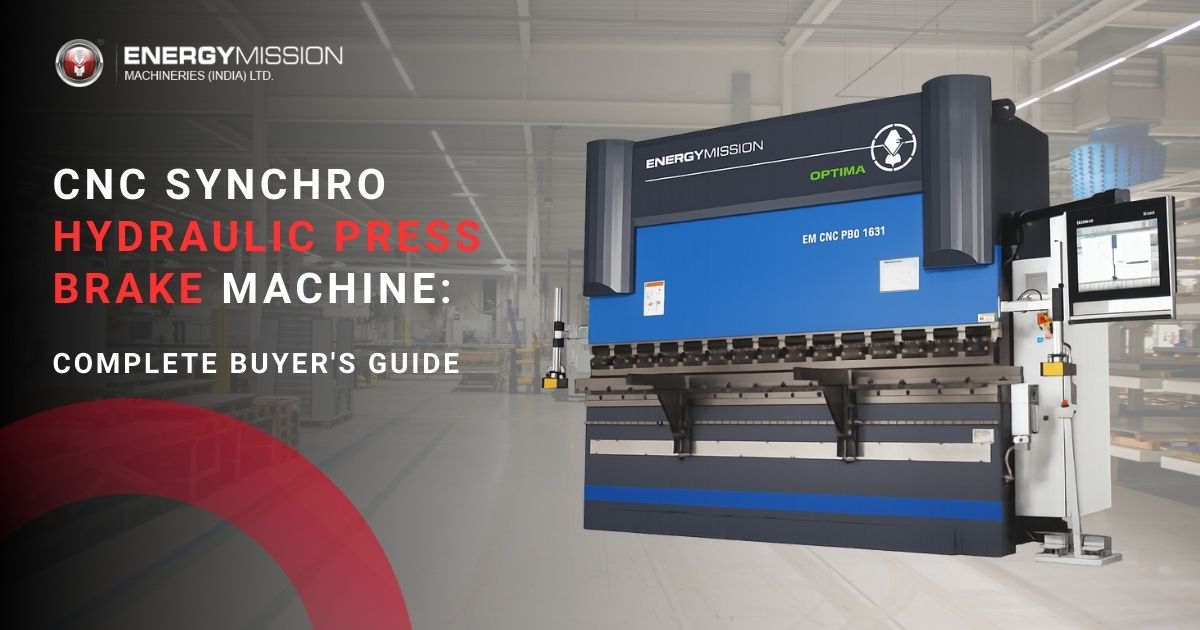
If you are in the metal fabrication, automotive, construction, or sheet metal industry, investing in the right bending machine is one of the most critical decisions you will make. A CNC Synchro Hydraulic Press Brake Machine is not just a machine it is the backbone of precision bending operations. Whether you are setting up a new plant or upgrading your existing equipment, this guide covers everything you need to know before making your purchase.
At EnergyMission, India’s trusted CNC Press Brake Manufacturer in India, we have helped hundreds of manufacturers select the right machine for their production requirements. This guide is written for buyers who want technical clarity, not sales jargon.
What is a CNC Synchro Hydraulic Press Brake Machine?
A CNC Synchro Press Brake Machine is a hydraulically operated bending machine where two cylinders one on the left and one on the right work in perfect synchronization. The term “Synchro” refers to this synchronized movement of both cylinders, controlled by an advanced CNC (Computer Numerical Control) system.
Unlike conventional press brakes where beam movement can be uneven, the synchro system uses linear encoders and a real-time feedback loop to maintain parallelism between the upper beam and the lower die throughout the full stroke. The result is consistent, repeatable, and highly accurate bends even on long workpieces.
Key Technical Components:
- Dual hydraulic cylinders with servo valve control
- Linear encoders on both sides for real-time position feedback
- CNC controller (DA-52, DA-66T, or Delem series)
- Upper ram (punch) and lower beam (die) with precision tooling
- Y1/Y2 axis for left-right synchronization, X-axis back gauge, R-axis crowning
Why Choose a CNC Synchro Press Brake Over a Conventional Press Brake?
Many buyers ask: why pay more for a CNC Synchro Hydraulic Press Brake when a simpler machine is available at a lower price? The answer lies in production demands, accuracy requirements, and long-term cost of operations.
1. Unmatched Bending Accuracy
The synchro system maintains a parallelism tolerance of ±0.01mm across the full beam length. For industries like aerospace, defence, and precision enclosures, this level of accuracy is non-negotiable. Standard torsion-bar machines simply cannot match this performance on longer bending lengths.
2. Faster Setup & Changeover
With a CNC controller, operators can save and recall bending programs instantly. Multiple bend sequences can be programmed in advance, reducing setup time from hours to minutes — directly impacting production output and machine utilisation.
3. Consistent Quality Across Shifts
Manual press brakes depend heavily on operator skill. A CNC Synchro Hydraulic Press Brake Machine delivers the same bend angle in the first piece as it does in the ten-thousandth piece, regardless of who is operating it. This consistency reduces rejection rates and material waste significantly.
4. Ideal for Complex & Long Parts
For workpieces that are 3 meters, 4 meters, or longer, the Synchro system is the only reliable choice. Synchronized cylinders prevent beam twist and ensure the punch enters the die evenly along the full length of the part.
While CNC synchro machines are preferred for high-precision bending, many fabrication shops still rely on solutions such as the NC Press Brake Rear Cylinder Machine and the NC Press Brake Front Cylinder Machine for cost-effective sheet metal bending where advanced CNC programming is not essential.
How to Choose the Right CNC Hydraulic Press Brake Machine: 7 Key Factors
Choosing a CNC Hydraulic Press Brake Machine is not just about picking a tonnage number. Here are the seven factors every buyer must evaluate:
1. Bending Force (Tonnage)
Tonnage depends on material thickness, tensile strength, and bending length. A general formula: Tonnage = (1.42 × L × T²) / V, where L = length in meters, T = thickness in mm, V = die opening in mm. Always add a 20–25% safety margin.
2. Bending Length
Standard lengths range from 1600mm to 6000mm. Choose a length at least 200–300mm longer than your largest workpiece to allow for tooling and material handling clearance.
3. Open Height & Stroke
Open height determines the maximum throat depth available between punch and die. If you work with deep boxes or profiles, ensure sufficient open height and stroke length for your tooling setup.
4. Back Gauge Configuration
The back gauge positions the sheet metal before bending. Standard machines offer X-axis back gauges. Advanced configurations include R-axis (height), Z1/Z2 (left-right movement), and X’ axis for complex multi-bend programs.
5. CNC Controller
The controller is the brain of the machine. Common options include Delem DA-52 (entry-level), DA-66T (mid-range with 3D graphics), and DA-69T (high-end with full offline programming). Choose based on programming complexity and operator skill level.
6. Crowning System
On longer bending lengths, the lower beam deflects under load. A hydraulic or mechanical crowning system compensates for this deflection and maintains a consistent bend angle along the full part length. It is essential for parts over 2 meters.
7. After-Sales Support & Spare Parts Availability
This is often the most overlooked factor. Always choose CNC press brake machine suppliers who have a dedicated service team, readily available spare parts, and a proven track record of long-term support.
EnergyMission’s CNC Press Brake Range: Built for the Indian Industry
As a leading CNC Press Brake Manufacturer in India, EnergyMission designs machines specifically for the demands of the Indian manufacturing environment. Here is a quick overview of the product range:
Optima Series — Precision for Production
The Optima series is designed for job shops and OEMs who need reliable, accurate bending day after day. Built with a robust welded steel frame, European-grade hydraulic components, and a Delem CNC controller, the Optima delivers production-grade performance at a practical price point. Ideal for 1–6mm mild steel and stainless steel fabrication.
Prudent Series — Smart Bending, Lower Cost
The Prudent series is EnergyMission’s answer for buyers seeking a capable CNC Synchro Press Brake Machine at a cost-conscious price. It does not cut corners on critical systems — the synchro mechanism, back gauge, and controller are all full-specification. A smart choice for mid-scale fabrication shops.
Magnum Series — Heavy-Duty Industrial Performance
The Magnum series is built for heavy industry. With tonnage options from 200T to 1000T and bending lengths up to 6000mm, the Magnum handles structural steel, heavy plates, and demanding bending applications. Among CNC hydraulic press brake machine suppliers in India, EnergyMission’s Magnum stands out for structural rigidity and low-maintenance design.
Splendid Series — Advanced Automation for High-Volume Plants
The Splendid series represents the top of EnergyMission’s range — featuring adaptive bending, advanced crowning, multi-axis back gauge, and integration-ready architecture for robotic tending. For high-volume production environments where consistency and throughput are paramount, the Splendid is the right choice.
Where is a CNC Synchro Hydraulic Press Brake Machine Used?
The versatility of a CNC Synchro Hydraulic Press Brake Machine makes it the preferred bending solution across a wide range of industries:
- Sheet Metal Fabrication: Enclosures, panels, cabinets, and covers
- Automotive: Body parts, brackets, frames, and structural components
- Construction: Steel sections, purlins, angles, and metal cladding
- Electrical: Switchgear panels, bus ducts, cable trays, and transformer parts
- Railways & Defence: High-strength structural bending with tight tolerances
- Agriculture: Equipment chassis, frames, and structural fabrication
Questions to Ask Your CNC Press Brake Machine Supplier Before Buying
Not all CNC press brake machine suppliers are equal. Before signing a purchase order, ask these questions:
- What is the warranty period on the hydraulic system, CNC controller, and mechanical structure?
- How quickly can you supply spare parts after the warranty period ends?
- Do you have a dedicated service engineer in my state or region?
- Can you provide references from existing customers in my industry?
- What is the lead time for machine delivery after order confirmation?
- Do you provide operator training at the time of installation?
Why EnergyMission is India’s Trusted CNC Press Brake Manufacturer
EnergyMission has built its reputation over years of consistent engineering, responsive service, and a deep understanding of what Indian manufacturers need. Here is what sets us apart as a CNC Press Brake Manufacturer in India:
- In-House Engineering: All critical components are designed and quality-checked in-house
- Pan-India Service Network: Dedicated service engineers across major industrial cities
- Proven Track Record: Hundreds of machines running across automotive, electrical, construction, and defence industries
- Application Support: Technical team helps you select the right tonnage, tooling, and configuration
- Genuine Spare Parts: Fast availability of all critical spare parts with no long wait times
- Transparent Pricing: No hidden costs
Ready to Invest in the Right Machine?
Talk to EnergyMission’s technical team today. Share your material thickness, bending length, and production requirement and we will recommend the right machine from our range.
Browse Our CNC Press Brake Range. Contact us for pricing, specifications & demo booking at EnergyMission
Frequently Asked Questions (FAQ)
Q1. What is the difference between a CNC press brake and a CNC Synchro press brake?
A standard CNC press brake uses a torsion bar or basic hydraulic system. A CNC Synchro Press Brake Machine uses two independent hydraulic cylinders with linear encoders and a real-time feedback loop to maintain precise synchronization. The Synchro system offers higher accuracy and is preferred for longer bending lengths.
Q2. What tonnage do I need for 6mm mild steel?
For 6mm mild steel with a standard die opening of 48mm, you typically need approximately 100 tonnes per meter of bending length. For a 2500mm part, a 250-tonne machine is the minimum recommendation. Always consult with your supplier to factor in material tensile strength and safety margins.
Q3. How do I choose between the Optima, Prudent, Magnum, and Splendid series?
The Prudent suits cost-sensitive buyers with standard needs. The Optima fits production shops needing reliable accuracy. The Magnum handles heavy-duty high-tonnage work. The Splendid is for high-volume automated production. EnergyMission’s technical team will help you pick the right model for your exact application.
Q4. Is after-sales service available across India?
Yes. EnergyMission has a pan-India service network with engineers in major industrial hubs and stocked spare parts to minimize downtime. Annual Maintenance Contracts (AMC) are also available.
Q5. Can I get a custom machine with special specifications?
Yes. EnergyMission offers custom tonnage ratings, extended bending lengths, multi-axis back gauges, special tooling, and robotic integration. Contact the technical team to discuss your requirements.
Conclusion
A CNC Synchro Hydraulic Press Brake Machine is a long-term investment. Getting the selection right tonnage, bending length, controller, back gauge configuration, and supplier support directly determines your production efficiency and product quality for years to come.
EnergyMission, a trusted CNC Press Brake Manufacturer in India, is committed to helping you make the right choice. From application analysis to installation, training, and after-sales support we are with you at every step.
Browse our full range of CNC hydraulic press brake machines at www.energymission.com or contact our technical team to schedule a consultation today.