
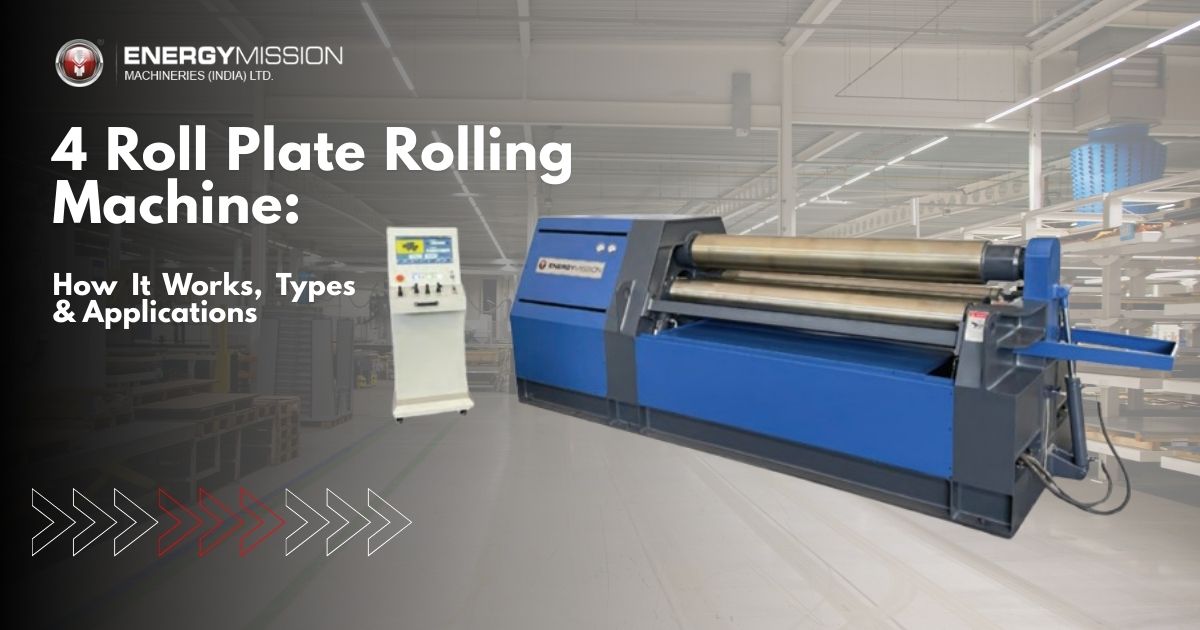
In metal fabrication, the quality of a rolled shell whether it is a pressure vessel, a storage tank, or a structural cylinder depends almost entirely on the machine doing the rolling. Among all plate rolling configurations available today, the 4 roll plate rolling machine stands out as the most capable, most efficient, and most accurate option for serious fabrication operations.
This guide covers exactly how a 4 roll plate rolling machine works, what makes it different from a 3-roll machine, the types available, which industries use it, and what to look for when buying one.
EnergyMission manufactures a complete range of plate rolling machines, including the high-performance 4-Roll DP Series built for fabricators who cannot afford inaccuracy or production delays.
What is a 4 Roll Plate Rolling Machine?
A 4 roll plate rolling machine is an industrial metal forming machine that uses four rolls one top roll, one bottom roll, and two side rolls to bend flat metal plates into cylindrical, conical, or curved profiles.
The four-roll configuration gives this machine a fundamental mechanical advantage over 3-roll machines: all four rolls work together simultaneously, which means the plate is gripped, pre-bent, and rolled in a single continuous operation without stopping to reposition the plate.
This is the defining feature that separates a 4 roll plate rolling machine from every other rolling configuration. In a 3-roll machine, the operator must remove the plate, flip it, and reinsert it to pre-bend the trailing end. In a 4-roll machine, both ends are pre-bent in the same pass automatically.
How Does a 4 Roll Plate Rolling Machine Work?
Understanding the working principle helps you appreciate why this machine delivers superior results. Here is the step-by-step operation:
Step 1: Plate Insertion & Clamping
The flat metal plate is fed between the top roll and the bottom roll. The bottom roll rises hydraulically to clamp the plate firmly between the two central rolls. This clamping action holds the plate in position and prevents slipping during rolling a common problem in 3-roll machines.
Step 2: Pre-Bending the Leading End
The side roll on the leading end of the plate rises to apply bending force. The plate moves forward slightly, and the leading edge is pre-bent to the required radius. Because the plate is clamped between the top and bottom rolls, it does not need to be repositioned for this step.
Step 3: Rolling the Plate
The plate is driven forward by the rotation of the top and bottom rolls. As it moves, the side rolls apply continuous bending pressure, curving the plate progressively into the required radius. The operator monitors the diameter using the digital position readout on the NC or CNC control panel.
Step 4: Pre-Bending the Trailing End
As the trailing end of the plate approaches the rolling zone, the opposite side roll rises to pre-bend the trailing edge again without stopping or repositioning the plate. This is the key mechanical advantage of the 4-roll design.
Step 5: Closing the Shell & Removal
Once the full plate has been rolled, the two ends meet to form a closed cylinder. The side roll drops hydraulically, and the rolled shell is removed from the machine. On EnergyMission’s 4-Roll DP Series, the side roll drop is fully hydraulic making shell removal fast and safe.
Key Components of a 4 Roll Hydraulic Plate Rolling Machine
A well-built hydraulic plate rolling machine in the 4-roll configuration consists of these critical components:
Top Roll
The top roll is the main drive roll. It rotates to drive the plate through the machine. Top roll diameter determines the minimum rolling radius the machine can achieve larger diameter top rolls are needed for thicker plates.
Bottom Roll
The bottom roll clamps the plate against the top roll. It is driven hydraulically upward to create the clamping force. On a hydraulic plate rolling machine, this clamping pressure is precisely controllable preventing plate slippage on thick or heavy sections.
Side Rolls (x2)
The two side rolls are the bending rolls. Each one moves independently on a hydraulic cylinder. Their vertical position determines the bending radius applied to the plate. Digital encoders on each side roll report their exact position to the control system giving the operator real-time radius feedback.
Hydraulic Power Unit
The hydraulic power unit drives all four roll movements clamping, side roll positioning, and side roll drop. On a quality 4 roll plate rolling machine, the hydraulic system uses high-quality seals, precision valves, and a well-designed circuit to ensure smooth, leak-free operation over a long service life.
CNC / NC Control Panel
The control system is what separates a modern hydraulic plate rolling machine from older mechanical designs. NC systems display roll positions digitally and allow the operator to set target positions numerically. CNC systems go further storing rolling programs, calculating required roll positions for a given radius, and running automatic rolling sequences.
Machine Frame
The frame carries all the rolling forces. On heavy-duty machines handling plates of 20mm, 40mm, or 80mm thickness, the frame must be extraordinarily rigid. EnergyMission’s 4-Roll DP Series uses a heavy welded steel frame with stress-relief treatment preventing deflection and ensuring parallel roll alignment under full load.
4 Roll vs 3 Roll Plate Rolling Machine: A Direct Comparison
| Feature | 3-Roll Machine | 4 Roll Plate Rolling Machine |
| Pre-bending Both Ends | Requires repositioning | Single pass — no repositioning |
| Plate Clamping | No positive clamping | Top & bottom roll clamping |
| Cycle Time | Slower | Significantly faster |
| Operator Skill Required | Higher | Lower |
| Rolling Accuracy | Good | High |
| Flat End Length | Longer flat ends | Minimal flat ends |
| Automation Potential | Limited | High — CNC integration ready |
| Surface Marking Risk | Higher (plate movement) | Lower (positive grip) |
| Cost | Lower | Higher |
The conclusion is clear: for any fabrication operation running medium to high volumes, working with tight diameter tolerances, or looking to reduce operator dependency a 4 roll plate rolling machine is the correct investment. However, many fabrication workshops still use traditional 3 Roll DP Plate Rolling Machine configurations for lighter rolling applications and smaller production runs.
Types of 4 Roll Plate Rolling Machines
Not all 4-roll machines are the same. Here are the main variants available:
Standard 4-Roll Hydraulic (Manual NC)
Entry-level 4-roll configuration with hydraulic roll movement and basic NC digital readouts. The operator sets roll positions numerically and monitors the rolling process manually. Suitable for fabricators moving up from 3-roll machines who want faster cycle times and better accuracy without a full CNC investment. Many workshops start with a 3 Roll Hydraulic Plate Rolling Machine before upgrading to a 4-roll configuration for higher precision and productivity.
4-Roll CNC Hydraulic
Advanced configuration where the CNC controller calculates required roll positions for a given material, thickness, and target diameter. The operator inputs the job parameters, and the machine positions the rolls automatically. Programs can be stored and recalled for repeat jobs eliminating setup time on recurring production runs.
4-Roll Heavy-Duty Hydraulic
Built for very thick plates typically 30mm to 120mm in mild steel. The machine frame, roll diameters, hydraulic system, and drive motors are all scaled u significantly. These machines are used in wind tower fabrication, large pressure vessel production, and heavy structural rolling.
EnergyMission 4-Roll DP Series
EnergyMission’s 4-Roll DP Series is a Double Pinch configuration where both side rolls operate as independent pinch rolls, giving maximum pre-bending capability and rolling accuracy. Available in a range of capacities from light plate work to heavy structural applications. The DP Series features:
- Full hydraulic roll movement on all four axes
- Digital position readouts with NC control
- Hydraulic side roll drop for fast shell removal
- All-roll drive for maximum traction on thick plates
Applications of 4 Roll Hydraulic Plate Rolling Machines
The hydraulic plate rolling machine in the 4-roll configuration is used across a wide range of demanding industries:
Pressure Vessel & Boiler Manufacturing
Pressure vessels require precisely rolled shells with tight diameter tolerances and minimal flat ends at the seam. The 4 roll plate rolling machine delivers both making it the standard machine in pressure vessel shops worldwide.
Storage Tank Fabrication
Large above-ground and underground storage tanks for oil, water, chemicals, and gases are built from rolled steel shells. 4-roll machines handle the full range of plate thicknesses used in tank construction from 6mm to 50mm and beyond.
Wind Tower Manufacturing
Wind turbine towers are constructed from thick steel sections rolled into large-diameter cylinders and welded together. The accuracy and throughput of a 4 roll plate rolling machine is essential for wind tower production where tight tolerances and high volumes are both required simultaneously.
Shipbuilding
Hull plates, structural frames, bulkheads, and pipe sections in shipbuilding all require precision rolling. The 4-roll configuration’s ability to roll heavy plates accurately and quickly makes it the preferred choice in shipyards.
Heavy Engineering & OEM Manufacturing
Custom cylinders, drums, rollers, and structural sections for OEM applications across mining, construction, and process industries are produced on hydraulic plate rolling machines in the 4-roll configuration.
Infrastructure & Construction
Curved structural sections for bridges, tunnels, and large-span roofing structures require precision plate rolling in thicknesses and radii that only a heavy-duty 4 roll plate rolling machine can handle reliably.
What to Check Before Buying a 4 Roll Plate Rolling Machine
When evaluating machines from any hydraulic plate rolling machine manufacturer, verify these specifications. Smaller workshops with limited production requirements sometimes begin with a 3 Roll Mechanical Plate Rolling Machine before investing in hydraulic or CNC rolling systems for higher production capacity.
- Maximum plate thickness and width at your material’s tensile strength
- Minimum rolling diameter — ensure it matches your smallest required cylinder
- Top roll diameter — larger is better for thick plate capability
- Roll drive configuration — all-roll drive is preferred for heavy plates
- Control system — NC digital readout minimum; CNC for high-volume or complex work
- Side roll drop type — hydraulic drop is essential for production efficiency
- Frame construction — stress-relieved welded steel for long-term rigidity
- After-sales service — local engineers and genuine spare parts availability
Talk to EnergyMission About Your Rolling Application
Whether you are rolling 6mm stainless steel for food-grade tanks or 60mm carbon steel for pressure vessels, EnergyMission’s technical team will recommend the right machine specification for your exact requirement.
The 4-Roll DP Series from EnergyMission is available across a wide range of capacities and our team will help you match the right tonnage, roll diameter, and control system to your production needs.
Visit Energymission or contact us for specifications, pricing, and a free application consultation.
Frequently Asked Questions (FAQ)
Q1. What is the main advantage of a 4 roll plate rolling machine over a 3-roll machine?
The primary advantage is that a 4-roll plate rolling machine pre-bends both ends of the plate in a single pass without stopping or repositioning the plate. This eliminates the flat end problem common in 3-roll machines, reduces cycle time significantly, and requires less operator skill. The positive clamping between the top and bottom rolls also prevents plate slippage on thick sections.
Q2. What plate thickness can a 4 roll hydraulic plate rolling machine handle?
This depends on the machine’s tonnage rating and roll diameter. EnergyMission’s 4-Roll DP Series covers a range from light plate work starting at 4mm up to heavy structural applications at 80mm+ in mild steel. Always specify your material and tensile strength when requesting capacity confirmation from the manufacturer.
Q3. What is “Double Pinch” in a 4-roll machine?
Double Pinch (DP) refers to the configuration where both side rolls operate as active pinch/bending rolls each moving independently on its own hydraulic cylinder. This gives maximum pre-bending control at both ends of the plate and allows tighter radii to be achieved compared to standard 4-roll configurations. EnergyMission’s 4-Roll DP Series uses this configuration.
Q4. Can a 4 roll plate rolling machine roll cones?
Yes. By tilting the side rolls at an angle relative to the top and bottom rolls, a 4 roll plate rolling machine can produce conical sections. The taper angle is set by the operator through the control system. Cone rolling requires a machine with independent side roll control which is standard on EnergyMission’s DP Series.
Q5. What materials can be rolled on a hydraulic plate rolling machine?
A hydraulic plate rolling machine can roll mild steel, carbon steel, stainless steel, aluminium, copper, brass, and other non-ferrous metals. Harder materials like high-strength steel require higher machine tonnage for the same plate thickness. Always specify material grade and tensile strength when sizing a machine.
Conclusion
A 4 roll plate rolling machine is the most capable and efficient rolling solution available for metal fabricators today. Its ability to pre-bend both plate ends in a single pass, deliver high accuracy, and run faster cycle times with less operator skill makes it the right choice for any serious production environment.
The hydraulic plate rolling machine in the 4-roll configuration particularly in the Double Pinch design is the industry standard for pressure vessel shops, tank fabricators, wind tower manufacturers, and shipbuilders worldwide. Fabricators evaluating different configurations can also explore the complete range of plate rolling machines offered by EnergyMission to compare capacities, rolling technologies, and machine configurations for different industrial applications.