
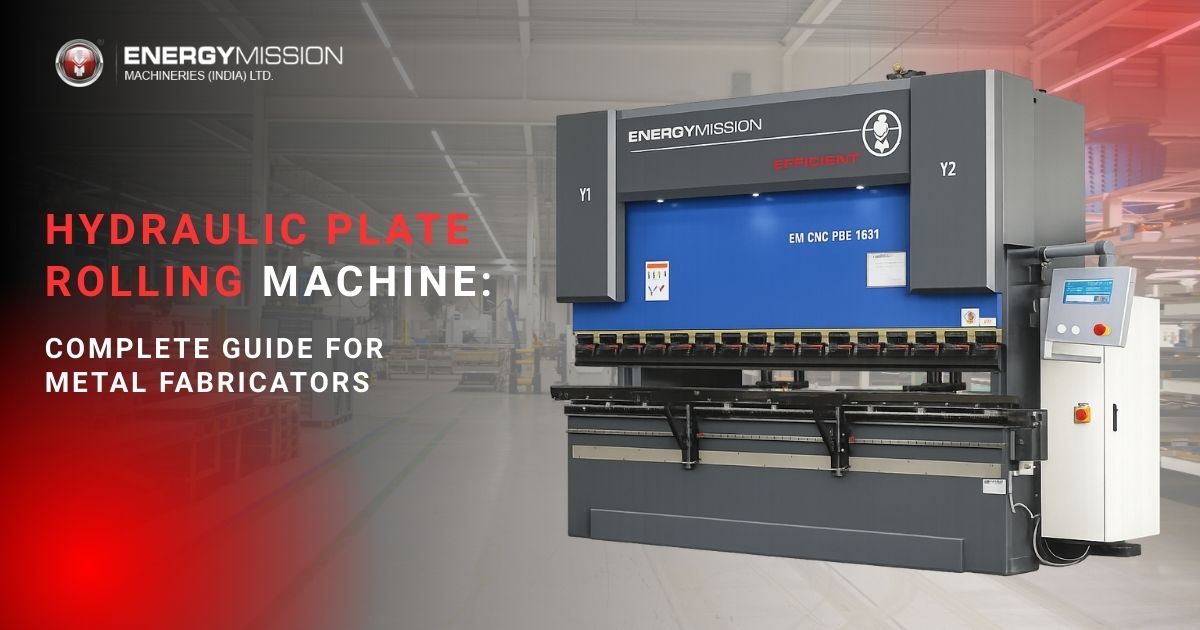
If your business involves rolling metal plates into cylinders, cones, or curved profiles, the machine at the center of your operation is a plate rolling machine. Choosing the right one the right type, the right tonnage, the right configuration directly determines your production quality, speed, and long-term profitability.
This guide covers everything a metal fabricator needs to know about hydraulic plate rolling machines: how they work, the different types available, what specifications matter, and how to make the right buying decision.
EnergyMission is a trusted plate rolling machine manufacturer with a complete range of 3-roll and 4-roll machines built for Indian and global fabrication requirements. This guide is based on real application experience across industries.
What is a Plate Rolling Machine?
A plate rolling machine also called a plate bending machine is an industrial machine used to bend flat metal sheets or plates into curved shapes. The metal passes between a set of rolls, and the position of the rolls relative to each other determines the radius and profile of the bend.
The key output of a plate rolling machine is a rolled shell used in pressure vessels, storage tanks, boilers, pipes, wind towers, shipbuilding structures, and structural cylinders.
Plate rolling machines work on three core materials:
- Mild steel and carbon steel plates
- Stainless steel sheets
- Aluminium, copper, and non-ferrous metals
The machine type mechanical or hydraulic, 3-roll or 4-roll determines how precisely and efficiently this rolling operation can be performed.
Mechanical vs Hydraulic Plate Rolling Machine: What’s the Difference?
Before going into types, it is important to understand why hydraulic plate rolling machines have become the standard choice for serious fabricators.
Mechanical Plate Rolling Machines
Mechanical machines use gear drives and mechanical linkages to move the rolls. They are simpler in construction and lower in cost but they have significant limitations:
- Limited control over roll pressure and positioning
- Cannot handle thick plates at high accuracy
- Inconsistent rolling force across the plate width
- Higher operator skill requirement
Hydraulic Plate Rolling Machines
A hydraulic plate rolling machine uses hydraulic cylinders to control the position and pressure of the rolls. This gives:
- Precise, adjustable roll positioning at any point during the operation
- Consistent pressure across the full plate width
- Ability to handle thicker plates with greater control
- Digital readouts and NC/CNC control options
- Safer operation with programmable pressure limits
For any serious fabrication shop working with plate thicknesses above 6mm, or requiring consistent rolled profiles, a hydraulic plate rolling machine is the correct investment.
Types of Hydraulic Plate Rolling Machines
There are two primary configurations in the hydraulic plate rolling machine category: 3-Roll and 4-Roll. Within 3-roll machines, there are further sub-types based on roll geometry.
1. 3-Roll Mechanical Plate Rolling Machine
The 3-roll mechanical configuration is the most basic type with one top roll and two bottom rolls arranged in a pyramid or pinch configuration. While the term “mechanical” is used in the product name, many modern versions incorporate hydraulic elements for roll adjustment.
EnergyMission’s 3-Roll Mechanical Series is designed for fabricators who need reliable rolling performance for standard plate thicknesses at a practical price point. Suitable for general fabrication, simple cylinders, and light to medium plate work.
Best For: Small to medium fabrication shops, light plate rolling, standard cylinders and cones
Limitations: Flat ends (pre-bending required separately), lower accuracy on thick plates
2. 3-Roll Double Pinch (DP) Series — Hydraulic
The 3-Roll Double Pinch hydraulic plate rolling machine is a significant step up from the basic 3-roll configuration. In a double pinch machine, both the bottom rolls can move independently one for pinching (gripping) the plate and one for bending. This design allows pre-bending of both ends of the plate without removing and reinserting it.
EnergyMission’s 3-Roll DP Series is a fully hydraulic plate rolling machine with digital position readouts, heavy-duty construction, and precise roll control. It handles medium to heavy plate thicknesses with good accuracy and is a popular choice for pressure vessel and tank fabrication.
Key Advantages:
- Pre-bending of both ends without repositioning the plate
- Higher accuracy than basic 3-roll machines
- Hydraulic roll adjustment for consistent pressure
- Suitable for thicker plates and tighter radii
Best For: Pressure vessel manufacturers, tank fabricators, boiler shops, medium to heavy plate rolling
3. 3-Roll HM Series — Heavy Mechanical with Hydraulic Control
The 3-Roll HM Series from EnergyMission is built for heavy-duty plate rolling applications where high tonnage and structural rigidity are the primary requirements. This series combines a heavy mechanical frame with hydraulic roll control giving fabricators the strength to handle thick structural plates with the precision of hydraulic positioning.
The HM Series is particularly suited for fabricators working in infrastructure, energy, and heavy engineering where plate thicknesses from 20mm to 80mm+ are common.
Best For: Heavy engineering, wind tower fabrication, large diameter vessels, infrastructure projects
4. 4-Roll Double Pinch (DP) Series — Hydraulic
The 4-Roll hydraulic plate rolling machine represents the highest level of performance and automation in the plate rolling category. With four rolls one top, one bottom, and two side rolls the 4-roll machine offers:
- Pre-bending of both ends in a single pass — no plate repositioning needed
- Precise digital control over all roll positions simultaneously
- Higher throughput — faster cycle times compared to 3-roll machines
- Automatic plate alignment — the plate feeds straight without manual correction
- CNC/NC control options for programmed rolling sequences
EnergyMission’s 4-Roll DP Series is the flagship hydraulic plate rolling machine in our range designed for high-volume production environments, precision vessel fabrication, and applications where operator efficiency and part quality are both critical.
Key Advantages:
- Complete rolling and pre-bending in one operation
- Higher accuracy and repeatability than 3-roll machines
- Faster production cycle significantly less operator intervention
- Ideal for automation integration
- Better surface finish on rolled products
Best For: High-volume pressure vessel production, large tank fabrication, shipbuilding, wind energy, heavy OEM manufacturing
3-Roll vs 4-Roll Hydraulic Plate Rolling Machine: Which Should You Choose?
| Feature | 3-Roll DP Hydraulic | 4-Roll DP Hydraulic |
| Pre-bending Both Ends | Yes (with repositioning) | Yes (single pass) |
| Cycle Time | Moderate | Faster |
| Plate Alignment | Manual | Automatic |
| Accuracy | Good | High |
| Operator Skill Required | Medium | Low-Medium |
| Suitable Thickness | 4mm–80mm | 4mm–100mm+ |
| Cost | Moderate | Higher |
| Best Application | General to heavy fabrication | High-volume, precision work |
Simple rule: If you run moderate volumes with skilled operators a 3-Roll DP hydraulic plate rolling machine is a cost-effective, capable choice. If you run high volumes, need faster cycle times, and want consistent quality with less operator dependency the 4-Roll DP series is the right investment.
Key Specifications to Check Before Buying a Plate Rolling Machine
Whether you are sourcing from a plate rolling machine manufacturer or a plate rolling machine supplier, always verify these specifications before placing an order:
1. Maximum Plate Thickness & Width
This is the most critical specification. The machine must handle your thickest plate at your widest required width. Always specify your material mild steel, stainless steel, or aluminium as tensile strength affects rolling capacity.
2. Minimum Rolling Diameter
Every plate bending machine has a minimum diameter it can achieve. If you roll small-diameter cylinders, verify the machine can achieve that radius without over-stressing the material or rolls.
3. Top Roll Diameter
A larger top roll diameter allows rolling of thicker plates. For heavy plate work, top roll diameter directly affects the machine’s structural capability.
4. Roll Drive Type
Hydraulic drive on all rolls gives better traction and control on thick plates. Single-drive or two-drive configurations may slip on heavy sections.
5. Control System
Basic machines use manual handwheels. Advanced hydraulic plate rolling machines offer NC digital readouts, CNC controllers with programmable sequences, and position memory for repeatable jobs.
6. Side Roll Drop (for 3-Roll machines)
On 3-roll machines, the side roll must drop to allow the rolled shell to be removed. Check whether the drop is hydraulic or manual hydraulic drop significantly improves throughput.
Industries That Use Hydraulic Plate Rolling Machines
A sheet rolling machine or plate rolling machine is found across a wide range of industries:
- Pressure Vessel & Boiler Manufacturing: Rolling shells, heads, and nozzle reinforcements
- Storage Tank Fabrication: Large diameter tanks for oil, water, and chemical storage
- Shipbuilding: Hull sections, structural frames, pipe bending
- Wind Energy: Tower sections and nacelle structural components
- Construction & Infrastructure: Curved structural sections, bridge components
- Heavy Engineering & OEM: Custom cylinders, drums, and formed sections
- Agricultural Equipment: Chassis sections and structural parts
Why Choose EnergyMission as Your Plate Rolling Machine Manufacturer?
EnergyMission is a reliable plate rolling machine manufacturer and plate rolling machine supplier with a complete product range from entry-level 3-roll mechanical machines to high-performance 4-roll CNC hydraulic systems.
What sets EnergyMission apart:
- In-House Engineering: Machines designed and built under one roof with strict quality control
- Complete Range: 3-Roll Mechanical, 3-Roll DP, 3-Roll HM, and 4-Roll DP one manufacturer for all your rolling needs
- Heavy-Duty Construction: Robust frames built for long service life in demanding production environments
- Pan-India Service Support: Dedicated service engineers and genuine spare parts across India
- Application Expertise: Technical team helps you select the right machine for your exact plate thickness, width, and rolling diameter requirements
- Proven Track Record: Machines running in pressure vessel, tank, shipbuilding, wind tower, and heavy engineering industries
Get the Right Machine for Your Application
Selecting the right hydraulic plate rolling machine requires more than just matching a tonnage number. Material grade, plate width, minimum rolling diameter, production volume, and operator setup all factor into the right choice.
EnergyMission’s technical team will assess your application and recommend the right machine from our range at the right specification and price.
Browse Our Full Plate Rolling Machine Range. Visit EnergyMission or contact us directly for specifications, pricing, and a free application consultation.
Frequently Asked Questions (FAQ)
Q1. What is the difference between a plate rolling machine and a plate bending machine?
The terms plate rolling machine and plate bending machine are often used interchangeably in the industry. Both refer to machines that bend flat metal plates into curved profiles. “Rolling” typically implies continuous curving into cylinders or arcs, while “bending” can also refer to single-angle bends. In most fabrication contexts, they describe the same category of equipment.
Q2. What is the advantage of a hydraulic plate rolling machine over a mechanical one?
A hydraulic plate rolling machine offers precise, adjustable roll positioning via hydraulic cylinders giving consistent pressure across the full plate width, better control on thick plates, and digital position readouts. Mechanical machines are simpler and cheaper but lack the control and capacity needed for serious plate fabrication work above 6–8mm.
Q3. What is the difference between 3-roll and 4-roll plate rolling machines?
A 3-roll machine uses three rolls one top and two bottom and typically requires plate repositioning for pre-bending both ends. A 4-roll machine adds a fourth roll, allowing pre-bending of both ends in a single pass without repositioning. The 4-roll configuration is faster, more accurate, and requires less operator skill but at a higher machine cost.
Q4. What plate thickness can EnergyMission’s machines handle?
EnergyMission’s plate rolling machine range covers plate thicknesses from 4mm to over 80mm depending on the series. The 3-Roll Mechanical handles lighter plates, the DP Series handles medium to heavy plates, the HM Series handles heavy structural plates, and the 4-Roll DP Series covers the full range including thick vessel and tower sections.
Q5. Do you supply plate rolling machines outside India?
Yes. EnergyMission supplies hydraulic plate rolling machines to customers across South Asia, the Middle East, and Africa. Contact the sales team for export pricing, shipping arrangements, and after-sales support options for international customers.
Q6. Can I get an on-site demonstration before purchasing?
EnergyMission offers application-specific consultations and, where possible, material trials. Contact our technical team with your plate material, thickness, and required rolling diameter to arrange a demonstration or technical discussion.
Conclusion
A hydraulic plate rolling machine is a long-term production asset. Choosing the wrong type under-specified or over-specified leads to either production limitations or unnecessary capital expenditure.
Understanding the difference between 3-Roll and 4-Roll configurations, mechanical versus hydraulic drive, and NC versus CNC control gives you the foundation to make the right decision for your fabrication business.
EnergyMission as a trusted plate rolling machine manufacturer and plate rolling machine supplier offers the complete range, the technical expertise, and the after-sales support to back your investment for years to come.
Visit www.energymission.com today and speak to our team about the right sheet rolling machine for your application.