
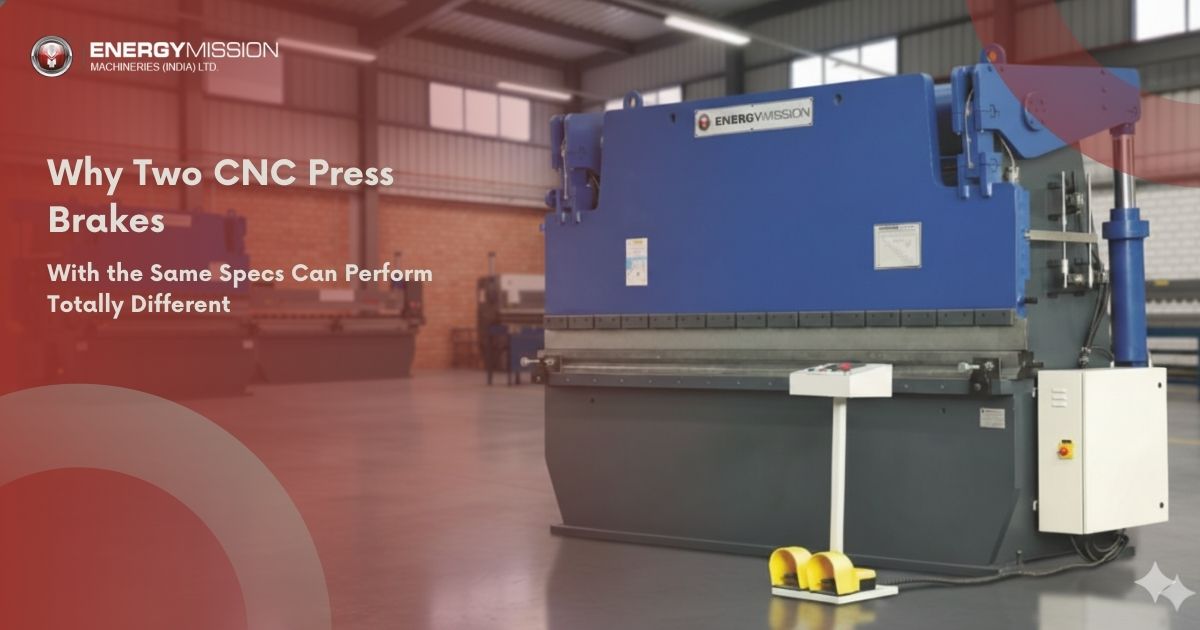
You’ve compared tonnage, bending length, and controller specs across multiple machines. The numbers match. The datasheets look identical. Yet, six months after installation, one machine delivers tight tolerances while the other struggles with angle drift and inconsistent backgauge positioning.
This frustrating reality hits fabricators harder than expected. Two machines carrying the same specifications can produce vastly different results on the shop floor. The issue isn’t false advertising; it’s that published specs only tell part of the story. What happens between the blueprint and the finished machine determines real-world performance far more than any datasheet reveals.
At Energy Mission, we’ve seen buyers learn this lesson the hard way. Understanding why identical specifications produce different outcomes starts with recognising what those numbers don’t capture.
What Press Brake Machine Specifications Don’t Reveal About Performance
Tonnage & Bending Length
A 100-ton, 3-meter machine sounds straightforward. Both Machine A and Machine B claim identical capacity. However, tonnage ratings don’t account for frame rigidity under load. A lighter frame flexes more during heavy bends, causing inconsistent angles across the bending length. The stated tonnage might be achievable, but deflection undermines accuracy.
Controller Brand
Listing “Delem DA-66T” or “ESA S640” suggests equivalent capability. What datasheets skip: how that controller is programmed, tuned, and integrated with the hydraulic system. Two machines using the same controller can respond completely differently based on servo tuning, feedback loop configuration, and motion parameters set during assembly.
Backgauge Axes
Four-axis backgauge systems appear identical on paper. The difference emerges in component quality, including servo motor precision, ball screw grade, and guide rail straightness. Poor components introduce backlash and positioning errors that specifications never mention.
Ram Stroke & Open Height
Stroke length and open height determine what you can bend. They don’t reveal ram movement smoothness, parallelism under load, or vibration levels during operation. Two machines with identical stroke specs can feel entirely different when running production parts.
The Hidden Factors That Change Performance (Even With the Same Specs)
Frame Strength & Stress Relief Process
The frame is the foundation of bending accuracy. A CNC Press Brake Machine with insufficient frame thickness or improper welding will flex during high-tonnage operations, causing angles to vary across the workpiece length. Stress relief (heating the welded frame to remove internal tensions) determines long-term dimensional stability. Manufacturers who skip or rush this process deliver machines that drift out of calibration within months.
Hydraulic System Quality
Hydraulic components rarely appear in specification sheets beyond “hydraulic drive.” The reality:
- Pump quality affects pressure consistency and heat generation
- Valve response time determines ram speed control and positioning accuracy
- Pressure stability under varying loads impacts angle repeatability
A Hydraulic Press Brake Machine using premium valves and servos maintains tighter control than one built with generic components, even when both claim the same tonnage.
Backgauge Components & Guide Rails
Backgauge precision depends on:
- Servo motor resolution for fine positioning
- Ball screw grade (C3, C5, C7 tolerance classes make huge differences)
- Guide rail straightness and preload to eliminate play
Cheap ball screws and undersized servos create positioning errors that accumulate across multiple bends. You’ll never see these details in a basic spec comparison.
Tooling Compatibility & Alignment
Poor tooling alignment between the punch and die creates uneven bending forces. Even with correct tonnage, misalignment produces inconsistent bend angles and surface marking. Setup procedures and tooling holder precision separate reliable machines from problematic ones. Repeatability suffers when tooling systems lack proper registration and clamping force.
Machine Assembly Quality: Where the Real Difference Starts
Welding Precision & Machining Accuracy
Frame welding quality directly impacts structural integrity. Uneven welds introduce stress concentrations that cause distortion over time. After welding, precision machining of mounting surfaces, guide rails, and cylinder mounts determines how accurately components align. A CNC Press Brake Machine Manufacturer committed to quality invests heavily in post-weld machining to achieve tight tolerances.
Calibration & Factory Testing
Reputable manufacturers test every machine under full load before shipping. This includes:
- Test bending actual metal at rated tonnage
- Repeatability testing across the full bending length
- Backgauge positioning verification at multiple points
Factories cutting corners skip comprehensive testing or only run machines at partial capacity. The first real test becomes your production floor.
Quality Control Standards
Strong manufacturers document every critical measurement and calibration point. ISO-certified processes ensure consistent assembly quality across all machines. A well-managed Press Brake Machine Manufacturer provides detailed inspection reports showing frame straightness, ram parallelism, and hydraulic pressure curves.
CNC Programming + Controller Parameters Matter More Than People Think
Servo Tuning & Motion Smoothness
Identical controllers deliver different results based on tuning. Servo gain settings, acceleration curves, and feedback response times require expert adjustment during commissioning. Poor tuning causes:
- Ram hunting (oscillation around target position)
- Jerky motion during approach
- Inconsistent stopping points
An Optima Series CNC Press Brake Machine configured by experienced technicians moves smoothly and positions accurately because proper tuning translates controller capability into real performance.
Angle Correction, Material Database & Crowning Setup
Advanced features mean nothing without proper implementation. Angle correction algorithms compensate for springback, but only if material databases contain accurate data. Crowning systems prevent centre deflection when correctly calibrated. Machines lacking proper setup of these functions force operators to compensate manually, destroying productivity and consistency.
Operator Experience vs Machine Design
A skilled operator can compensate for minor machine limitations through experience and technique. However, fundamental engineering weaknesses can’t be overcome by operator skill alone. Consistent, repeatable bending should result from machine design, not operator tricks developed through trial and error.
If your team needs specialised techniques to achieve acceptable results, the machine’s basic performance is insufficient. Quality fabrication shouldn’t depend on workarounds.
What to Ask a Press Brake Machine Manufacturer Before Buying
Must-Ask Questions
Smart buyers dig deeper than published specifications:
- Do you provide a factory test report? Request documentation showing actual measured performance, not theoretical capabilities.
- Do you test under full tonnage load? Partial-load testing hides deflection and accuracy issues.
- What’s the frame stress relief method? Understand the process and duration used to stabilise the frame.
- What grade are the ball screws and rails? Component specifications directly impact positioning accuracy.
- Can you run my sample part? Nothing proves capability like bending your actual production pieces before purchase.
A transparent CNC Press Brake Machine Manufacturer welcomes these questions and provides detailed answers backed by documentation.
Must-Request Documents
Before committing to purchase, obtain:
- Accuracy test results measured across the full bending length
- Calibration reports for backgauge, ram parallelism, and tonnage
- Component list detailing hydraulic pump, valves, servo motors, and linear guides
Manufacturers confident in their quality provide this information readily. Hesitation or vague responses signal potential problems.
Real Example: Two Machines, Same Specs, Different Output
Consider two 135-ton machines with 3-meter bending length, both using the same controller and claiming ±0.01mm backgauge accuracy.
Machine A maintains consistent angles across production runs. The backgauge returns to position within 0.005mm repeatedly. Ram movement is smooth, and operators achieve target angles on the first piece. This machine came from a Splendid Series CNC Press Brake Machine line where frame stress relief takes 24 hours, and every machine undergoes full-load testing.
Machine B struggles with angle drift during long runs. The backgauge shows positioning variation reaching 0.03mm. Operators notice vibration during ram descent and inconsistent springback compensation. Investigation revealed welded frame construction without proper stress relief, generic ball screws with C7 tolerance, and factory testing limited to no-load cycling.
The specification sheets looked identical. The engineering, assembly quality, and testing standards were worlds apart.
Why Energy Mission Focuses on Real Performance, Not Just Specs
At Energy Mission, we recognise that numbers on paper don’t guarantee shop floor results. Our CNC Press Brake Machines undergo rigorous testing that validates performance under actual working conditions. Frame stress relief, precision machining, and component selection follow strict protocols developed through decades of manufacturing experience.
We also understand that different applications demand different solutions. An Efficient Series CNC Press Brake Machine balances performance with cost-effectiveness for moderate production environments, while a Tandem CNC Press Brake Machine addresses high-tonnage requirements with synchronised dual-machine operation.
Whether you need a Magnum CNC Press Brake Machine for heavy industrial work or a Prudent Series CNC Press Brake Machine for precision sheet metal fabrication, performance comes from engineering integrity throughout the entire build process.
For simpler applications, our NC Front Cylinder Press Brake Machine and NC Rear Cylinder Press Brake Machine offer reliable bending without CNC complexity, still maintaining quality standards that ensure consistent results.
Understanding the difference between suppliers and manufacturers also matters. Learn more about making informed purchasing decisions through our guide on press brake supplier versus manufacturer distinctions.
FAQs
Can two CNC press brakes with the same tonnage perform differently?
Absolutely. Tonnage rating indicates force capacity, but frame rigidity, hydraulic quality, and component precision determine how effectively that force translates into accurate bending. A machine with superior frame construction and stress relief will outperform one with identical tonnage but weaker structural engineering.
What affects CNC press brake accuracy the most?
Frame stiffness and stress relief create the foundation. From there, ball screw quality, guide rail precision, hydraulic valve response, and servo tuning all contribute significantly. Accuracy results from the entire system working together, not any single component.
Why does frame strength matter in a press brake machine?
The frame resists bending forces during operation. Insufficient strength or improper stress relief causes deflection that varies across the bending length, creating inconsistent angles. Strong, properly treated frames maintain parallelism under load, enabling repeatable results.
What is a factory test report for a CNC press brake machine?
A factory test report documents actual measured performance before shipment. It should include ram parallelism measurements, backgauge positioning accuracy, tonnage verification, and test bend results. This report proves the machine meets specifications under real operating conditions.
How do I choose the right CNC press brake machine manufacturer?
Prioritise manufacturers who provide detailed component specifications, factory test reports, and allow sample part testing. Ask about frame stress relief processes, hydraulic component brands, and quality control procedures. A manufacturer confident in their product welcomes detailed technical questions and provides transparent answers.
Specs Are the Starting Point, Not the Decision
Tonnage, bending length, and controller type establish basic capability. Real performance emerges from engineering decisions invisible in specification sheets: frame treatment, component quality, assembly precision, and testing rigour. Two machines sharing identical published specs can deliver completely different results because these hidden factors create the actual performance envelope.
Smart buyers recognise that choosing a proven Press Brake Machine Manufacturer means investigating what happens beyond the datasheet. Request factory test reports, component specifications, and the opportunity to run sample parts. Your shop floor success depends on real-world performance, not theoretical capabilities.
When you’re ready to discuss your specific bending requirements with a manufacturer committed to engineering integrity, Contact our team to find the right solution for your fabrication needs.