
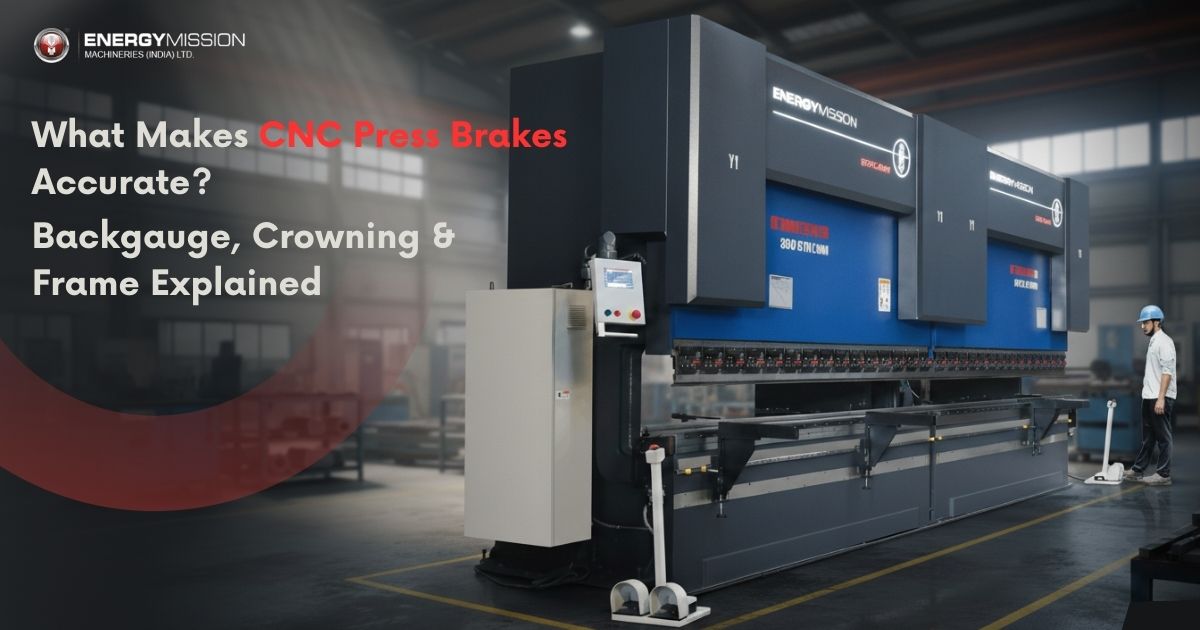
Bending accuracy separates profitable production from costly rework. When sheet metal parts fail to meet tolerances, the issue isn’t operator error or bad material; it’s usually the machine’s internal engineering. Many buyers assume higher tonnage equals better precision, but that’s a costly misconception. Real accuracy comes from three critical systems working in harmony: backgauge positioning, crowning compensation, and frame rigidity.
At Energy Mission, we’ve spent years refining these core systems because we understand what production floors actually need. As a trusted CNC Press Brake Machine Manufacturer, we know that consistent bends require more than marketing promises; they demand solid engineering.
What Makes a CNC Press Brake Machine Truly Accurate?
Accuracy in metal bending isn’t about one component; it’s a system. Four elements determine whether your parts meet spec every time:
Backgauge positioning controls where the material sits before each bend. Even a 0.1mm error here multiplies across multiple bends, creating unusable parts.
Crowning compensation addresses the natural deflection that occurs during bending. Without it, the centre of long workpieces bends to a different angle than the edges.
Frame rigidity provides the structural foundation. A weak frame flexes under load, making consistent angles impossible regardless of your controller’s precision.
Tooling and controller logic translate your settings into physical movement, but they can’t compensate for mechanical weaknesses in the first three systems.
When evaluating any CNC Press Brake Machine, ask how these four elements integrate. Machines with weak points in any area will frustrate your operators and limit your capabilities.
Backgauge Engineering – The Real MVP of Repeatable Bending
What Is a Backgauge in a Press Brake Machine?
The backgauge is a programmable positioning system that holds and locates sheet metal at precise distances from the bending line. Think of it as the reference point for every bend dimension on your part. Without accurate backgauge control, you’re essentially guessing where each bend occurs.
How Backgauge Accuracy Affects Final Bend Quality
Backgauge precision directly impacts two critical quality factors:
Flange length consistency: If the backgauge positions material 0.2mm off target, every flange dimension carries that error. Over a production run of 500 parts, this variation compounds into significant waste.
Multi-bend part repeatability: Complex parts require multiple bends with tight relationships between features. Each bend uses the backgauge as its reference. Small positioning errors accumulate, causing later bends to miss their targets even when earlier bends looked acceptable.
Backgauge Axis Types (X, R, Z1, Z2)
Modern machines use multiple axes to position material accurately:
The X-axis moves the backgauge forward and backwards, controlling the primary bend dimension.
R-axis provides rotational adjustment, tilting the fingers to match angled bend sequences.
Z1 and Z2 axes control independent left and right movement, enabling asymmetric positioning for complex parts.
Multi-axis capability matters for modern fabrication. Simple parts might need only X-axis control, but anything with angles, offsets, or asymmetric features requires coordinated movement across all axes. The Optima Series CNC Press Brake Machine demonstrates how synchronised axis control improves production flexibility.
Common Backgauge Problems That Kill Accuracy
Four mechanical issues destroy backgauge precision:
Backlash in drive components creates positioning slop. When the direction reverses, lost motion means the backgauge doesn’t arrive exactly where commanded.
Misalignment between guide rails and the bed causes the backgauge to cant, creating position errors that vary along the machine’s length.
Weak motor control lacks the resolution or holding torque to maintain exact positions under varying material weights and forces.
Poor guide rails wear quickly, introducing play that increases over time and makes calibration temporary at best.
Crowning Systems – Why Long Bends Stay Straight
What Is Crowning in CNC Press Brake Machines?
During bending, the machine’s bed and ram deflect under load. This deflection is greatest at the centre and minimal at the ends, creating a curve in the machine’s profile. Without compensation, this deflection translates directly to the workpiece; the middle section receives less penetration than the edges, producing inconsistent bend angles across the length.
Crowning systems counteract this deflection by pre-curving the bed, ram, or both in the opposite direction. When tonnage is applied, the machine straightens to neutral, delivering uniform force across the entire bend length.
Manual Crowning vs CNC Crowning
Manual crowning uses wedge blocks that operators adjust based on material thickness and length. It’s simple and reliable, but requires experience to set correctly and doesn’t adapt during the bend cycle.
CNC crowning employs hydraulic or mechanical actuators controlled by the machine’s computer. The system automatically adjusts compensation based on tonnage, material properties, and bend length. This provides superior consistency but adds complexity and cost.
Most manufacturers offer manual systems on entry-level machines and CNC systems on premium models. The Splendid Series CNC Press Brake Machine incorporates adaptive crowning that adjusts throughout the bending process for optimal results.
How Crowning Improves Angle Consistency
Proper crowning solves deflection-related angle variation. On long bends—anything over 2 meters—uncorrected deflection can produce angle differences of 2° or more between centre and edges. For parts requiring ±0.5° tolerance, that’s unacceptable.
Quality crowning systems reduce this variation to within tolerance across the full machine length. This improvement allows fabricators to run longer parts without manual shimming or constant angle checking.
Signs a Press Brake Machine Manufacturer Uses Weak Crowning
Two indicators reveal inadequate crowning:
Inconsistent angles across bend length: Measure angles at multiple points on long bends. More than 1° variation between the centre and edges indicates insufficient compensation.
Constant operator adjustment: If operators continuously tweak settings or add shims during long-bend runs, the crowning system isn’t handling deflection properly.
Frame Strength – The Backbone of Every Press Brake Machine
Why Frame Rigidity Controls Accuracy
The frame provides the foundation for all machine components. When tonnage is applied, frame deflection affects:
Ram parallelism: Frame flex changes the relationship between upper and lower tooling, creating angle variations across the bend length.
Backgauge positioning: Frame distortion moves the reference surface the backgauge uses for positioning, introducing dimensional errors.
Vibration damping: Rigid frames absorb bending forces smoothly while weak frames transmit vibration to the workpiece, degrading surface finish and edge quality.
Welded Frame vs Stress-Relieved Frame
Manufacturing method dramatically affects long-term performance:
Welded frames start with steel plates joined by welding. The welding process introduces internal stresses that cause the frame to warp over time as these stresses relieve naturally. Without proper treatment, the machine loses calibration within months.
Stress-relieved frames undergo heat treatment after welding to normalise internal stresses. This thermal process eliminates the tendency to warp, maintaining calibration for years. The Efficient Series CNC Press Brake Machine uses stress-relieved frames precisely machined after heat treatment for maximum stability.
How Frame Strength Affects Machine Life & Calibration
Strong frames deliver two practical benefits:
Long-term stability: Machines hold their original accuracy specifications for years rather than requiring recalibration every few months.
Reduced maintenance: Less frame flex means less wear on guide systems, bearings, and seals. Components last longer because they operate within design parameters rather than fighting structural deflection.
How These 3 Systems Work Together (Backgauge + Crowning + Frame)
Think of accuracy as a three-legged stool. Each system supports the others:
A precise backgauge means nothing if frame flex moves it during bending. Perfect crowning can’t compensate for a backgauge that positions material inconsistently. A rigid frame provides no benefit if the backgauge has 0.5mm of backlash and the crowning system doesn’t work.
The accuracy triangle works like this: the frame provides stable geometry → crowning maintains uniform force distribution → the backgauge delivers repeatable positioning. Break any leg and the whole system fails.
Even sophisticated controllers with advanced algorithms can’t fix mechanical inadequacies. Software can optimise what the hardware delivers, but it can’t create the precision that the mechanical systems don’t possess.
Quality Checks Buyers Should Ask a CNC Press Brake Machine Manufacturer
Backgauge Testing Checklist
Request these specific tests during machine inspection:
Positioning test: Command the backgauge to a specific position 10 times. Measure the actual position each time with an indicator. Variation should stay within ±0.05mm.
Repeatability check: Run a complete bend program 20 times. Measure flange dimensions on finished parts. Consistent dimensions indicate reliable backgauge performance.
Axis calibration: For multi-axis systems, check that R, Z1, and Z2 movements reach commanded positions independently and when moving together.
Crowning Test Checklist
Physical testing reveals real-world performance:
Long bend sample: Bend a 3-meter piece of 3mm mild steel. This generates enough deflection to test the crowning system properly.
Angle check across full length: Measure bend angles at 300mm intervals along the entire length. Quality crowning keeps variation under 0.5° across the span.
Frame & Build Quality Checklist
These checks verify structural integrity:
Stress relief proof: Ask for heat treatment certificates showing post-weld stress relief cycles. Reputable manufacturers document this process.
Machining accuracy: Check that guide surfaces and mounting faces show proper machining marks, not rough weld surfaces. Precision machining after stress relief indicates quality construction.
Alignment test: Have the manufacturer demonstrate the ram-to-bed parallelism measurement. Quality machines maintain parallelism within 0.05mm across the full stroke.
Why Choosing the Right Press Brake Machine Manufacturer Matters
Manufacturing quality varies dramatically across suppliers. Three factors differentiate manufacturers:
Engineering quality: Some manufacturers design machines using proven engineering principles and finite element analysis. Others copy designs without understanding the underlying mechanics. This shows in component selection, material specifications, and dimensional tolerances.
Assembly standards: Precision assembly requires skilled technicians, proper tooling, and rigorous quality checks. Mass production with minimal quality control produces machines that meet basic specs but fail under sustained production demands. The Prudent Series CNC Press Brake Machine exemplifies careful assembly, where every critical dimension gets verified before shipment.
Component selection: Quality manufacturers use components matched to application requirements—servo drives with appropriate resolution, linear guides rated for the load cycle, hydraulic valves that maintain pressure stability. Budget manufacturers choose parts based solely on initial cost, creating reliability issues down the line.
The difference between a reliable Press Brake Machine Manufacturer and a budget supplier appears gradually. Initial performance might seem similar, but after six months of production, quality construction proves its value through maintained accuracy and lower downtime.
Understanding key differences between suppliers and manufacturers helps buyers make informed decisions based onthe total cost of ownership rather than just purchase price.
Explore Energy Mission CNC Press Brake Machines
Energy Mission manufactures a complete range of bending solutions engineered for accuracy and reliability. Our machines integrate advanced backgauge systems, effective crowning compensation, and stress-relieved frames to deliver consistent results across demanding production environments.
Whether you need the precision of our Tandem CNC Press Brake Machine for synchronised bending or the robust performance of our Magnum CNC Press Brake Machine for heavy-duty applications, each model reflects our commitment to engineering quality. For specific applications, consider our NC Front Cylinder Press Brake Machine or NC Rear Cylinder Press Brake Machine configurations, along with our reliable Hydraulic Press Brake Machine for straightforward bending tasks.
View our complete range of CNC Press Brake Machines.
FAQs
What is the most important part for press brake bending accuracy?
All three systems—backgauge, crowning, and frame contribute equally to accuracy. However, if forced to prioritise, backgauge precision has the most immediate impact on dimensional consistency since it controls material positioning for every bend.
How does crowning improve bend consistency?
Crowning compensates for the natural deflection that occurs when tonnage is applied. By pre-curving the machine components in the opposite direction of deflection, crowning ensures uniform penetration across the entire bend length, eliminating angle variation between centre and edges.
What background axes should I choose for complex parts?
For simple bends with parallel flanges, X-axis movement is sufficient. Parts requiring angled bends, asymmetric features, or complex bend sequences benefit from full multi-axis capability (X, R, Z1, Z2) that provides independent control and rotational positioning.
Why does frame strength matter in a CNC press brake machine?
The frame provides the stable foundation that maintains relationships between all critical components. Frame deflection under load causes ram parallelism loss, backgauge position shifts, and vibration, all of which destroy bending accuracy regardless of how advanced other systems are.
How do I choose a reliable CNC press brake machine manufacturer?
Focus on verifiable quality indicators: stress relief documentation, actual test reports showing positioning and angle accuracy, component specifications, and assembly procedures. Request machine demonstrations using parts similar to your production requirements rather than relying solely on marketing specifications.
Final Thoughts – Accuracy Comes from Engineering, Not Marketing
Bending accuracy isn’t a feature you add or a setting you adjust—it’s the result of deliberate engineering decisions made during design and manufacturing. Backgauge precision, crowning effectiveness, and frame rigidity determine whether your machine produces consistent parts or constant headaches.
When evaluating equipment, look past tonnage ratings and controller brand names. Ask about stress relief processes, background testing procedures, and crowning system design. Request demonstration bends on parts similar to your production requirements. The right CNC Press Brake Machine Manufacturer will welcome these questions because they’re confident in their engineering.
Don’t settle for machines that “should work fine” based on specifications alone. Request actual test reports showing positioning accuracy, angle consistency across bend length, and frame deflection measurements. Choose manufacturers with proven engineering and verifiable quality control. Your production quality depends on it.
Ready to discuss your bending requirements with a manufacturer who values engineering over marketing? Contact us for detailed specifications, and let’s talk about what your application actually needs.