

In the field of metal fabrication, precision cutting forms the foundation of every successful project. A Hydraulic Shearing Machine plays a crucial role in achieving clean, accurate cuts in metal sheets and plates. Whether in an automotive workshop or heavy fabrication plant, this machine ensures productivity, consistency, and cost efficiency.
Understanding how a hydraulic shearing machine works and how it is classified helps in selecting the right model for your production requirements. This detailed guide explains its working principle, classifications, major components, and factors to consider before purchasing from a trusted Hydraulic Shearing Machine Manufacturer or Supplier.
What Is a Hydraulic Shearing Machine?
A Hydraulic Shearing Machine is an industrial tool designed to cut metal sheets with the help of hydraulic pressure. It uses fluid power to generate the force required for shearing. Unlike mechanical shears that rely on flywheels or gears, hydraulic systems offer smooth force transmission, adjustable cutting pressure, and consistent performance.
These machines are widely used in fabrication industries, shipbuilding, steel structures, and machinery production for cutting stainless steel, mild steel, aluminum, copper, and various alloys. Their ability to deliver precise, repeatable cuts makes them indispensable in high-quality sheet processing operations.
Working Principle of a Hydraulic Shearing Machine
The core of a hydraulic shearing machine lies in its fluid mechanics. It converts hydraulic energy into mechanical force for cutting metal sheets. Here’s how it works:
1. Hydraulic Power Generation
The process begins when the hydraulic pump draws fluid (typically oil) from the reservoir and delivers it under high pressure through pipes to the hydraulic cylinders. This pressurized fluid acts as the energy source that drives the cutting blades.
2. Actuation of the Blades
Inside each cylinder, a piston converts hydraulic pressure into linear motion. This piston pushes the upper blade downward toward the fixed lower blade. The downward stroke of the upper blade applies shear force to the sheet metal, initiating the cut.
3. Shearing Process
The metal sheet is positioned between the upper and lower blades. A controlled gap between the two blades known as the blade clearance ensures a clean cut without excessive burrs or deformation. The sheet is firmly clamped in place by a hold-down system to prevent movement during cutting.
4. Return Stroke
Once the cut is complete, the hydraulic fluid is redirected, allowing the piston to retract. Springs or nitrogen cylinders assist in returning the upper blade to its original position, ready for the next cutting cycle.
5. Control and Precision
Modern shearing machines feature NC or CNC control systems. These systems manage cutting length, blade clearance, hydraulic pressure, and back gauge positioning with precision. The result is a highly accurate, efficient, and repeatable cutting operation suitable for industrial-scale production.
Major Components of a Hydraulic Shearing Machine
A hydraulic shearing machine consists of several essential components, each playing a vital role in the cutting process:
- Frame / Body: Provides rigidity and absorbs vibration during operation.
- Upper and Lower Blades: The primary cutting tools responsible for shearing the sheet.
- Hydraulic Cylinders: Convert hydraulic pressure into mechanical motion.
- Hydraulic Pump and Valves: Generate and regulate pressure throughout the system.
- Hold-Down Clamps: Secure the sheet metal to prevent slippage.
- Back Gauge: Determines the cutting length and ensures consistency.
- Blade Gap Adjustment Mechanism: Allows fine-tuning based on material thickness.
- Control Panel / CNC Unit: Manages machine operation, speed, and cutting parameters.
- Safety Guards: Protect operators from accidental contact with moving parts.
Each component must be designed with precision and durability to ensure long-term reliability and minimal downtime.
Classification of Hydraulic Shearing Machines
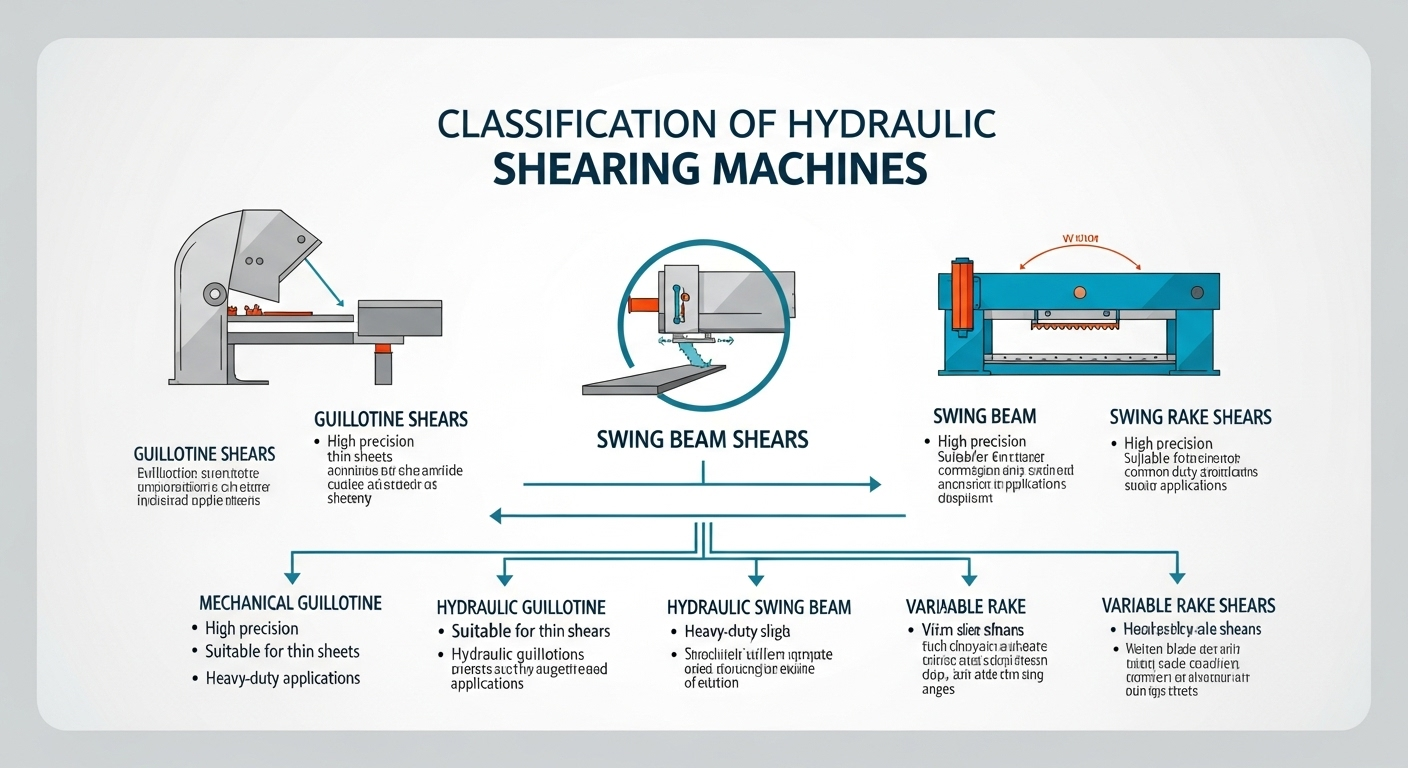
Hydraulic shearing machines are classified based on motion, structure, control type, and application. Understanding these types helps users choose the right model for specific operations.
1. Based on Blade Movement
- Guillotine Type Shear
In this design, the upper blade moves vertically in a straight line while the lower blade remains fixed. Guillotine shears are known for their accuracy and suitability for thick plates. - Swing Beam Type Shear
Here, the upper blade is mounted on a pivoted beam that swings in an arc during cutting. Swing beam shears consume less power and are ideal for medium-duty operations.
2. Based on Control System
- Conventional Hydraulic Shear
Operated manually or semi-automatically, suitable for small workshops and general fabrication tasks. - NC Hydraulic Shear
Equipped with numerical control for back gauge and cutting sequence, improving productivity and precision. - CNC Hydraulic Shear
The most advanced version, using computer-controlled parameters for fully automated, accurate, and high-speed cutting processes.
3. Based on Rake Angle and Gap Adjustment
- Fixed Rake Angle Shears: Maintain a constant angle, suitable for uniform sheet thickness.
- Variable Rake Angle Shears: Allow adjustment to optimize performance for different materials and thicknesses.
4. Based on Application / Capacity
- Light-Duty Shears: Designed for thinner sheets, often used in light metal fabrication and ducting.
- Medium-Duty Shears: Ideal for general-purpose metal workshops handling moderate sheet thicknesses.
- Heavy-Duty Shears: Built for industrial-grade cutting of thick steel plates, used in heavy fabrication, shipbuilding, and large-scale metal processing industries.
Comparison Between Hydraulic and Mechanical Shears
Hydraulic shears are preferred for heavy-duty operations due to their smooth pressure control, low maintenance, and adjustable force. They produce clean cuts with less vibration and noise.
Mechanical shears, on the other hand, are simpler and faster for light-duty, repetitive cutting but lack the flexibility and precision of hydraulic systems.
How to Choose the Right Hydraulic Shearing Machine
Selecting the right machine involves more than just comparing prices. Here are the primary considerations:
- Cutting Capacity: Match the machine’s rated capacity (thickness × width) with your production needs.
- Material Type: Choose blades suitable for the materials you process—mild steel, stainless steel, or aluminum.
- Blade Quality: Opt for high-grade alloy steel blades with superior heat treatment for longer service life.
- Rake Angle & Gap Adjustment: Variable settings help maintain cut quality across various sheet thicknesses.
- Back Gauge System: Look for precision movement and programmable settings in NC/CNC models.
- Control Panel & Automation: Modern controls enhance safety, repeatability, and operational efficiency.
- Safety Features: Ensure the machine includes light curtains, emergency stops, and overload protection.
- After-Sales Service: Choose a Hydraulic Shearing Machine Supplier offering reliable service, parts availability, and technical support.
A trusted Hydraulic Shearing Machine Manufacturer provides not only advanced equipment but also consultation for selecting suitable configurations and automation levels.
Applications and Advantages
Applications
Hydraulic shearing machines are extensively used in:
- Steel and metal fabrication shops
- Construction and infrastructure projects
- Electrical panel and appliance manufacturing
- Automobile and aerospace component production
- Shipbuilding and heavy engineering
Advantages
- Smooth and Precise Cutting: Hydraulic systems ensure uniform pressure distribution.
- Reduced Maintenance: Fewer moving parts lead to lower wear and downtime.
- High Safety: Integrated interlocks and guards ensure operator safety.
- Flexibility: Can handle a wide range of materials and thicknesses.
- Energy Efficiency: Hydraulic systems operate efficiently with minimal power waste.
Operation and Maintenance Guidelines
To ensure efficient and long-lasting performance, operators should follow these key practices:
Operating Tips
- Confirm proper alignment of the sheet before each cut.
- Adjust blade clearance according to material thickness.
- Use appropriate hydraulic pressure settings.
- Ensure clamps hold the material firmly to prevent slipping.
Maintenance Routine
- Check oil levels and quality regularly.
- Replace filters at recommended intervals.
- Inspect hoses and seals for leaks.
- Lubricate mechanical joints periodically.
- Sharpen blades when cutting edges dull.
- Test safety features before every shift.
Safety Measures
- Always keep guards in place.
- Avoid manual handling near blades.
- Use PPE including gloves, goggles, and protective clothing.
- Never bypass interlocks or emergency systems.
Leading Manufacturers and Suppliers
Several reputable companies worldwide manufacture high-quality hydraulic shearing machines, including:
- Hindustan Hydraulics – India-based manufacturer offering NC and CNC guillotine shears.
- Accurpress – Known for heavy-duty shearing and press brake solutions.
- Durmark Machinery – Offers cost-effective hydraulic guillotine and swing beam shears.
- LVD Group – Specializes in advanced CNC sheet metal cutting solutions.
- Yangli Group – Produces heavy-duty shears and forming machinery.
Choosing a manufacturer with proven expertise ensures consistent performance, durable construction, and strong after-sales service.
Conclusion
A Hydraulic Shearing Machine is an essential tool for precision cutting in modern fabrication industries. Its superior power control, stability, and adaptability make it ideal for both small workshops and large manufacturing plants.
Understanding its working principle and classification allows you to select the right model that matches your production needs. Whether you’re sourcing from a Hydraulic Shearing Machine Manufacturer or a Supplier, prioritize build quality, control systems, safety, and long-term service support.
When chosen wisely and maintained properly, a hydraulic shearing machine can serve as a cornerstone of efficiency and accuracy in your metal fabrication operations.