

NC Rolling Machines vs Conventional Rolling Machines in Metal Fabrication
In the fast-paced world of manufacturing and metal fabrication, precision and efficiency are no longer just advantages they are necessities. Rolling machines play a crucial role in shaping sheet metals and plates into desired cylindrical or conical forms. For decades, industries relied heavily on conventional rolling machines, which required high operator skills and manual adjustments. However, with the rise of automation, the nc rolling machine (Numerical Control Rolling Machine) has transformed the landscape by introducing better accuracy, faster production, and reduced dependence on skilled labor.
Today, many industrial players including trusted brands like Energymission offer a wide range of rolling machines to meet the diverse needs of manufacturers. But how exactly do NC rolling machines differ from conventional rolling machines, and which one is right for your business?
This detailed guide will walk you through the key differences, advantages, applications, and future prospects of both types of machines.
Understanding the Basics
What is a Conventional Rolling Machine?
A conventional rolling machine is one of the oldest types of sheet rolling machines used in fabrication workshops. These machines typically come with two, three, or four rollers that bend and shape metal sheets by applying pressure.
In conventional machines, most of the work is manual. The operator positions the sheet, adjusts the rollers, and monitors the bending process closely. This means the quality and consistency of the finished product rely heavily on the operator’s skill and experience.
Key Features of Conventional Rolling Machines:
- Manual or semi-manual operation
- Lower cost compared to advanced machines
- Require skilled labor for accurate results
- Suitable for small-scale and custom jobs
- More time-consuming in repeat production
Conventional machines are still widely used because of their affordability and simplicity. Many small workshops prefer them as they are easy to maintain and good for low-volume production.
What is an NC Rolling Machine?
An nc rolling machine is a modern evolution of the conventional machine. It uses Numerical Control technology to automate many aspects of the rolling process. Instead of adjusting rollers manually, operators can program parameters such as thickness, diameter, bending radius, and number of passes directly into the machine.
The NC system then controls the rollers with high precision, producing consistent results every time.
Key Features of NC Rolling Machines:
- Semi-automated with programmable settings
- High accuracy and repeatability
- Faster cycle times compared to manual rolling
- Less dependence on operator expertise
- Suitable for medium and large-scale production
- Ideal for industries where precision and efficiency matter
By combining automation with flexibility, NC machines reduce errors, increase productivity, and save costs in the long run.
NC Rolling Machine vs Conventional Rolling Machine: Detailed Comparison
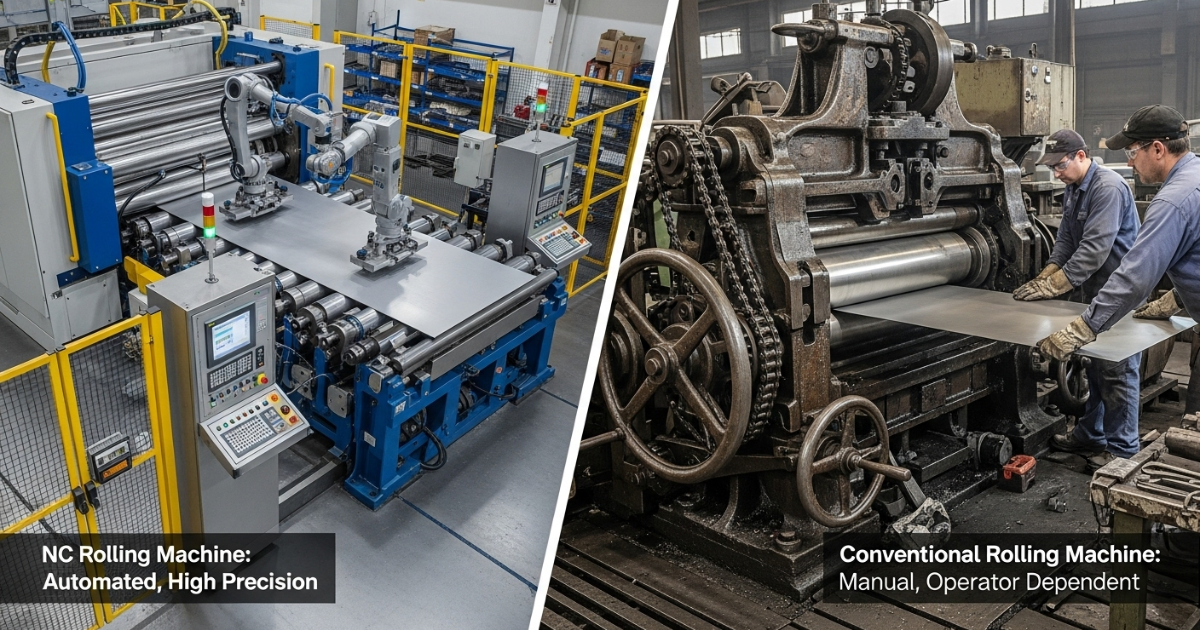
To fully understand the differences, let’s analyze both machine types in terms of various aspects:
1. Automation
- NC Machine: Semi-automated, allowing operators to pre-set rolling parameters.
- Conventional Machine: Mostly manual, with minimal automation.
2. Precision
- NC Machine: Delivers consistent, accurate results thanks to programmable controls.
- Conventional Machine: Accuracy depends on operator skill and may vary from batch to batch.
3. Production Speed
- NC Machine: Faster rolling cycles with reduced downtime.
- Conventional Machine: Slower, as each adjustment requires manual effort.
4. Cost
- NC Machine: Higher initial investment but more cost-effective in the long term.
- Conventional Machine: Lower upfront cost but higher labor and material wastage costs.
5. Operator Skill
- NC Machine: Can be operated with moderate training.
- Conventional Machine: Requires highly skilled operators for precision results.
6. Material Handling
- NC Machine: Handles complex tasks such as rolling conical shapes, thicker sheets, or large diameters.
- Conventional Machine: Limited to simple jobs and smaller projects.
7. Suitability
- NC Machine: Best for industries with high production demands.
- Conventional Machine: Suitable for small workshops or customized, one-off jobs.
Advantages of NC Rolling Machines
- Higher Precision and Consistency
NC machines remove human error by automating critical adjustments. Each batch has identical results. - Improved Productivity
With faster cycle times, industries can meet large orders in less time. - Reduced Material Waste
Since the machine follows precise instructions, chances of errors or defective parts are much lower. - Lower Dependence on Skilled Labor
Skilled operators are becoming harder to find. NC machines bridge this gap by allowing less-experienced operators to achieve accurate results. - Versatility
They can handle different materials such as mild steel, stainless steel, and aluminum with varying thicknesses. - Long-Term Cost Efficiency
Despite higher upfront investment, the long-term savings in labor, time, and material make NC machines more economical.
Where Conventional Machines Still Have an Edge
While NC machines are superior in many ways, conventional rolling machines are not obsolete. They still hold value in specific scenarios:
- Affordability: Perfect for startups and small workshops with limited budgets.
- Customization: Easier to adapt for unique or irregular rolling requirements.
- Simplicity: No need for programming or advanced knowledge.
- Maintenance: Lower maintenance cost compared to NC systems.
Thus, for businesses with smaller production volumes, conventional machines remain a practical choice.
Applications of Rolling Machines
Both NC and conventional rolling machines are used in a wide range of industries.
Construction and Infrastructure
- Rolling beams, pipes, and panels for bridges, buildings, and heavy structures.
- NC machines ensure faster production for large projects.
Automotive Industry
- Manufacturing exhaust systems, chassis components, and frames.
- NC machines dominate here due to precision requirements.
Shipbuilding
- Producing large hull plates and pipelines.
- NC machines roll thick plates accurately, while conventional machines are used for small repairs.
Aerospace
- Creating ducts, fuselage components, and precision parts.
- NC machines are indispensable due to tight tolerance requirements.
Energy Sector
- Rolling towers for wind turbines, pipelines, and boilers.
- Both machine types are used depending on the project scale.
Role of Energymission in the Rolling Machine Industry
When it comes to reliable industrial solutions, Energymission is a name trusted by manufacturers worldwide. The company provides both nc rolling machines and conventional rolling machines, catering to diverse client needs.
Why Choose Energymission?
- Expertise in metal forming equipment
- Advanced technology and durable designs
- Reliable after-sales service
- Wide range of sheet rolling machines and plate rolling machines
- Customizable solutions for industries like automotive, construction, shipbuilding, and energy
By balancing innovation and affordability, Energymission ensures that businesses can select machines best suited for their scale and budget.
Maintenance Tips for Rolling Machines
To maximize performance and longevity of both NC and conventional machines, regular maintenance is essential.
- Lubrication: Regularly oil the moving parts to prevent friction.
- Alignment Checks: Ensure rollers are properly aligned for consistent rolling.
- Hydraulic Care: For hydraulic machines, monitor fluid levels and seals.
- Cleaning: Remove metal debris and dust to prevent mechanical issues.
- Inspections: Schedule routine checkups to detect wear and tear early.
By following these steps, industries can ensure uninterrupted operations and extend machine life.
The Future of Rolling Machines
The future of metal fabrication is leaning toward smarter and more automated solutions. NC machines will evolve further into CNC (Computer Numerical Control) systems, fully integrating with CAD/CAM software. This will allow manufacturers to design digitally and execute flawlessly on machines.
However, conventional machines will not vanish completely. They will continue to serve smaller workshops, low-budget setups, and industries where manual flexibility is valuable.
Energymission predicts a hybrid future where NC and conventional rolling machines coexist, each supporting different segments of the fabrication industry.
Frequently Asked Questions
Q1: Are NC rolling machines more expensive than conventional machines?
Yes, but the long-term savings in labor and efficiency make them cost-effective.
Q2: Can NC machines handle heavy-duty tasks?
Yes, NC machines combined with hydraulic systems are excellent for rolling thick and heavy sheets.
Q3: Which machine is best for small workshops?
Conventional machines are budget-friendly and practical for smaller setups.
Q4: Does Energymission provide after-sales support?
Yes, Energymission is known for its reliable customer service and support.
Q5: What industries use NC rolling machines the most?
Construction, automotive, shipbuilding, aerospace, and energy industries benefit the most from NC machines.
Conclusion
The comparison between nc rolling machines and conventional rolling machines shows a clear distinction in terms of automation, precision, efficiency, and scalability. NC machines lead the way in modern manufacturing, offering unmatched accuracy and productivity. Conventional machines, however, still hold their place in small workshops and customized jobs where flexibility and lower cost matter.
Ultimately, the choice between the two depends on your production scale, budget, and long-term goals. With brands like Energymission providing both options, industries can confidently invest in machines that align with their business needs.